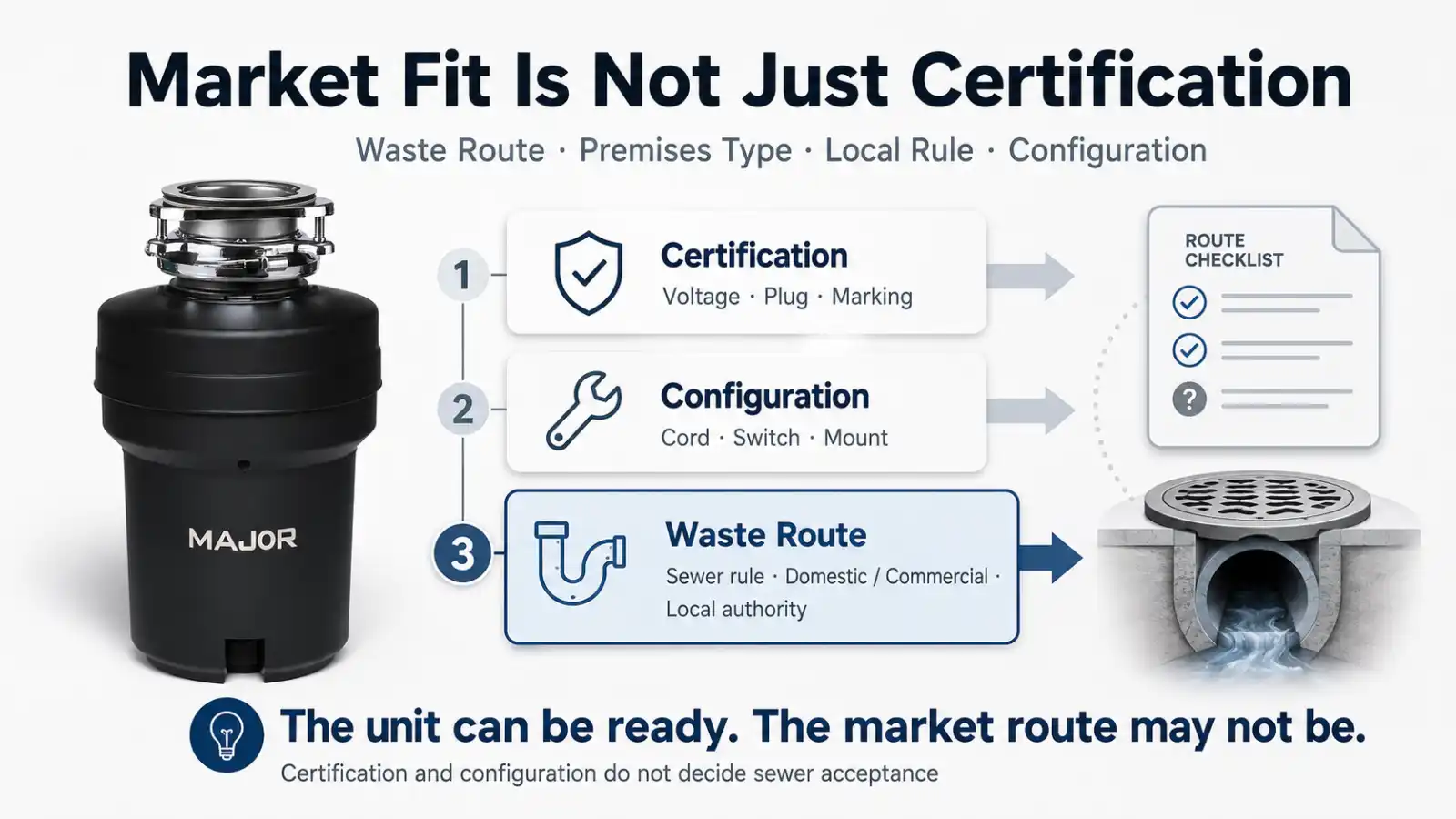
| Layer | What it sets | Does it decide whether the category can be sold? |
|---|---|---|
| Configuration — voltage, cord, plug, switch, mount | the unit’s fit to the local mains and kitchen | No — necessary, not sufficient |
| Certification — UL, CE, CB, KC, SII, BIS | whether customs clears the unit | No — clears import, not use |
| Installation habit — control method, sink and cabinet fit | how the unit gets switched on and fitted | No — fits the kitchen, not the rule |
| Waste route — local sewer / water-protection law | whether the macerated output may enter the sewer | Yes — can exclude the category outright |
The buyer brings the market; we configure to it
This part we keep short, because it lives in other articles. A buyer arrives with a market already chosen — they have researched their own food waste disposer market and know whether it carries demand for the category. We don’t assess acceptance for them. We set the unit to the market they sell into: voltage and frequency, cord and plug, and the certification package, which is covered in the certification-by-market breakdown, and the wider field list sits in the B2B sourcing guide.
On terminology we follow the buyer rather than translate. If a customer writes “waste disposal unit,” “garburator,” or “food waste disposer,” we answer in the same word they used, so nothing gets lost between the RFQ and the spec sheet. The name is the buyer’s market signal; we mirror it.
All of that is the configuration layer. It is necessary, and it is not where the Swiss relationship ended.
The waste route is the layer that decides
A disposer’s job ends at the drain. Whether the drain is a legal destination for what comes out of it is a separate question, written into water-protection law rather than product law.
In Switzerland the federal water-protection framework — the Waters Protection Act (GSchG, SR 814.20) and its ordinance (GSchV, SR 814.201) — governs what may enter the sewer. The national water-sector reference “Is it wastewater? Is it waste?”, published by the VSA (the Swiss water and water-protection professionals’ association), records the prohibition on disposing of solid and liquid waste via the wastewater; the Canton of Schwyz, for one, restates it as: solid and liquid waste may not be discharged into the foul-water sewer or a water body. How fine or fluid a material is doesn’t move it across the wastewater/waste line. Reading where ground food falls in a specific market is a job for the buyer’s counsel against the official text, not something we resolve.
We don’t reduce one customer’s twelve-year exit to a single clause. What we can say is narrow and checkable: the unit carried the certifications the market required, the output was liquefied after grinding though not water-thin, and the close wasn’t a certification or quality matter on our side. What we can’t do is reclassify that output for a jurisdiction — we describe what our unit produces; the wastewater-versus-waste line gets read from the official text, not from us.
The same layer, split by who is using it
This rule does not read the same across a single label, which is why a country-level “accepted / not accepted” verdict is the wrong instrument. The same waste-route question, in the cases with a government instrument behind them, is drawn between domestic and commercial premises.
In Scotland, the use of macerators to discharge food waste to the public sewer became unlawful for non-rural food businesses from 2016, with domestic premises and rural areas outside that requirement (Zero Waste Scotland). In Wales, the Environment (Wales) Act 2016 prohibits disposing of food waste to a public sewer from non-domestic premises, and the Act expressly excepts domestic property. Two jurisdictions, the same underlying concern about food solids in the sewer, and in both the line is drawn between business and household rather than across the whole market.
So a buyer who hears “it’s banned there” has the headline. The rule underneath splits by premises, by nation within a state, and by which authority is speaking — and what matters to a quote is whether the answer comes from a government instrument or from a forum thread repeating an impression.
Installation habits shape the SKU; the waste route sits above them
Local habit does change the unit, at the installation interface. A market where kitchens come pre-wired for a disposer switch takes a different control method than one where they don’t — an air switch, a wall switch, or a remote — and that choice, the cord and plug to the local mains, and the mount that meets the sink all move with the destination. The control side is set out in the air switch differences by market; whether a given sink and cabinet take the unit is an install question that stays with the installer.
None of that clears the waste route. A buyer can match the plug, the switch, the mount and the sink opening to a market exactly and still have no market if the destination keeps ground food out of the sewer. Installation fit is what lets the unit go in; it does not decide whether the unit is allowed to run.
What we can speak to, and what we leave alone
We are a B2B manufacturer. We build the unit, set its configuration to the market the buyer names, hold the certification files, and describe what the product does and what its output is. We do not decide whether a market accepts the category — the buyer brings that — and we do not interpret a jurisdiction’s waste law on anyone’s behalf. When a rule turns on local classification, the citable source is the government text, and the reading belongs to the buyer’s own counsel in that market.
What we can do is flag the layer before it becomes a stopped container: ask, early, whether the destination treats macerated food waste to the sewer as permitted, restricted to certain premises, or excluded — and confirm it against the official instrument, not against the general sense that a place “doesn’t really use these.”
Whether that waste-route layer ends a relationship or never surfaces depends on the market the buyer chose, and that is the part I can’t read from the order itself.
Before you commit a market
If you’re scoping a new market for a disposer line, the layer to confirm first — against the destination’s own text, with your counsel where it matters — is the waste route: may the macerated output enter the local sewer, and for which premises. Bring us the market and we configure and certify the unit to it. The waste-route reading is the one part that has to come from the destination’s rules rather than from us.
Related market checks: certification, configuration and naming
The certification layer — which mark a market’s customs needs and which SKU carries it — is handled separately in the certification-by-market article, and the voltage, cord, switch and mount fields sit in the B2B sourcing guide. This article covers the layer above both of those: whether the processed output is legally allowed into the local sewer at all, which neither a certificate nor a plug resolves. Where the product is known by different words from one market to the next, that is the buyer’s signal to mirror, not a spec to convert.
FAQ
Are food waste disposers banned in the UK?
There is no single UK answer. The rules are devolved and often split domestic from commercial: Scotland and Wales restrict discharging food waste to the public sewer from non-rural or non-domestic premises, with domestic property treated differently. Check the specific nation and premises type against the government instrument before treating “banned” as a fact.
Why are garbage disposals common in the US but rare in some European markets?
It is a mix of waste-collection habit, kitchen practice, sewer-system policy and, in some places, water-protection rules that keep solid and liquid waste out of the sewer. “Rare” and “prohibited” describe different things, and they don’t share one cause.
Is a food waste disposer allowed in Switzerland?
Swiss water-protection law (GSchG / GSchV) does not permit solid or liquid waste to be discharged into the sewer, and whether a material is wastewater or waste is sorted by the technical reference the authorities point to (“Is it wastewater? Is it waste?”). A buyer sourcing for that market should read the federal and cantonal instruments directly, or have counsel do so.
Does making the output more liquid change whether a disposer is allowed?
No. Where a rule keeps waste out of the sewer, making the output more fluid doesn’t move it across the wastewater/waste line; fluidity isn’t the test the rule turns on.
Is a waste disposal unit common knowledge in every market?
No. In some markets the product itself is unfamiliar — buyers there search how a waste disposal unit works before they buy one — and that recognition gap is its own entry barrier, separate from any rule.
Can you install a food waste disposer on any sink?
Not automatically. The mount, the sink drain opening and the cabinet clearance have to match, and that fit is an install-side question for the destination kitchen rather than something the supply quote settles.
What should an importer check before selling disposers in a new market?
Beyond certification and configuration, confirm the waste-route layer: whether macerated food waste to the sewer is permitted, limited to certain premises, or excluded in that jurisdiction — sourced from the official text.
Does food waste collection affect demand for disposers?
It can. Where separate food-waste collection or composting is the established route, the sewer route is both less needed and, in some places, restricted, which shapes whether the category feels normal to buyers there.
Sources
- Switzerland — Federal Act on the Protection of Waters (GSchG, SR 814.20), official compilation The Waters Protection Ordinance, GSchV, SR 814.201, sits under this Act.
- VSA — technical reference “Ist es Abwasser? Ist es Abfall?” Referenced for the wastewater-versus-waste classification and the prohibition on disposing of solid and liquid waste via wastewater.
- Canton of Schwyz, Office for Waters — industrial and commercial wastewater guidance Referenced for cantonal guidance stating that solid and liquid waste may not be discharged into the foul-water sewer or a water body, with classification made per the VSA reference above.
- Zero Waste Scotland — Waste (Scotland) Regulations Referenced for the ban on using macerators to discharge food waste to the public sewer for non-rural food businesses.
- Environment (Wales) Act 2016, section 66 — legislation.gov.uk explanatory notes Referenced for the prohibition on disposal of food waste to public sewer from non-domestic premises, with domestic property excepted.
The twelve-year OEM relationship, the product’s output description, the configuration and terminology practice, and the company boundary in this article are based on Wanjiamei Technology Development Co., Ltd. records and product information. Regulatory statements are drawn only from the government instruments cited above and are presented without evaluation.