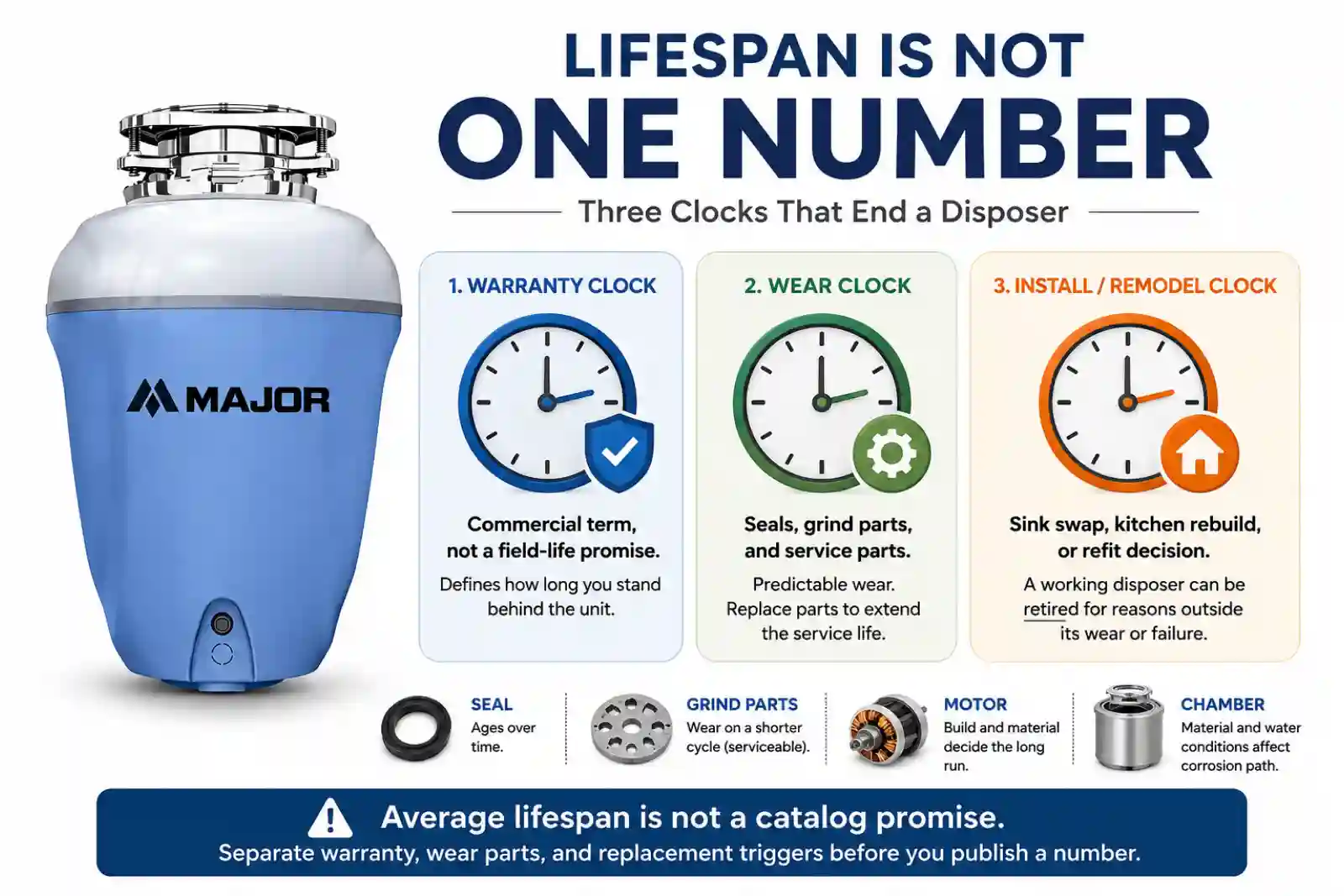
A disposer is rarely retired by calendar age alone. Its grind parts wear on roughly a 7–8 year cycle and get replaced; the motor, the seals, and the body carry the rest. Horsepower sets grinding capacity, not lifespan. So a buyer asking “how many years will it last” can’t get one honest number. The real answer is which part is on the clock — and which clock the buyer means.
Public sources put the homeowner average around 8 to 15 years. That figure is fine on a blog. It is not something to copy into a catalog, a PI, or a warranty line. The number blends three different things, and they end a unit at different times.
Three clocks, not one number
A lifespan number hides three separate clocks. They rarely run together.
The warranty clock is a commercial term. It says how long you’ll stand behind the unit, not how long the unit will physically run. The wear clock is the grind parts and seals aging — predictable, gradual, and fixed by a replacement part. The install clock is the kitchen: a sink swap or a remodel retires a working disposer that had years left. Collapse these into “lasts 10 years” and you’ve promised something none of them actually says.
This is why we don’t publish a lifespan figure. We can tell a buyer what wears, when, and how easily it’s replaced. We can’t promise a calendar.
Read the failure, not the age
Most “it’s dying” reports are a worn part, not a dead unit. Here’s how the common ones actually sort:
| What the customer sees | Usual cause | What it actually needs |
|---|---|---|
| Grinding got weaker | Grind parts hit their 7–8 year wear point | Replace the grind parts, not the unit |
| Leaking from the body or bottom | An aged seal, or internal corrosion / a cracked housing | Seal: replace it. Corrosion or crack: usually the unit |
| Won’t drain | The drain line, not the disposer | Clear the line (routing here) |
| Hums, needs frequent resets | A jam or a motor at end of life | Check the motor path first |
| Rust inside the chamber | Material and water conditions | Depends on the build (material here) |
Read down that table: several of these end at a part rather than a new machine. Whether the swap is worth it depends on the unit and on local labor. Sometimes the labor outweighs the part. That’s a repair-or-replacement call rather than a lifespan one.
It started leaking — and the kind of leak decides
A seal leak reads like a death sentence. Often it isn’t one.
Rubber ages. The best gasket still hardens over years, loses its squeeze, and starts to weep. That’s normal physics rather than a quality fault, and a seal is replaceable. But a body or bottom leak isn’t always a seal. Internal corrosion or a cracked housing looks the same from outside, and those usually do end the unit. Which one you’re facing is the repair-or-replacement call, and that routing sits in the guide.
One thing a leak is not: a drain clog. A blocked line has nothing to do with the disposer. Any drain can clog, disposer or no disposer, and clearing the pipe is plumbing work.
Where a disposer’s lifespan actually lives
The industry sells horsepower as durability. We’d put it differently, and carefully: horsepower decides how much and how fast the unit grinds. It is not the thing that decides how many years the unit survives.
A bigger share sits in the motor, and the metal inside it. Motor windings are wound in copper or aluminum. Copper conducts better, runs cooler, and tends to last longer, which is why we wind in copper. (Stainless steel belongs to the chamber and body, not the windings.) A higher-grade winding extends the unit’s life past what the HP figure suggests.
The motor isn’t the whole story either. Seals, the housing, corrosion, water conditions, and how hard the unit is run all move the real number. Choose on horsepower alone and you’re reading the grinding spec, while the years sit across several parts.
The grind parts are a separate, shorter clock. They wear over roughly 7–8 years; grinding capacity drops as they do, because the parts themselves abrade. That is normal, and they’re easy to swap. Our brushless (BLDC) models are built so the grind parts don’t need the periodic replacement a blade-type unit does.
What our two-year warranty actually covers
Our standard warranty is two years. How it works in practice is shaped by B2B logistics, not by a homeowner’s service call.
If the problem is a part, we send the replacement part free — but with your next order, not on its own. A courier charge for a single seal can run higher than the seal. So the part rides along with the next shipment. If the problem is the unit itself, we replace the affected units in your next batch. And if a machine has a genuine fault, we repair it free when it’s sent back to the factory.
When a buyer asks us to extend the warranty to more years, we steer them somewhere more useful: a small stock of spare parts. Most failures are wear parts — seals, grind components. A buyer holding spares fixes a customer same-day. A longer warranty mostly covers those same parts, a year or two further out. The aim is simple: let you sell the unit without worry.
One rule, not a long list
Most lifespan articles end with a list of foods to keep out. We don’t keep that list. The unit is a food waste disposer. The one rule is in the name: keep non-food out.
Bones-versus-no-bones charts vary by build and capacity, and they belong in the size and HP discussion, not in a lifespan rule. What shortens a unit’s life is rarely the food — it’s non-food in the chamber, and seals and grind parts reaching their normal age.
What to lock before you publish a lifespan claim
Before a lifespan or warranty figure goes into a catalog or PI, separate what you’re actually committing to:
- The warranty term and how it’s serviced — parts with the next order, units in the next batch, factory repair for unit faults.
- The wear parts and their spares — seals and grind components, and whether the buyer stocks them.
- The use condition and the one exclusion — food only; non-food voids the premise.
- What you are not promising: a field lifespan in years. A number on a blog is a homeowner average, not a commitment.
Where lifespan ends and the other guides begin
Lifespan touches several articles, and this one stays out of their lanes. Whether a specific unit is worth fixing is the repair-or-replacement question. Why the chamber material matters is the stainless-steel verification piece. What horsepower does and doesn’t buy is the HP guide. This article only draws the line the others assume: a lifespan number is not a promise. The parts that age are mostly the parts you replace.
FAQ
How often should you replace a garbage disposal?
When a fault is in the unit itself — the motor — rather than a wear part. Seals and grind components are replaced, not retired with the whole machine. Age alone isn’t the trigger; the failing part is.
How long do garbage disposals last?
Public averages run about 8 to 15 years, but that range mixes warranty, wear, and remodel timing. A unit can run well past it on a good motor, or get pulled early in a kitchen remodel with years left.
Is 10 years old for a garbage disposal?
It’s mature, but not necessarily finished. A 10-year unit with a worn seal or dulled grind parts is usually a parts job, not a write-off, as long as the motor is sound.
Can you fix a garbage disposal leaking from the bottom?
Sometimes. If the leak is an aged seal, it’s replaceable. If it’s internal corrosion or a cracked housing — which can look identical from outside — it usually means the unit. Which one it is is the repair-or-replacement call, covered in that guide.
Does a higher HP garbage disposal last longer?
Higher HP grinds more and faster. It doesn’t by itself add years. The motor and its winding carry more of the lifespan; HP is the grinding spec.
Does warranty length mean the disposer will last that long?
No. A warranty sets how long the maker stands behind the unit. It isn’t a guarantee of field life, and a longer warranty can mostly cover wear parts a buyer could stock anyway.
Is a garburator lifespan different from a garbage disposal lifespan?
Same unit, different market word — “garburator” is Canadian. The parts that wear and the clocks that end it are identical. For the naming difference, see the garburator / garbage disposer / WDU market names article.
Should an old disposer be reused after a sink replacement?
That’s the install clock rather than the wear clock. A sound unit can be refitted; the call is whether its motor and seals have life left, not its age on paper.
Before you print a lifespan or warranty line, send us the model and the market: we’ll tell you what wears, on what cycle, and which spare parts to stock so a customer is back running same-day. We’d rather set you up with the right spares than sign you up for a number none of the clocks can keep. That’s how we mean “sell it without worry.”
Sources
- Consumer Reports — Garbage Disposals Buying Guide Referenced for a typical service life of roughly 11 years and warranties that generally run shorter than the unit’s life.
- Bob Vila — How Long Do Garbage Disposals Last? Referenced for a typical 8-to-15-year range that varies with model and use.
The warranty practice, the motor-material and grind-part wear logic, the brushless design point, and the spare-parts approach in this article are based on Wanjiamei Technology Development Co., Ltd. records and product information. The lifespan ranges are drawn from the public sources above and are presented as homeowner-side averages, not as a product promise.