A distributor sees a one-line complaint come through: the disposer hums but the grinding parts don’t spin. The temptation is to log it as motor failure, approve a replacement, and clear the ticket. The same one-line complaint covers more than one mechanical or electrical situation. The Allen wrench test recommended on most homeowner repair pages addresses one situation behind a garbage disposal humming but not spinning report, and leaves the others untouched.
Reset button position varies across our line
On our line, every unit ships with a hex-key release on the disposer body and a turntable plate driven by the motor shaft. The hex-key port sits in the same role across the line. The reset button does not. On some SKUs the reset sits on the underside of the housing. On other SKUs it sits on the side. The position is documented per SKU in the shipping paperwork.
A generic instruction (‘press the red button under the disposer’) gets written into homeowner repair pages, gets repeated into installer scripts, and gets quoted back to the consumer when they call for help. The instruction works for a subset of our SKUs. For SKUs with a side-mounted reset, a user under the sink looking straight up at the bottom of the housing won’t find anything. The unit looks dead. The reset position needs to be looked up before the next switch-on attempt.
The same kind of question shows up on mounting and on control choices. We’ve written separately about which mounting plate the SKU actually ships with and which one the distributor was expecting in 3-Bolt vs EZ Mount Garbage Disposals. The user’s confusion in the field traces back to which SKU is sitting under that specific sink, and which document the installer was reading when they wrote up the complaint.
What the user can see, and what the motor actually drives
Continuous-feed disposers on our line carry two swiveling impellers seated above the turntable plate. The impellers pivot. The turntable rotates under power. The two parts are mechanically linked. Pushing one tells the importer nothing about the other.
The diagnostic endpoint sits below the visible swiveling parts. A user says “the blades move,” but the return review still needs to establish whether the driven turntable can rotate using the release method specified for that SKU. The hex-key turn from below tests the motor shaft and the turntable plate. A spoon handle from above, with the power off, tests the impellers.
A US-based disposer manufacturer publishes a support article on its public website covering this distinction. The article describes the two swiveling impellers seated above the rotating disc, instructs the user to push each impeller with a spoon handle while the power is off, and recommends grinding a load of bones if the impellers do not move freely. If three grinding attempts fail to restore impeller movement, the article directs the user to request service.
Many homeowner help pages stop earlier than that at “replace the disposal” if the wrench step does not free anything. The manufacturer support article cited above does not skip the impeller check.
The return complaint that doesn’t separate the wrench check from the impeller check gets miscoded. Impeller obstruction reads as motor failure on the warranty form. The unit that comes back to the factory tests fine, because the obstruction is in the homeowner’s kitchen trash bin by the time the box reaches the dock.
When the wrench appears to fix a jam
This is the failure mode the public answers don’t separate from a jam.
A capacitor-start AC induction motor uses a starting capacitor and a centrifugal switch to give the rotor an initial torque pulse. The start winding stays engaged until the motor reaches a designed running speed, then the centrifugal switch opens and disconnects the start winding. The run winding carries the motor from there. When the centrifugal switch contacts burn or stick open, or when the starting capacitor loses capacitance, the motor draws current, hums, and doesn’t rotate. A manual push to the rotor — a hex-key turn from below, a broom handle from above — gives the rotor the initial speed it cannot generate by itself. After the push, the run winding takes over. The motor runs.
A user reporting “I had to spin it with the Allen wrench again this morning to get it running” is describing a pattern the starting-circuit failure mode produces. The pattern can also be produced by other causes — bearing damage, controller fault, supply-side issues, intermittent obstruction. The supplier should be able to rule out the starting circuit specifically before the return is coded as jam-related, because the RMA path is different.
The motor inventory on our line removes this layer for most of our SKUs. The DYNA D100-D700 and DCORE X1-X4 series run DC motors. The DAZZ M100-M500S series runs BLDC. None of our DC and BLDC motor types use a starting capacitor or a centrifugal switch. There is no start winding to disengage, no contact set to fail open, no capacitor to lose capacitance. The starting-circuit failure mode described above is structurally absent from those series.
The DURA Z100, Z100S, and Z200 use AC induction. Z100S also supports auto-reverse. The AC series sits in a different motor category. An importer reviewing a humming complaint should be able to look up which motor type ships in the SKU before the return goes into the motor-failure bucket. We’ve covered the wider motor topology question in DC vs AC Motor in Garbage Disposals.
What the user did between the first hum and the silence
A user keeping the switch on through repeated humming attempts eventually gets silence. The silence is not a separate defect — the unit responded to repeated stall conditions by tripping its overload protector.
ANSI/UL 430 is the safety standard for waste disposers in the US market. Disposers on our line carry an internal overload protector wired into the motor circuit, with a reset accessible to the user. When the motor stalls under power — jammed impellers, jammed turntable, locked rotor for any reason — the windings heat. The protector trips. Current stops. The unit goes silent. Pressing the reset button after the windings cool returns the unit to working order, if nothing else got damaged in between.
A user posted this on a homeowner forum:
I was able to freely spin from the bottom using an allen wrench but the humming continued. I then tried to get the blades on by giving it a spin while turned on. This actually caused the humming to stop completely – when I flip the switch on now, it’s totally dead. Hope I didn’t do any harm.
What the user did was simple. Kept the switch on while pushing the rotor against a stalled load, long enough for the protector to keep cycling. On AC motors, repeated start attempts against a stalled rotor push large currents through the start winding. In either motor category, repeated forced restarts against a stalled load can convert a recoverable thermal trip into a non-recoverable condition.
The return record doesn’t include either of the two variables that matter here: the number of switch-on attempts after the first hum, and the time between the first hum and the silence. These values come back when the supplier asks specifically. By phone, or in a video request.
Whether a given silence-after-humming event is recoverable depends on how long the windings sat in stall and how many restart attempts followed in that window. The transition from recoverable thermal trip to permanent winding damage falls on a gradient, not a clean threshold.
What an importer should have on file before the RMA opens
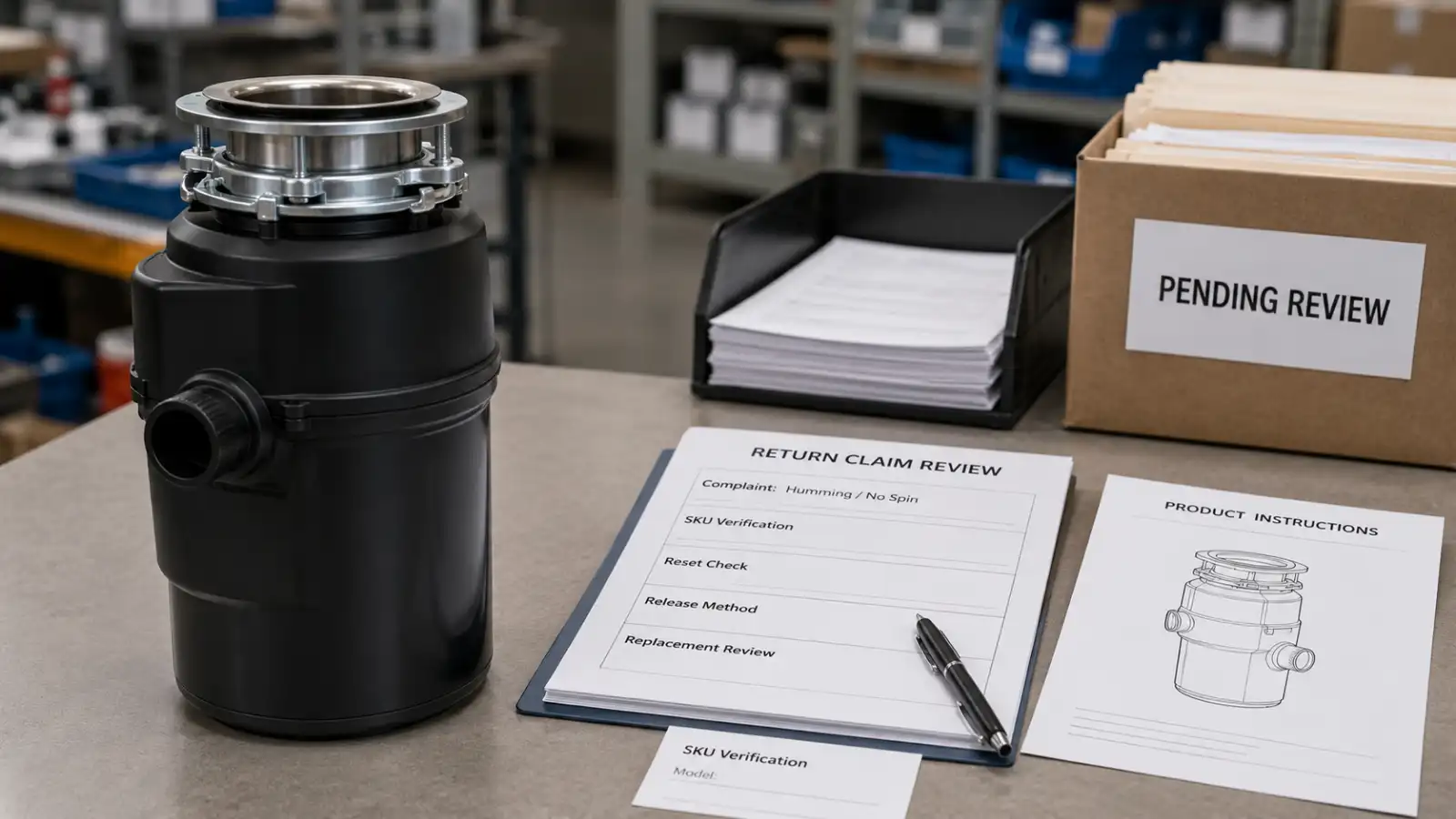
Before approving a replacement on a humming-but-not-spinning complaint, the review goes through the following, in any order:
- Which SKU shipped, and where the reset button sits on that SKU.
- Whether the hex-key turn from below produced free motor rotation, and whether the impellers were checked separately by pushing each one with a spoon handle.
- Whether the unit needed a manual rotor push to start running, on first power-up or on repeat starts.
- How many switch-on attempts happened between the first hum and the silence, if silence followed.
Air switch choices, wireless switch choices, and control method preferences sit alongside this on the SKU side. We covered the country-by-country pattern of those choices in Garbage Disposal Air Switch by Market. UL 430 listing, NSF marking, and certification scope by destination market sit upstream of this conversation — covered separately in Garbage Disposal Certifications by Market.
We do the factory-side configuration and we ship the units. We do not do home installation, and we do not run on-site teardowns on units still in customer kitchens. The review above is what we apply when a distributor sends us a return claim with photos, video, and a model number. It is not a substitute for a licensed plumber on site.
Humming is one branch of a wider intake. The same sort-before-you-ship logic applies to silent units, leaks, and slow drains — laid out in routing any field complaint before the RMA opens.
FAQ
Why is my garbage disposal humming but not spinning?
A garbage disposal humming but not spinning means power is reaching the motor — the humming says so — but something is preventing rotation. A garbage disposal turns on but does not spin in this way for several distinct reasons: an obstruction at the impellers above the turntable, a jam on the turntable itself, a starting circuit failure on AC induction motors, or an overload protector that has tripped. The Allen wrench test from below addresses one of these. A homeowner should check the impellers separately by pushing each one with a spoon handle, with the power off. A distributor should ask the supplier which motor type ships in the SKU before assuming motor failure.
Why does my garbage disposal just hum but not work?
If the motor hums and the turntable doesn’t move under the hex-key wrench, something is jamming the turntable or the impellers above it. A garbage disposal stuck humming with the turntable free under the wrench suggests the starting circuit on AC induction motors as the next place to check, or the overload protector has tripped and needs reset. DC and BLDC units do not fail in the starting-circuit category, but bearing, controller, and supply-side issues remain in play.
Can a garbage disposal still be jammed if the visible impellers move freely?
Yes. The visible impellers ride on top of the turntable plate. The turntable plate is driven by the motor shaft. A coin or screw can wedge under the turntable plate, locking it, while the impellers above remain free to swivel. Many users describe this as “garbage disposal blades not spinning” because the parts they see from above are what they call blades; the part actually driven by the motor sits below them. The hex-key turn from below tests the turntable plate directly. The spoon handle from above tests the impellers.
What if a garbage disposal hums but has no Allen wrench slot underneath?
A small set of products on the market use a different release method, with rotation accessed from above through the throat of the disposer using a manufacturer-supplied tool. Every disposer on our line ships with a hex-key socket on the underside. For a unit without one, the user should locate the model number on the side of the housing and check the manufacturer’s release instructions before applying torque through the throat with a broom handle.
When should an importer treat a humming disposal complaint as a replacement claim?
After the review in the section above returns: a confirmed SKU and reset position, a confirmed hex-key test that showed a locked turntable, a confirmed impeller mobility check, and a confirmed switch-on attempt count. If those items return clean and the unit still won’t run, the complaint moves to a motor or controller failure path, and the replacement decision has a basis.