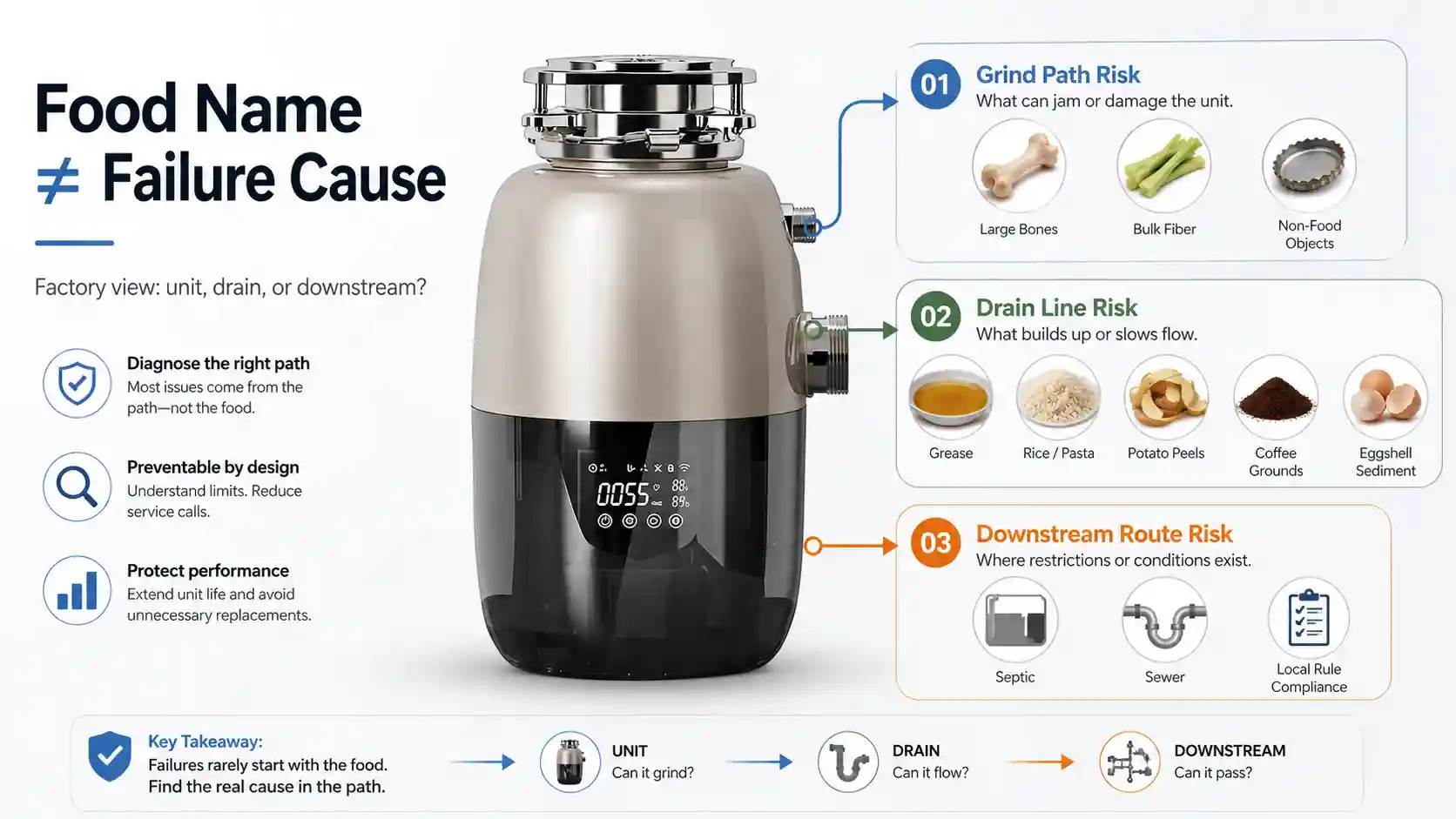
| Path | Typical load named in the ticket | Factory read | RMA meaning |
|---|---|---|---|
| Unit path | Large load-bearing bones, bulk fiber, non-food objects | Can jam, overload, or damage the grind path | Check banned load, forced reset, and actual unit condition |
| Drain path | Eggshells, coffee grounds, rice, pasta, potato peels, grease | Can pass the chamber and build up after the outlet | Drain-line check comes before replacement |
| Downstream path | Septic load, sewer route, local rule | Market acceptance is separate from grind capability | Confirm destination route before PO |
Read the complaint by path before you call it a defect
Start at the drain line, not the motor. When a complaint reads “customer put something down it and it quit,” the fastest check is what’s sitting in the discharge line. Large-bone fragments lodged past the outlet are common, and in most of those cases a reset brings the unit back. A genuine unit fault is the exception here.
The overheat case has its own signature. A large load-bearing bone can trip the motor on thermal overload — the unit protects itself and stops. If the customer keeps pressing reset to force that bone through, the strain that follows is from handling, not from the build. We log that as user-caused.
From here, I can’t see the customer’s trap or wall line. The drain-line check is the dealer’s to confirm on site, not something we read from a photo.
So a “bad item” complaint splits before any RMA. Most land on the drain line, where a reset or a line check clears them. Some are user-caused — a banned load plus a forced reset. The unit-side fault, where the machine quits on ordinary food waste, is the one that’s actually a return. A bad-item complaint is one branch of a bigger question — whether any “not working” ticket is a unit fault at all. We routed that the same way in how importers should route a disposal complaint before opening an RMA.
What actually faults the unit
A short list reaches the machine and stresses it, and it stresses the machine in three different ways. Sorting a complaint by which one keeps the wrong unit out of an RMA.
Hard impact and overload. Large load-bearing bones — beef or lamb leg bones — are the case our manual keeps out, regardless of the model’s power. The failure mode isn’t gradual. The bone overloads the motor, the unit trips on thermal cut-out, and a forced reset turns a protected stop into damage. Small, hard bones sit in a different class, and that one comes down to power (more on that below).
Fiber binding and moving-plate drag. Fiber is a quantity problem. A handful of celery or corn husk goes through. A sink packed with it winds around the rotating parts and drags the moving plate down — and that holds on a BLDC motor too. Small loads, fine. Bulk loads, bind.
Foreign-object jam and component damage. A fork, a bottle cap, a shard of glass — none of it grinds. It jams the plate or nicks a component, and that is the one category with no “in moderation” version.
One myth is worth clearing here, because it changes how a complaint reads. These units have no blades. An impeller forces food against a stationary grind ring, so “fiber wrapped the blades” or “bones dulled the blades” describes parts that aren’t there. Fiber binds the moving plate under load; it doesn’t blunt an edge. We’ve gone deeper on the grind path and noise behaviour in the quiet-disposal build.
Fed normally, ordinary food waste doesn’t damage the unit. The failures that do happen trace back to a large bone forced through, fiber in bulk, or something that was never food.
What passes the unit and clogs the drain
A bigger group never reaches a fault at all. It grinds, leaves the chamber, and then settles or pastes up somewhere in the line.
Eggshells and coffee grounds top every “never” list. The unit handles both — the manufacturer guidance is that neither is harmful to a disposal; they’re sedimentary, and the only real risk is build-up in the pipe when the water flow is weak. Major processes them the same way. A complaint that names eggshells points at a drain, not a grind component.
Starch behaves the way you’d expect. Rice, pasta, and potato grind without trouble, then can turn to paste and gather where the line slows. Grease never becomes anything the pipe wants to carry — it films, cools, and waits downstream.
The thread under all of this: a machine that can grind something is not a line that can carry it. We pulled that apart in what actually leaves the unit. For a buyer, the read is shorter: a shell, a ground, a starch, or a fat points at the plumbing, not the machine.
The same food, a different answer by model
“Can you put bones down it” has no flat answer. It moves with the model’s power and with which bone you mean.
Small, hard bones — chicken, fish — go through a unit that has the power for them. The line we hold for hard-bone capability is 750 W and up. Below that, we’d rather the unit not be marketed for bones. Large load-bearing bones don’t move with power. No motor rating reopens that door; they stay out.
Grinding capacity changes the fibrous answer the same way. A lower-power, single-stage unit can let strands pass through without grinding them, which is how fiber ends up downstream. More grinding capacity cuts that down. Independent testing has shown higher-horsepower units handling tougher and more fibrous loads.
For a buyer, the takeaway is a sourcing one, not a kitchen one. “Bones: yes” can’t sit on a spec sheet as a flat field. The honest answer is a load class tied to a specific model and its power. We sorted the horsepower side of that in what HP you actually need.
After the outlet: septic and market route
Past the outlet, the food and the machine stop being the question. A septic system and a local rule decide what a ground load is allowed to do next.
On septic, a steady solids load is a system matter, sized and pumped on its own schedule. On the municipal side, some destinations limit ground food waste to the sewer no matter what the unit can grind. Which markets, and how that gets read, we laid out in waste disposal unit by market.
So a “what can’t go in” list that ignores the destination is half a list. A route can shut out a load the machine handles without a complaint.
What to lock on the RFQ
All of this turns into a few fields on an RFQ, not a kitchen poster.
Lock the load class the model is rated for. Does it carry hard-bone capability at 750 W and up, or ship below that without a bone claim? Lock the use boundary the manual will state: large load-bearing bones out, fiber in moderation, water running through the grind. And pin the destination route before the PO, so a market rule doesn’t surface later. With those set, a later “customer put X down it” ticket resolves quickly — banned load and forced reset, drain line, or genuine fault.
Bring us the model and the market you’re selling into, and we’ll set the load class and write the boundary your customer should see. Talk to us about a model. Our DC-motor food waste disposers carry the load-class detail on each model page.
Common questions
What should you not put down a garbage disposal?
Large load-bearing bones like beef or lamb leg bones, grease and oil, and anything that was never food. Most other scraps — small bones, eggshells, coffee grounds, peels — the unit grinds; the question with those is the drain, not the machine.
Do eggshells sharpen the disposal’s blades?
No, on two counts. These units have no blades — an impeller forces food against a fixed grind ring, so there’s no edge to sharpen. And eggshells aren’t a sharpening agent in the first place. They grind fine in normal amounts; in bulk, the only real risk is sediment settling in the pipe.
Can you put bones in a garbage disposal?
Small, hard bones — chicken, fish — yes, on a unit with the power for them, which we put at 750 W and up. Large load-bearing bones, no, regardless of horsepower. Those overheat the motor, and forcing a reset to push them through is what causes the damage.
Can you put grease down a garbage disposal?
No. Grease is a drain-line problem. It films and cools downstream and builds up, so keep it out of the sink.
What happens if the disposal overheats and the customer keeps pressing reset?
The thermal cut-out is the unit protecting itself, usually after a large bone or an overload. Let it cool and clear the load, and it recovers. Forcing repeated resets to grind through a banned load is user handling, and the damage that follows from that counts as user-caused.
Sources
- InSinkErator Support — What food can I grind? Referenced for everyday food waste guidance, proper operation with cool water, moderation warnings for peels and fibrous items, eggshells and coffee grounds as sedimentary materials that need strong cold-water flushing, and the recommendation to avoid grease or fat down a disposal or drain.
- InSinkErator — What Can I Grind? Referenced for model-series differences in recommended food scraps, proper use steps, the bladeless grind system wording, tougher and fibrous food scraps being matched to higher-capability series, and the repeated warning not to put fats, oils, or grease into the disposal.
- Home Depot — Best Garbage Disposals for Your Home Referenced for household HP-selection context, the statement that higher HP is recommended for difficult-to-grind food waste such as fibrous materials or bones, and the distinction between basic disposals, normal food waste, small bones, and premium disposals handling larger jobs.
- Consumer Reports — Foods You Can and Can’t Put Down a Garbage Disposal Referenced as an independent consumer-testing source for disposer food-load discussion, small-bone / fruit-pit handling context, and the broader point that disposal capability differs by model rather than by food name alone.
Major-specific points — the manual’s exclusion of large load-bearing bones regardless of model power, the overheat-and-forced-reset handling, the bulk-fiber motor caution including on BLDC motors, the 750 W hard-bone capability line, and the drain-line-first complaint triage — are based on Wanjiamei Technology Development Co., Ltd. (Major) product manuals and after-sales practice. These Major-specific points should be read as Major product and service boundaries, not as universal industry rules.