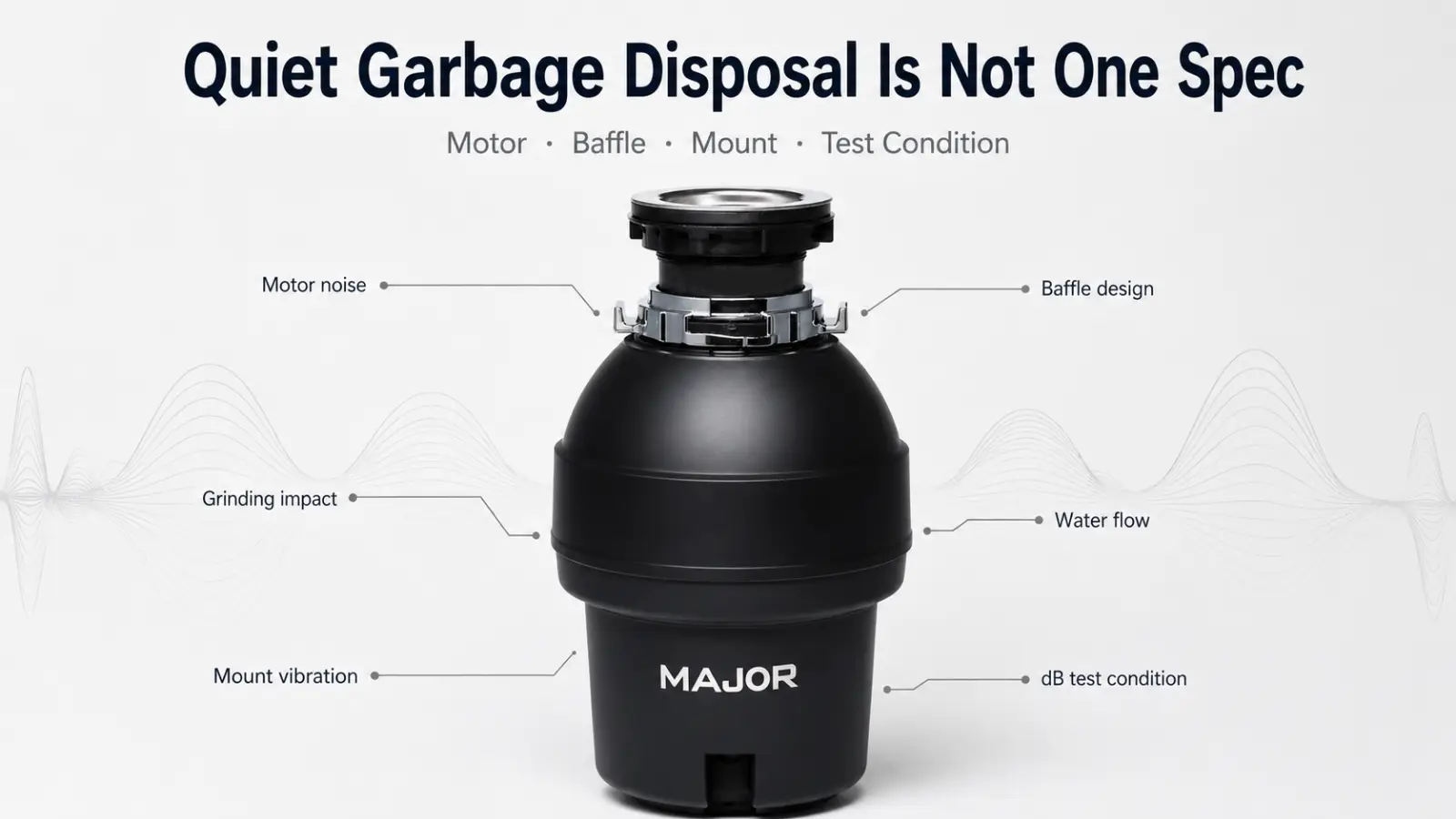
| Quiet field | What it changes | What to lock before quote |
|---|---|---|
| Motor type | The noise starting point before insulation is added | AC / DC / BLDC package and model sheet |
| Sound-deadening package | How much chamber and motor noise reaches the cabinet | Insulation level and gasket package used on the sample |
| Sink baffle | Sound and splash coming back through the sink opening | Baffle size, fitment and spare part number |
| Mount and sink interface | Vibration transfer into the sink and cabinet | Mount system and sink-interface note, without promising the final kitchen sound |
| dB test condition | Whether the number can be repeated at sample review | Load, water, microphone position and room condition |
A quiet garbage disposal gets quieter from a few things working together: sound-deadening material and vibration damping around the motor and grind chamber, the motor type itself, and a rubber baffle that seals the sink opening.
They behave differently. Insulation and damping bring the noise down without, on their own, saying anything final about grinding capacity. The baffle is the piece with a side effect the user sees at the sink — seal the opening tightly enough to block sound and it can also slow the water going through it.
So “quiet” is the sum of several design choices. The label hides which ones a given SKU actually made.
That gap shows up on the sourcing side more than the retail side. On June 2 a buyer in the US sent us an inquiry that opened with one line: they wanted a quiet food waste disposer, and they pasted the link to a well-known brand’s page as the reference. The page was a B2C sell sheet — “quiet,” “quieter,” “whisper” repeated down the screen, no condition attached to the number behind the claim.
I did not answer the question they thought they were asking, which was whether we could build the same thing as that brand. I asked them to pick the unit first — the housing, the HP, AC or DC or BLDC — and said I would send the lab dB figure for that model. If that number was higher than their target, we could add insulation and step up the rubber gaskets, but I put the baffle issue in the reply: on our build, the baffle change can affect drainage, and we would re-check throughput on that exact configuration before committing to it.
They read it, picked our standard model, and said they would wire it into a kitchen and listen to the real thing before deciding whether they needed the quieter build, which is the order we want settled on paper before a sample ships.
What a quiet build is actually made of
Whether a unit reads quiet, and how low it reads, comes from the sound-deadening and damping inside, the motor underneath, and the baffle at the opening. The catalog page flattens those into one word.
The baffle is the clear one. A tighter baffle blocks more sound coming up through the sink, and it can also hold water above it before the flaps open. Insulation and vibration damping are a different question. They lower the noise the unit makes, and any effect on throughput belongs to the specific build rather than to a rule placed on every disposer.
When a buyer asks us to push a model below its standard noise level, we do not quote that as a free change. We flag throughput and drain speed for re-check on that exact configuration, because raising a possible side effect before sampling is cheaper than finding one after.
For an importer, the quietest option on a catalog page does not earn a stock position by being quietest. For compact apartment kitchens where the product brief puts low wall noise above heavy scrap handling, the quote can lean quieter. For heavier kitchen use, the safer path is a model where the grinding capacity stays clear before the buyer asks for a lower sound reading. Picking “quietest” without naming the use is how a buyer turns a noise feature into a later capacity complaint.
A dB figure with no test condition belongs outside the quote
Pages rank disposers by decibel and stop there. A bare number — “62 dB,” “quiet operation,” “low noise” — cannot serve as a quote spec, because it does not say how the reading was taken.
We test every model in house, and we hand the figure over with the condition attached. We read it with the microphone sitting on the sink itself, the tap running wide open, and the unit grinding the kind of everyday scraps that come off plates after a meal. The room is set up to sound like a kitchen in daytime use rather than a silent chamber.
A figure taken that way and a figure taken in a sound booth with the unit spinning empty are different figures. Neither predicts everything the end user hears with a thin steel bowl, a hollow cabinet, and the door left open.
I don’t know how the outside reference page in that June 2 inquiry was tested, and that is the reason I kept the buyer on the model first and the number second.
When a dB value lands in an RFQ with no load state, no water-running condition and no microphone position behind it, treat it as sales copy and ask for the test sheet — ours or anyone else’s.
A quiet claim you cannot reproduce in a quote turns into a dispute at sample stage.
The motor changes the noise starting point
Insulation works on the noise after it exists. The motor package sets the starting point.
On the Major models we test, BLDC versions give us a lower noise starting point than the same-class fixed-speed motor package. That stays a Major model-level observation tied to the sheet in front of us, not a universal motor claim.
For a buyer, the usable part is narrow: motor type belongs in the quiet conversation alongside the insulation. A buyer comparing only horsepower has moved to the wrong field.
HP and noise sit in different columns. A 1/2 HP and a 3/4 HP unit compared on noise alone are being compared on the wrong column. The deeper motor architecture point sits in our DC vs AC motor garbage disposal breakdown, where the same issue is handled at the motor level rather than the noise level.
The baffle is the quiet part that buyers hear about later
The rubber baffle at the sink opening is the cheapest piece in the quiet package and the one we want flagged before the quote leaves. It seals the mouth of the disposer to keep sound and splash from coming up. A tighter baffle can also hold water above it until the flow builds enough pressure to push the flaps open, and a customer who sees water sitting in the sink reads it as a clog.
That drains-slowly behavior shows up in public homeowner discussion and in how the part itself is described, which is enough reason to put it in front of the buyer before it becomes a return. The fix is rarely the disposer body. It is the baffle spec and the after-sales wording that should have flagged the behavior in advance.
The same logic runs through any consumable on a disposer: the baffle is a fitment-sensitive spare, not a generic rubber ring. It is sized to a mount platform, and a quiet version should be treated as its own part number when the buyer plans the carton and spare set. The related fitment problem is covered in the splash guard replacement article.
If the baffle is fitment-specific and the spare is missing from the accessory set, the importer has no part number ready when the first baffle request arrives.
What to lock in the RFQ before you quote a quiet line
We sell to importers, distributors and OEM buyers. We hand over the lab figure and the condition behind it. We do not install under anyone’s sink or measure the sound in the buyer’s customer kitchen. The install we never see is where the rest of the noise appears.
With that boundary clear, these fields need to be settled before a quiet line gets a price:
- The unit before the noise target: housing, HP and motor type. The dB figure attaches to a model, not to the word “quiet.”
- The insulation and gasket package: what the sample uses, and whether throughput and drainage require re-check on that exact configuration.
- The baffle: dimension, fitment to the mount platform and a matched spare in the accessory set.
- The mount and sink interface: written as a note, not a promise. Vibration travels through the mount and into the sink shell; a 3-bolt versus EZ mount choice and a thin steel bowl change what the end user hears.
- The dB test condition: load state, water-running condition, microphone position and room condition.
The B2B sourcing guide handles the same problem across the whole disposer spec. Here the issue is narrower: a quiet line has to be quoteable, repeatable and explainable when the sample reaches the buyer’s kitchen.
FAQ
What makes a garbage disposal quieter?
Sound-deadening material and vibration damping around the motor and grind chamber, the motor type, and a rubber baffle sealing the sink opening. The baffle is the one with a visible trade-off: a tighter one blocks more sound and can also slow the water draining through it.
What is the quietest garbage disposal unit?
There is no single answer worth quoting until the load, microphone position, water condition and sink setup are named. Choose the model and use first; read the dB figure against its test condition second.
Is a 1 HP garbage disposal quieter than a 3/4 HP?
No. Horsepower and noise sit in separate columns on the spec sheet.
Why is my new quiet garbage disposal louder than my old one?
The install interface can make that happen. A new disposer placed into a thin steel sink, a hollow cabinet, or a mount that transfers vibration can sound louder than an older unit that sat in a more forgiving setup. An empty run is also louder and rattlier than a loaded one. A sharp recurring sound points to a mechanical problem, which belongs outside quiet-SKU selection.
What is a good decibel level for a garbage disposal?
A dB number with no test condition behind it is not something you can quote against. Ask for the figure and the condition it was measured under, then compare like with like.
Does the splash guard or baffle make a disposal quieter?
Yes. A tighter baffle can damp sound coming up through the sink opening, and it can also hold water above it long enough for the user to read slow drainage as a problem.
Why does my garbage disposal sound like metal on metal?
That points to a foreign object or worn part, not a quiet-spec question. Keep abnormal-noise troubleshooting separate from buying for low noise.
Is dishwasher drain noise the same as disposal noise?
No. Water draining back through the dishwasher line and the air gap can carry noise into the sink while the disposer is not running.
Related sourcing checks: motor, baffle and drain noise
The baffle point above uses the same accessory logic as the splash guard article: a low-cost rubber part looks generic until the mount platform decides the size. The motor section builds on the AC-versus-DC breakdown, where the power package is handled before the buyer starts comparing feature names. The noise that reaches the sink through another path connects to the dishwasher connection article, because drain noise can be blamed on the disposer while the disposer is not running. For current motor-package options tied to this discussion, see Major DC motor food waste disposers.
If you’re scoping a quiet line, the one document to ask any supplier for is the dB figure with its test condition — load, water and microphone position. We can send that sheet for the AC, DC and BLDC models, with the baffle spec and spare part number, so the quiet claim stays repeatable when your sample reaches the kitchen.
Sources
- InSinkErator Quiet Series — Garbage Disposals Referenced for public manufacturer wording around sound insulation, vibration-reducing connections and a Quiet Collar sink baffle.
- DoItYourself.com Community Forums — New disposal, “quiet collar” / sink baffle too tight Referenced as a public homeowner discussion showing a quiet-style baffle holding water until pushed open.
- Lowe’s — Quietest Garbage Disposals Referenced as a retail category page that presents quiet disposal options through fields such as Noise Level, Grind Stage and Power Cord rather than a stated test condition.
Major-specific product statements, internal noise-reading method, June 2 inquiry handling, product-line boundary and RFQ judgments in this article are based on Wanjiamei Technology Development Co., Ltd. product information and sales communication records rather than the external public sources listed above.