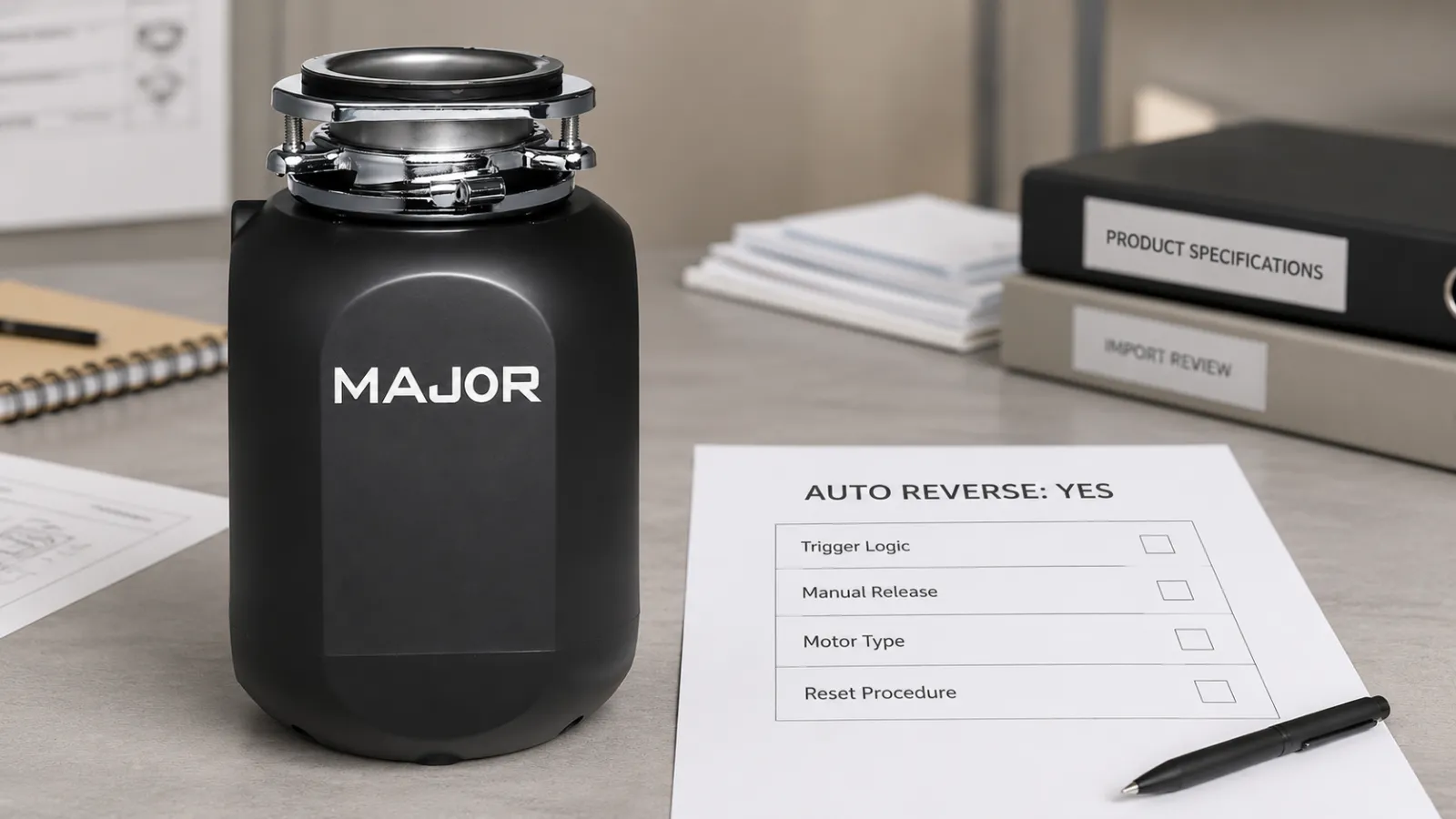
In April 2026, a buyer from Indonesia emailed our team asking for a catalogue. He had shortlisted two models — the Z100 and the Z100S. Same form factor, same grind chamber, same housing. The price was different. He wrote back asking why. The line “auto-reverse” sat on one spec sheet and not on the other, and the line had not told him what changed. After we walked him through what an auto reverse garbage disposal actually does at the mechanism level, he placed an order. Seventy percent went to the Z100. Thirty percent to the Z100S.
“Auto Reverse: Yes” is where the buyer’s questions should start
A spec sheet reading “Auto-Reverse: Yes” is a one-bit answer to a question the buyer probably had not finished asking.
What triggers the reversal? Stall detection, alternation on every startup, or a timed cycle during operation. The yes/no does not say which. Whether the same SKU also carries a separate torque-boost circuit that increases motor force without changing direction is a different field, listed on some spec sheets and absent from others. The instruction sheet (a separate document from the spec sheet) handles what the user does when reversal fails to clear the obstruction. And whether the motor architecture in this specific SKU makes reversal a useful path at all is its own conversation.
Direction reversal and torque boost are different circuits
An established US-based disposer manufacturer’s current product page for one of its disposers lists two anti-jam features under separate names. One is an automatic torque-boost circuit that increases motor torque to break through tough jams. The other is a grind-system reversal that automatically reverses grind direction.
Torque boost applies additional turning force without changing grind direction. Reversal changes the direction of rotation after a stall is detected, attempting to release the stalled grinding path from the opposite direction. The two features are listed separately because they are different anti-jam responses.
A retail page that compresses both into “anti-jam” does not tell the buyer which mechanism ships in this specific SKU. Some products on the market have both circuits. Some have one. Some have neither. The marketing label has stopped distinguishing them.
What our auto-reverse actually does on the DAZZ and Z100S
On our line, auto-reverse is triggered by stall detection. The motor turns in its primary direction during normal grinding. When the controller on the DAZZ BLDC series — or the stall-sensing path on the Z100S AC induction model — registers that the motor has stopped rotating against a load, the unit reverses direction in an attempt to release the stalled grinding path. Normal startup and normal grinding stay in one direction. Reversal is event-triggered.
We can build the alternation-per-startup version, where the direction flips on every switch-on as a different control strategy. The buyers we ship to have not asked for it as a default. We can also build the timed-reversal version, where the direction flips on a clock during operation. Same situation — the buyers on our line have configured around stall-triggered reversal.
Our standard explanation of stall-triggered logic is direct: normal startup remains in one direction, and reversal is described only as a response to a stall event. We are describing the configuration our buyers consistently pick. We are not claiming simpler logic is always the right engineering answer for every market.
The BLDC stack in the DAZZ series reverses through the controller. The inverter changes the commutation sequence sent to the windings, and the rotor follows. The single-phase AC motor in the Z100S reverses through the windings themselves — switching the polarity of the auxiliary winding flips the rotating magnetic field. The grind components above the motor see the same outcome from either implementation. We’ve written about the wider motor-topology question in DC vs AC Motor in Garbage Disposals, and what it changes for sourcing decisions.
One thing we do not claim certainty on. The exact stall-detection threshold — how long the controller waits, how much current rise it tolerates, what RPM drop counts as a stall — sits inside the controller logic on the DAZZ and inside the motor-protection circuit on the Z100S. The two are tuned separately. Two units returning a “did not reverse on the jam” complaint can land on either side of the threshold for reasons that do not show up on the spec sheet.
Even with auto-reverse, the manual release procedure stays in the instruction sheet
Auto-reverse does not remove the wrench-and-reset path. Retail copy blurs this. A disposer described as “automatically reverses on a jam” sounds, from the marketing copy, like a disposer that handles its own problems.
The same disposer cited earlier, the one whose spec page lists both an automatic torque-boost circuit and an auto-reverse grind system as separate features — ships with a self-service wrenchette in the box, a documented release procedure in its user manual, and a reset button on the housing.
The user manual published by that same manufacturer instructs the user, in its “To release jam” section, to:
- turn off the disposer and the water
- insert the self-service wrenchette into the center hole on the bottom of the disposer
- work the wrenchette back and forth until it turns one full revolution
- reach into the disposer with tongs and remove the object
- allow the motor to cool for three to five minutes
- press the red reset button on the bottom of the disposer
The same manual ships with the same disposer that runs both the jam-sensor torque-boost circuit and the auto-reverse grind system. The wrench-and-reset procedure sits in the manual anyway.
On our line, every unit ships with a reset button, with or without auto-reverse. Our default user manual carries the same kind of manual-release procedure, with a hex-key release as the primary tool. OEM buyers can adapt the manual content for their own brand, and our default keeps the manual-release path in. The diagnostic chain for jam-related “garbage disposal keeps getting stuck” and humming-but-not-spinning complaints is covered in Garbage Disposal Humming But Not Spinning, which walks through the review layers behind that return-claim pattern.
What we tell our buyers about the case where auto-reverse runs and the obstruction is still there: the recovery procedure is the same as on a unit without auto-reverse. Power off, remove the object, let the motor cool, press reset.
Auto-reverse appears on some product lines and not on others, even within the same brand
The same US-based brand’s current product list contains a counter-example. The 1 HP model carrying both an auto-reverse system and a separate torque-boost circuit shares its category with another 1 HP model — same horsepower rating, sold as a newer series — whose product page does not list auto-reverse at all. The newer series cites motor torque improvements and grind-component upgrades as its anti-jam story.
A buyer reading ‘Auto-Reverse: Yes’ as a tier signal is reading meaning into a spec line the manufacturer’s own product range tells a different story about.
The same configuration logic shows up on our line. The DURA Z100 and the DURA Z100S share the same form factor, the same grind chamber, the same housing. The single difference is auto-reverse, present on the Z100S and absent from the Z100. We treat the Z100 as a configuration choice for buyers whose markets do not call for the reversal path, or whose price points need a simpler control logic. It is not a downgrade.
The market splits on this
The pattern across our orders is uneven.
The Indian customers we work with do not request auto-reverse. Their PI documents specify units without the feature, year after year. From Korea, we see inquiries that include the feature — the total shipment volume from that market is a thin slice of our annual books, but the spec request shows up. Israel and Russia send the feature in their RFQs. So does the US side, where retail copy presents auto-reverse as worth paying more for, and end-customers shop for it by name.
A handful of buyers configure both versions and sell them at two price points side by side. The end-customer makes the call.
Back to that April 2026 email. The Indonesian buyer. The buyer did not know what auto-reverse meant. He had two SKUs in front of him at two prices and could not square the difference. After the call, he ordered both — seventy percent Z100, thirty percent Z100S. He kept the lower SKU as his volume seller, and used the Z100S to cover the consumers in his market who would ask for the feature by name. He used the split to sort his catalogue by what his consumers were likely to ask for.
We’ve written about the way Air Switch configurations vary by destination market in Garbage Disposal Air Switch by Market. The same kind of country-by-country split shows up on auto-reverse. When buyers specify it, the reasoning we hear from them comes back to consumer expectation — a retail position to defend, an end-customer that asks for it by name, or a competitor SKU to match.
What an importer should pin down before signing the PO
Before adding auto-reverse to a SKU, or before treating its presence on a quotation as decided, the buyer’s review covers the following.
- What triggers the reversal — stall detection, every startup, or a timed cycle.
- Whether the unit also has a separate torque-boost circuit, or whether the spec sheet’s “anti-jam” label means reversal alone.
- What the user manual asks the user to do if reversal does not clear the obstruction.
- Whether the motor architecture in this SKU — single-phase AC induction, DC, or BLDC — implements reversal in a way the buyer’s after-sales team can support.
- Which destination market is buying this SKU, and whether the end-customer in that market values the feature enough to pay for the configuration.
We do the factory-side configuration on these SKUs and we ship the units. We do not run the consumer-facing marketing for our buyers, and we do not write the after-sales scripts that go to the end-user. The questions above are the ones we get asked by buyers who already understood the feature, and the ones we recommend new buyers ask before the PI gets signed. For the spec-sheet fields around HP, voltage, and motor selection, we have covered those separately in What HP Garbage Disposal Do I Need?.
For an evaluation sample of the Z100 or Z100S, or for a custom RFQ specifying auto-reverse trigger logic, contact the Major Product Team.
FAQ
Does auto reverse prevent garbage disposal jams?
Auto reverse reduces some jam events. The mechanism handles obstructions that reversal can mechanically dislodge — soft food matter wedged between the impellers and the grind ring, fibrous material caught at the cutting edge. The mechanism does not handle foreign objects lodged where the grind ring meets the chamber wall — a coin, a screw, a small bone fragment, a piece of glass. When the obstruction is a foreign object, the motor reverses, the rotation hits the same obstruction from the other direction, and the homeowner still has to power the unit off, remove the object, and press reset.
Is auto reverse the same as a jam sensor?
No. A jam sensor circuit detects the stall condition. What the circuit does in response varies between products — some use increased motor torque in the same direction, some use direction reversal. The disposer cited earlier in this article runs both circuits in the same unit; they act on the same stall event through two different mechanisms. A spec line reading “Auto-Reverse” by itself does not tell the buyer whether a jam sensor and a separate torque boost ship alongside it.
Why does my garbage disposal keep getting stuck even with auto reverse?
A garbage disposal that keeps getting stuck with auto reverse active is getting stuck on something reversal cannot clear. The first place to check is the chamber itself — for foreign objects like coins, fruit pits, small bones, glass fragments, twist-ties. The second is overfeed of fibrous waste like celery strings or corn husks faster than the unit can process. The auto-reverse circuit was built for stall events during normal grinding. Keeping non-food objects out of the chamber is on the homeowner’s side of the equation.
Does an auto-reverse garbage disposal still need a wrench or reset button?
Yes. Both ship on disposers that have auto-reverse. The manual published by one US-based disposer manufacturer specifies a self-service wrenchette procedure and a reset-button step in the jam-release section, on a unit that also has automatic reversal. On our line, every disposer ships with a reset button. Our default manual includes the manual-release procedure with the wrench. The wrench is in the box.
Is auto reverse necessary on a BLDC food waste disposer?
A BLDC disposer can ship with or without auto-reverse. Implementing it on BLDC is straightforward — the controller already changes commutation in software during normal operation, so adding stall-triggered reversal happens at the firmware level. The question for the buyer becomes whether the end-customer in the destination market values the feature enough to pay for the SKU that ships with it.
Sources
- InSinkErator Evolution Excel — official product page (insinkerator.com, en-CA market). Lists Jam-Sensor® Circuit and Auto-Reverse Grind System® as separate features. View page
- InSinkErator Evolution Excel — official installation, care and use manual (PDF, document reference en-us-69006, hosted on insinkerator.com). Contains the “To release jam” wrench-and-reset procedure quoted in this article. View PDF
- InSinkErator Power Series 1 HP (model PWR-1HP) — official product page (insinkerator.com, en-US market). Feature list cites motor torque and grind-component upgrades as the anti-jam approach; auto-reverse is not listed. View page
Related
- Garbage Disposal Humming But Not Spinning: A Factory View of the Return Complaint
- 3-Bolt vs EZ Mount Garbage Disposals: What Importers Should Ask in Replacement RFQs
- Garbage Disposal Certifications by Market: What Importers Ask First
- Stainless Steel Garbage Disposal: The Two Questions a Spec Sheet Doesn’t Answer