October 2023. An Indian importer walked through our factory floor. Halfway through the visit, he asked whether the internal parts were 304 or 201. He didn’t ask whether the unit was a “stainless steel garbage disposal.” He already knew that phrase doesn’t pin down what’s inside.
Most “stainless steel garbage disposal” claims don’t answer either of the two questions an importer asks: which part of the disposer is stainless, and which grade of stainless it is.
Major makes household food waste disposers. We hold a supplier mill certificate for SS304 covering the steel stock in our water-contact parts. We send the document to importers who ask for material documentation. We don’t publish it as a public graphic. Anyone can fabricate a chemistry table for a website.
“Stainless Steel” Doesn’t Tell You Which Part
Pull any public disposer spec sheet from the consumer market. The material line usually says “stainless steel grinding components.” That phrase leaves the chamber unspecified.
Common construction across the consumer disposer market:
- Grinding components: stainless steel or galvanized steel, depending on price tier
- Grind chamber: reinforced polymer, glass-filled polyester, or nylon composite
- Sink flange: stainless steel when the visible flange is metal, with a separate finish coating in many SKUs
A consumer reading “stainless steel garbage disposal” reads it as a unit with stainless internals top to bottom. That isn’t what most consumer SKUs deliver. The chamber under the grinding components is a polymer body in the bulk of the residential market.
Polymer chambers work. They don’t corrode, they keep weight down, they keep cost manageable. The spec language is what’s slippery. “Stainless steel garbage disposal” as a marketing line implies more than what a polymer-chamber unit actually delivers in the material BOM.
An importer reading “stainless steel” in a spec sheet should ask which line items it covers. Grinding components only. Components plus chamber. Components plus chamber plus visible flange. Each carries a different cost and a different corrosion exposure over the unit’s service life.
304 or 201
The Indian importer’s question wasn’t unusual. It’s the second layer that doesn’t show on most spec sheets.
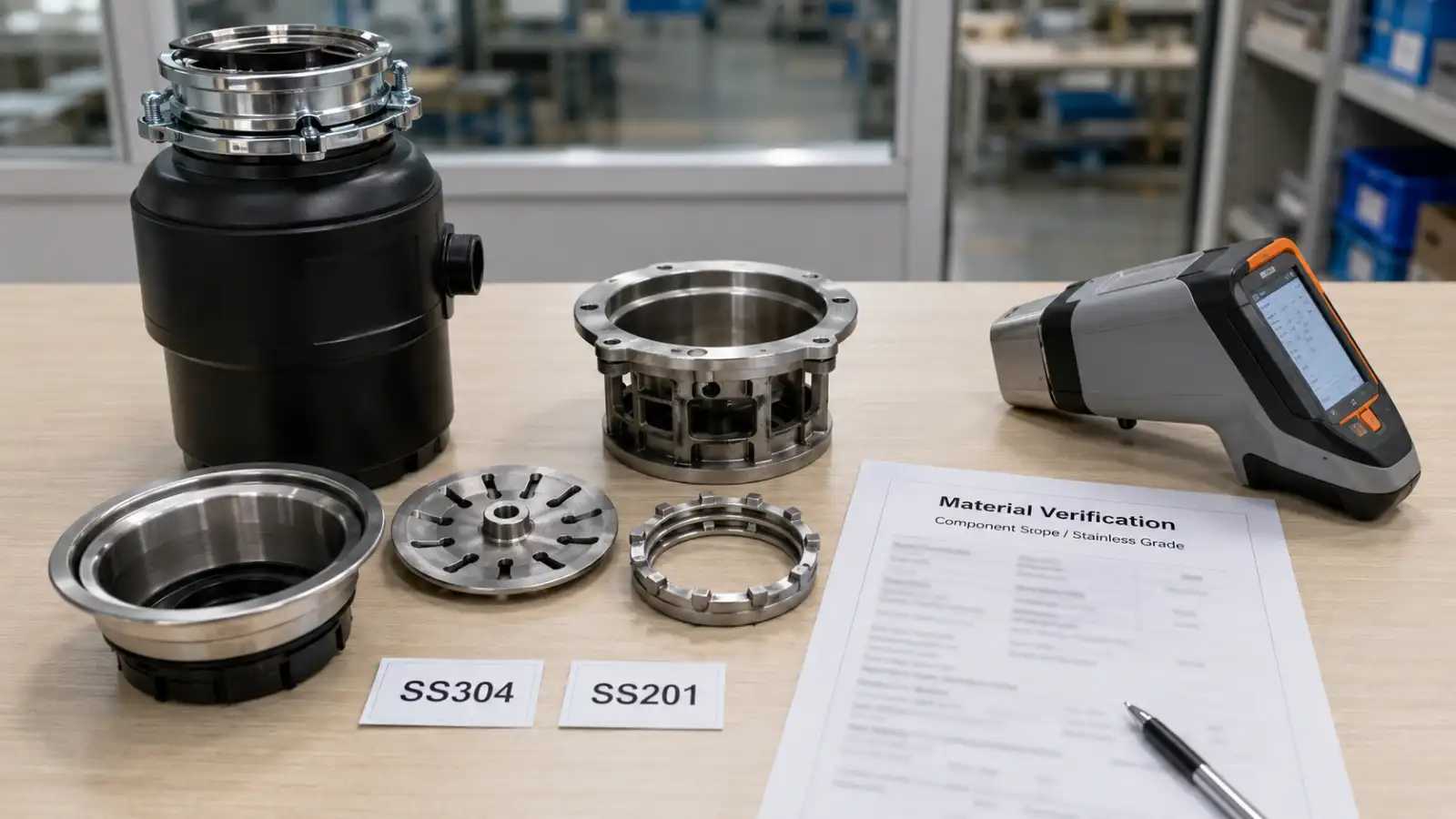
SS304 is the standard food-grade austenitic stainless. Around 18% chromium, around 8% nickel, low carbon. Strong corrosion resistance against water and mild kitchen acids. Higher material cost driven primarily by nickel content.
SS201 substitutes most of the nickel with manganese. Around 16% chromium, lower nickel, higher manganese. Corrosion resistance is lower, particularly in long-term wet contact. Visually, the two are indistinguishable without a chemistry test or a portable XRF gun.
A factory writing “stainless steel” without specifying grade can ship either. The spec sheet language doesn’t force disclosure. An importer wants to know which grade the factory uses by default, and which grade gets quoted at the lower price point.
What a Mill Certificate Actually Tells You
Our current SS304 mill certificate was issued August 10, 2025, from our steel supplier. It documents the chemistry of the SS304 stock used in the production batch covering our water-contact disposer parts:
- Chromium: 19.35% (ASTM A240 spec: 18.0–20.0%)
- Nickel: 8.86% (spec: 8.0–10.5%)
- Manganese: 1.11% (spec: ≤ 2.0%)
- Silicon: 0.254% (spec: ≤ 0.75%)
- Carbon: 0.003% (spec: ≤ 0.08%)
- Phosphorus: 0.0001% (spec: ≤ 0.045%)
- Sulfur: 0.0006% (spec: ≤ 0.030%)
- Lead: 0.0002%
- Iron: 69.64% balance
Every value sits inside the SS304 range. Carbon at 0.003% is well below the 0.08% ceiling, which puts this stock at 304L-equivalent for welding behavior. Lead at 0.0002% is essentially absent.
This is the document an importer should ask for. The chemistry either matches 304 or it doesn’t. SS201 has a different elemental window, and a mill certificate identifies it the same way.
The certificate date links the document to a specific production window. A certificate from 2018 doesn’t cover steel rolled in 2025. Importers reviewing material claims should look at the certificate date and ask whether the steel batch behind their next PO is covered by the document.
Supplier identity matters too. Mill certificates come from the steel maker, not the disposer factory. A disposer factory presenting a “stainless steel material report” on its own letterhead, without supplier traceability, isn’t presenting a mill certificate. It’s presenting a marketing document with chemistry numbers on it.
Our Material Map
Default shipment across our 20 SKUs is SS304 on all water-contact surfaces:
- Grinding components (impeller plate, lugs, shredder ring)
- Grind chamber body
- Sink flange when the metal flange option is ordered, with a separate rubber gasket
- Splash guard cover, with a separate rubber gasket
- Upper hardware on 3-bolt mount configurations, with rubber gaskets at the seal points
EZ Mount upper hardware is ABS plastic by design, not stainless. The plastic ring isn’t a cost cut. It’s how the twist-and-lock mechanism works.
Non-water-contact metal parts can be built in SS201 on customer request to bring the unit cost down. We don’t quote 201 by default and we don’t substitute it without confirmation. When a customer wants 201 on non-contact surfaces, that line gets written into the PO. When the PO doesn’t mention 201, the unit ships in SS304 throughout the metal BOM.
We hold the mill certificate for the SS304 stock. The polymer parts, rubber gaskets, and ABS hardware come from different supply chains with their own material documentation, provided separately when an importer’s market-entry certification scope asks for it.
We don’t replace finished-product certification with a material claim. We retain and provide the supplier material documentation for the relevant parts going into the disposer.
Need the mill certificate before quoting? Send your SKU list. We send the supplier document upfront.
Send your target SKU, required material grade and destination-market documentation needs. We can review component scope, SS304 material documentation and configuration requirements before quoting.
Related articles on this site
- DC vs AC Motor in Garbage Disposals: What Importers Should Compare Beyond RPM
- What HP Garbage Disposal Do I Need? 1/2 vs 3/4 vs 1 HP
- Garbage Disposal Certifications by Market: What Importers Ask First
- 3-Bolt vs EZ Mount Garbage Disposals: What Importers Should Ask in Replacement RFQs