| Who is reading the claim | What “septic compatible” can cover | What it cannot guarantee |
|---|---|---|
| Factory | Grind, output, load class, use note | Tank capacity, pump schedule, drainfield performance |
| System owner | Maintenance, pumping, field condition | Appliance-side design promises beyond the outlet |
| Wholesaler / importer | Conditional wording on label or carton | Local-rule override or unconditional customer reading |
| Homeowner | Basic use compatibility | “Install it and forget it” treatment of the whole septic system |
The factory’s view: the appliance ends at the outlet
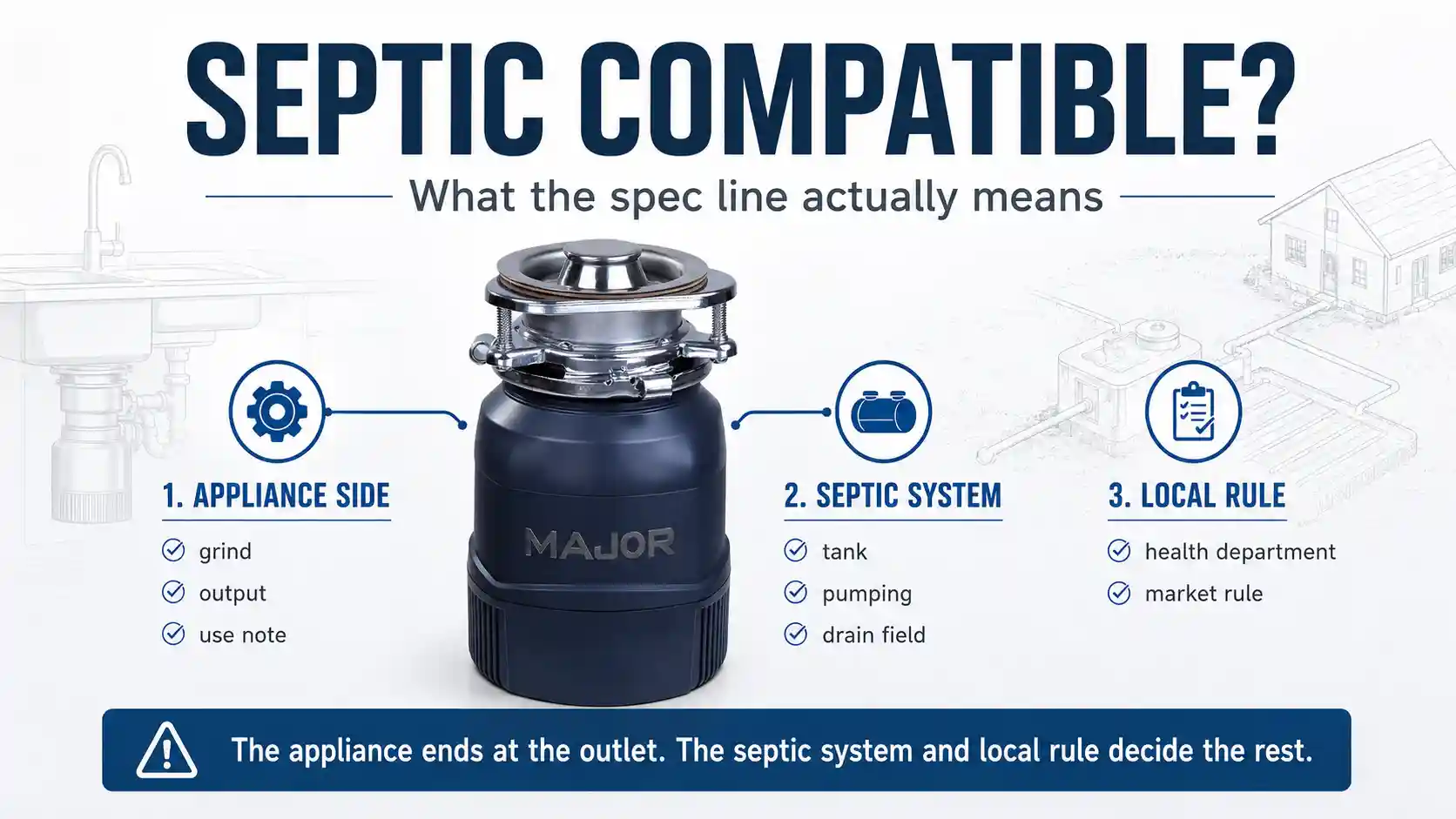
We don’t label our disposers septic-safe or septic-compatible. The reason is narrow: our responsibility is the appliance, and the appliance ends at the outlet.
Inside that boundary, the unit does its job well. Rotting, soft food is the easy case — it’s soft to begin with, and the grind is built for it. The one hard limit is large hard bones — and those don’t rot anyway, so they’re out for a separate reason (what can’t go in). We give one operating note that matters on septic or sewer alike: keep cold water running so ground food clears the chamber instead of sitting there and turning to odor. Fibrous waste goes in small amounts, rotten or not, or it wraps the moving parts.
There’s one thing we build into the appliance that gets confused for a system claim. When we mould the inner chamber, we blend an antimicrobial powder into the material, so the chamber resists bacterial growth. That’s a hygiene measure on the part we own. It says nothing about the tank downstream. The line we hold is the same one: we improve the appliance, and we don’t reach past the outlet.
We also make no additive-based septic claim. There’s no enzyme or bacteria injection in our units, and we don’t market a disposer as treating a septic system.
So for “septic compatible,” what we’ll put our name to is the grind, the output, the load class, and the use note. Everything past the outlet belongs to the system, and we’d rather write that down than let four words imply otherwise. Bring us the model and the market you’re selling into. We’ll tell you what the spec can say and where it stops. Talk to us about a model.
The system’s view: after the outlet, the tank keeps score
Past the outlet, a different party is keeping count: the tank. Ground food is organic load. It settles as sludge and scum, and the tank fills on its own clock.
The public health guidance is consistent on direction. The EPA tells septic owners to limit disposal use, because food waste adds solid material the tank has to hold. A tank fed by a disposal needs pumping more often. Massachusetts is more specific: a septic home without a disposal is told to pump about every three years; with a disposal, every year.
There’s a second body of evidence pointing the other way. A 2019 University of Minnesota study, commissioned by the manufacturer, reported food waste breaking down faster than sewage solids — roughly 76% against 37%. It found less accumulation in the tank, and concluded that disposer systems didn’t need more frequent pumping. Food scraps are mostly water to begin with.
Which body of evidence holds for a given home, I can’t tell from the factory. It turns on a tank and a maintenance schedule we never see. The grind is the same on a city sewer and on a septic field. What differs sits past the outlet — tank size, maintenance, pump schedule, the age of the drainfield — and the unit controls none of it. One thing carries over either way. Even a clean grind can leave rotting-food residue in the line that smells back up later. The smell is a drain matter, not a unit fault. We followed the particles past the sink in how the ground output behaves after the grind.
The wholesaler’s view: a claim you’ll have to stand behind
For the buyer who prints the label, “septic compatible” is something you carry. The returns, the disputes, the local rule — they come back to whoever put the words on the box.
A product attribute isn’t a local permit. Some jurisdictions restrict or discourage disposals on septic regardless of which unit it is. A few health departments tell owners not to use one at all. A label printed at the factory doesn’t move that line. We separated market permission from product configuration in waste disposal unit by market.
Worth noting: even the septic claims that do get made come with a condition attached — “properly maintained,” “properly sized.” By their own wording, the label is conditional. A buyer who prints it flat, with no condition, is the one holding the gap when a customer reads it as unconditional.
What’s firmer to lock is the part the factory owns. The model’s load class. The use boundary the manual states — cold water running, fiber in small amounts, the items that belong in the trash instead (what can’t go in). And the destination’s rule, confirmed before the PO. When the market restricts disposals on septic, the rule decides it, and no wording on the carton overrides that.
The homeowner’s view: the misread you inherit
The homeowner reads the shortest version of all. “Septic safe” becomes “install it and forget it” — no schedule, no pumping, an additive somewhere handling the rest.
That reading is the one a buyer inherits. A finer grind doesn’t shrink the load. It changes the particle, not the amount of organic matter — something we walked through in what actually leaves the unit. An enzyme cartridge doesn’t stand in for pumping. And a label was never the local rule. A flat “septic safe” on the box is what turns those three gaps into a complaint with your name on it.
Common questions
Can you have a garbage disposal with a septic tank?
Yes — the unit grinds food the same as on a sewer. What changes is downstream: the tank holds the solids, and how often it’s pumped depends on the system, not the disposer.
What does “septic safe” actually mean?
It’s a market label, not a single standard. At most it says the appliance grinds food fine enough to flow into the tank. It doesn’t promise the tank’s capacity, the pump schedule, or that your local rule allows a disposal on septic. Read it as a condition, not a guarantee.
Does a garbage disposal make a septic tank fill faster?
Health guidance says yes — food waste adds solids, so a disposal-fed tank gets pumped more often. Massachusetts puts it at yearly versus every three years. A manufacturer-commissioned 2019 study reported food waste degrading faster and adding little to the settled solids. The honest answer for a buyer: the system decides it, not the unit.
Does an enzyme or additive cartridge replace pumping?
No. The EPA’s position is that septic additives aren’t required or recommended, and some can interfere with the system. An additive is a feature; it doesn’t replace pumping. Major doesn’t make an additive-based septic claim.
Does “septic compatible” mean it’s approved where I sell?
No. A product label can’t grant a local permit. Some markets restrict or discourage disposals on septic regardless of the model. The destination’s rule has to be checked before you print the claim.
Sources
- EPA — How to Care for Your Septic System
Referenced for the appliance-to-septic transition, limiting or eliminating garbage disposal use because food waste adds solid material to the septic tank, and the point that use of a disposal increases maintenance burden and can affect drainfield performance. - EPA — Frequent Questions on Septic Systems
Referenced for the statement that using an in-sink garbage disposal can impact how often a septic tank must be pumped, because food waste is slowly digested and can accumulate as scum and sludge. - Mass.gov / MassDEP — Caring for Your Septic System
Referenced for jurisdiction-specific septic care guidance that advises severely limiting garbage disposal use and recommends pumping about every three years for homes without a disposal and every year for homes with one. - InSinkErator — Garbage Disposals for Septic Systems
Referenced for the manufacturer septic-safe claim language, the condition wording around “properly maintained” systems, and the manufacturer-cited summary of the 2019 University of Minnesota study, including the 76% versus 37% degradation comparison and the conclusion that disposer-equipped septic systems did not require more frequent pumping. - Lin, Wang, van Lierop, Zamalloa, Furlong, Keleman, Hu (2019) — Study of food waste degradation in a simulated septic tank
Referenced for the study named in the article as the 2019 University of Minnesota work on food waste degradation in a simulated septic tank. - EPA — Septic Tank Additives Fact Sheet
Referenced for the EPA position that septic tank additives are not required or recommended for normal operation, and that some additive types may interfere with treatment or harm system performance. - Tacoma-Pierce County Health Department — Caring for Your Septic System
Referenced as an example of local health guidance that discourages garbage disposal use on septic systems, supporting the statement that a few health departments tell owners not to use one at all.
Major-specific points — that Major does not apply septic-safe or septic-compatible labeling, makes no additive-based septic claim, blends an antimicrobial powder into the inner-chamber material as an appliance-side hygiene measure, and advises cold-water flushing and limited fibrous loads — are based on Wanjiamei Technology Development Co., Ltd. (Major) product manuals and practice. These points describe the appliance only and are not statements about any septic system’s capacity, maintenance, or local approval.