Private Label vs OEM vs ODM Disposers: Where an Importer’s Brand Actually Lives
An importer finds a disposer already selling in their market under another company’s brand. They ask us to put their logo on the same unit, and assume that makes the product theirs.
Two things are true at once. The machine is a shared platform we build for more than one buyer. And on a food waste disposer quote, the letters — OEM, ODM, private label — won’t tell them which parts of “theirs” they actually got. Suppliers don’t even agree on what the letters mean. One guide calls private label a kind of ODM. Another says private and white label only describe branding, and sit on top of OEM or ODM production. A third treats private label as an OEM job.
OEM vs ODM food waste disposer orders: what each term actually changes
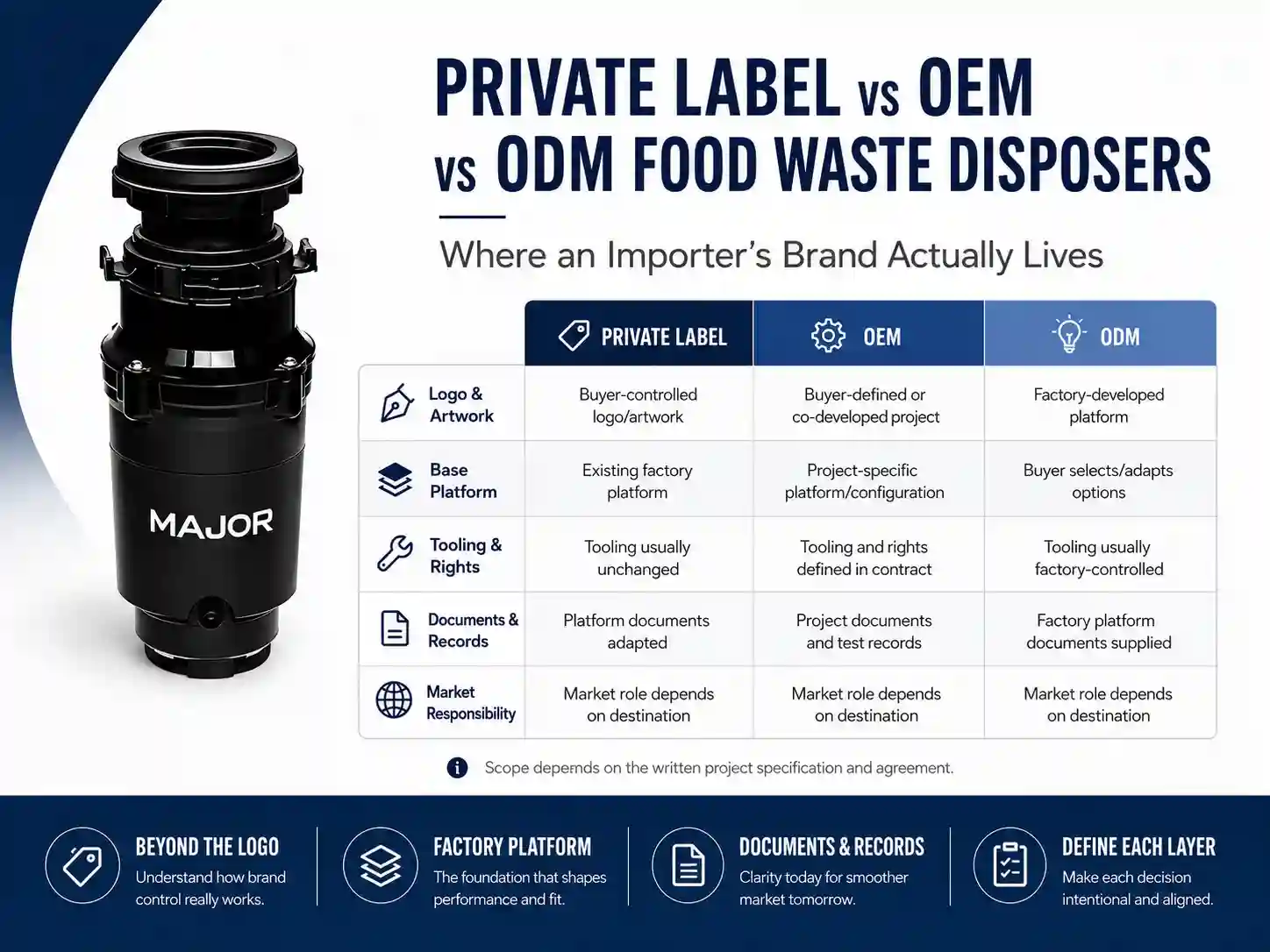
The three terms describe who designs the product and whose specification it runs on. They don’t, on their own, settle ownership, exclusivity or the compliance record. This is how they line up for a disposer order:
| Term | Who designs it | What you control | What it does not settle by itself |
|---|---|---|---|
| Private label | Factory (existing platform) | Logo, artwork, packaging | Platform ownership, exclusivity, tooling, compliance subject |
| ODM | Factory’s existing design, adapted | Configuration choices, branding | Who owns the base platform and drawings |
| OEM | Buyer’s specification | Design intent, spec, IP you bring | Whether a mould is transferable; exclusivity |
For our line, ODM is the common case. The base platform is designed and owned by us; a buyer adapts it — voltage, mount, accessories, branding — without commissioning a new design. A full OEM job, where the buyer brings the design, is a different starting point. Neither label decides the questions that follow, Neither label settles the questions below.
One model name, several market builds underneath it
We don’t rename a model for each market, and we don’t add a regional suffix. The same model number ships to the US, to Europe, to India. What changes underneath the name runs deeper than the cord.
A market build is the whole electrical package: the motor or controller configuration, the rated voltage and frequency, the connection method, the markings, the instructions and the covered compliance record. On a DC or BLDC unit especially, moving from 120V/60Hz to 220–240V/50Hz is not a sticker change at the end of the line — the controller and rated input move with it. We fit each unit with a cord and plug that meet the destination’s requirements; we don’t make the cord ourselves, so we source the market-correct one. The mechanics of corded, plug and hardwired versions are in our power cord guide, so the detail sits there.
One detail matters for your brand. The nameplate carries the logo; the electrical parameters are printed on the outer carton. So the same model name can leave our line as several different market builds, and the name alone won’t tell a downstream buyer which build they’re holding. Whether a logo-only nameplate with ratings on the carton satisfies a given market’s marking rules is a destination question — and it lands on whoever owns the brand.
Private label, without the exclusivity clause
Most supplier pages let “private label” imply exclusivity — your brand, your product, no one else’s. Our position is narrower. We sign no exclusivity agreements with anyone. There is no clause that says a model belongs to one importer.
What we run instead is a practice. For a customer of a year or more, we won’t sell the exact same model into the same country, to protect a buyer who has already built that market. It covers the identical model — change the configuration or the logo and it’s a different product we can sell. And it lasts while that customer stays active; if they stop, the protection stops.
Here is how that plays out. An importer in India asked about a model we already ship into India. We pointed them to a nearby model instead. They knew we had a customer there, and rather than push, they were happy to work with us on the alternative. The logo and artwork are theirs to own. The platform stays ours. The protection is a policy we hold, not paper they can enforce. Whether you also need a registered exclusivity, and what a certification listing does to your brand record, is the ground our private-label certification article covers.
Whether “OEM” hands you the mould is a separate question
“OEM” on a quote gets read as “I own the design and the tooling.” The generic guides encourage that reading. The tooling reality — who owns a buyer-funded mould, who can move it, who maintains it — is its own subject, worked through in our MOQ, sampling and tooling article. For brand purposes, two points carry over. Paying for a mould and holding a transferable one are separate positions. And a logo change, a configuration change, a component change and a new mould are four separate orders.
I can’t point to a case of a buyer taking our platform to another factory and keeping the product identical — that isn’t something we’ve done.
Where the brand actually lives: the identity stack
The logo is the visible layer. Most of the brand sits below it. A single private-label SKU carries a stack of identities, and only the top ones move when you change the artwork:
| Brand layer | What shows on the record | Who controls it | Changes automatically with the logo? |
|---|---|---|---|
| Shell logo | Buyer trademark | Buyer | Yes |
| Carton and manual | Buyer brand / artwork | Buyer approves, factory produces | Yes |
| Commercial model name | Buyer or factory naming | Per order | Not necessarily |
| Production SKU / BOM | Factory-controlled build | Major | No |
| GTIN | Trade-item brand owner | Usually the buyer | Buyer must assign it |
| Certification record | Basic Applicant / Multiple Listee or applicable subject | Per scheme | No |
| Regulatory manufacturer identity | Per destination law | May be the buyer | No — not a visual change |
| Tooling | Per written agreement | May be jointly held | No |
| Spare-parts map | Factory platform family | Major | No |
| Warranty responsibility | Contract and market arrangement | Agreed by both | No |
Most of that last column reads No.: change the logo and most of the brand’s real anchors don’t move with it. The certification-record layer specifically — Basic Applicant, Multiple Listing, who appears in the listing — is the subject of the private-label certification article linked above— covered in the certification article linked above.
Cross a border under your own brand, and your legal role can change
Here is the layer a logo hides. In several markets, placing your name on an electrical product changes what you are, legally, in that market.
A food waste disposer is electrical equipment, so the governing frameworks are the product-specific ones. Under the EU’s Low Voltage Directive (2014/35/EU), a manufacturer includes a business that has equipment designed or manufactured and markets it under its own name or trademark. The EMC Directive and RoHS apply alongside it. The General Product Safety Regulation adds a general backstop — its Article 13 deems an own-brand seller the manufacturer. Great Britain uses the same test. Under the Electrical Equipment (Safety) Regulations 2016, you are the manufacturer if you make the equipment, or have it designed or manufactured, and sell it under your own name or trademark. Northern Ireland follows the applicable EU rules under separate guidance, so it is worth checking on its own rather than folding into “the UK.”
This is where the brand actually lives — in the obligations that follow the name, more than on the shell. From the factory side we provide the agreed technical-document package for the exact SKU, which can include dimensional drawings, controlled specifications, applicable test records, label artwork and production traceability. We don’t hand over the full platform BOM or manufacturing tooling drawings, and we don’t determine your legal duties in a destination market — that sits with you and your local advisor. What ships from our line is a machine and a document set. What the brand on it means in Frankfurt or Manchester is decided by rules we don’t write.
FAQ
What’s the difference between private label, OEM and ODM for a disposer?
They describe who designs the product — factory platform (private label / ODM) versus your specification (OEM). None of them, on its own, decides platform ownership, exclusivity or who carries the compliance record. Those are separate questions on the order.
Can another importer buy the same disposer from you after I put my brand on it?
If you’ve been with us a year or more, we hold that model out of your country while you’re active in it. It’s a practice we run, not a contract, and it covers the identical model — a changed configuration or logo is a different product.
Does putting my logo on it make the design mine?
The logo and artwork are yours. The platform, its BOM and its drawings stay ours.
Does “OEM” mean I own the mould?
No. Paying for a mould and owning a transferable one are separate things — the details are in our MOQ and tooling article.
Does selling under my own brand make me the manufacturer in the EU or Great Britain?
Under the EU and Great Britain product frameworks cited here, placing the disposer on the market under your own name or trademark can place manufacturer obligations on your business. The exact duties depend on the product, the destination and your supply-chain role, so confirm them with a local advisor.
Sources
Terminology and commercial usage
These pages are used only to document that OEM, ODM and private-label terminology is not applied consistently across suppliers and industries. The article uses Major’s stated order definitions for its own projects.
- Alibaba.com Seller — OEM vs ODM vs OBM vs Private Label: The Complete 2026 B2B Sourcing Guide — distinguishes buyer-designed OEM, manufacturer-designed ODM and branding-led private label, while noting that contract terms still control IP and exclusivity.
- Trade Entrust — Private Label vs OEM vs ODM — describes private label as branding an existing product, OEM as production to the buyer’s design and ODM as modification of a manufacturer-developed design.
- Aurora Global Brands — Decoding Industry Terms: Private Label vs ODM vs OEM — explicitly calls private label a form of ODM and reserves OEM for custom manufacturing, illustrating the terminology conflict discussed in the article.
Brand identity, GTIN and certification records
- GS1 — Who is responsible for numbering trade items? — states that the Brand Owner, meaning the organisation that owns the trade-item specifications regardless of where the item is manufactured, is normally responsible for assigning the GTIN.
- UL Solutions — Multiple Listing Service for UL Certified Products — explains how an identical UL Certified product may be offered under another brand name and how that brand can appear in UL Product iQ. The detailed Basic Applicant and Multiple Listee relationship is covered in the linked certification article.
European Union own-brand responsibilities
- Directive 2014/35/EU — Low Voltage Directive — defines a manufacturer to include a person that has electrical equipment designed or manufactured and markets it under that person’s name or trademark. It also states that an importer or distributor placing equipment on the market under its own name or trademark is treated as the manufacturer for the Directive.
- Regulation (EU) 2023/988 — General Product Safety Regulation, Article 13 — provides the general rule that a person placing a product on the market under that person’s name or trademark is deemed the manufacturer for the Regulation.
- European Commission — Importers and distributors — states that importers or distributors marketing products under their own names take over manufacturer responsibilities and need sufficient information on the product’s design and production.
Great Britain and Northern Ireland
- GOV.UK — Electrical Equipment (Safety) Regulations 2016: Great Britain — defines a manufacturer as a person that manufactures, or has equipment designed or manufactured, and markets it under that person’s name or trademark. The page also sets out the corresponding manufacturer obligations in Great Britain.
- GOV.UK — Electrical Equipment (Safety) Regulations 2016: Northern Ireland — confirms that Northern Ireland follows a separate application of the electrical-equipment rules aligned with relevant EU requirements under the Windsor Framework.
Major internal product and commercial records
The following statements are based on Wanjiamei Technology Development Co., Ltd. quoting practice, product-platform records, correspondence and production arrangements: one commercial model can have market-specific electrical builds; ODM is the common existing-platform order on this line; the customer owns its logo and artwork while Major retains the base platform, BOM and manufacturing drawings; Major does not sign contractual country exclusivity; the one-year same-country allocation practice, the India inquiry, tooling arrangements and the private-label technical-document package are Major-specific facts.
The statement that the current nameplate carries the logo while electrical ratings appear on the outer carton describes Major’s present labeling practice. It is not a declaration that this layout is sufficient in every destination. The exact SKU, rating label, carton, instructions and certification record must be checked against the applicable market rules and approved product file before shipment.
Major provides the agreed document package for the exact SKU. The package can include dimensional drawings, controlled specifications, applicable test records, label artwork and production traceability. It does not include the full platform BOM or manufacturing-tooling drawings unless a separate written agreement states otherwise. Market-role and legal-duty statements in this article are a procurement framework, not legal advice.