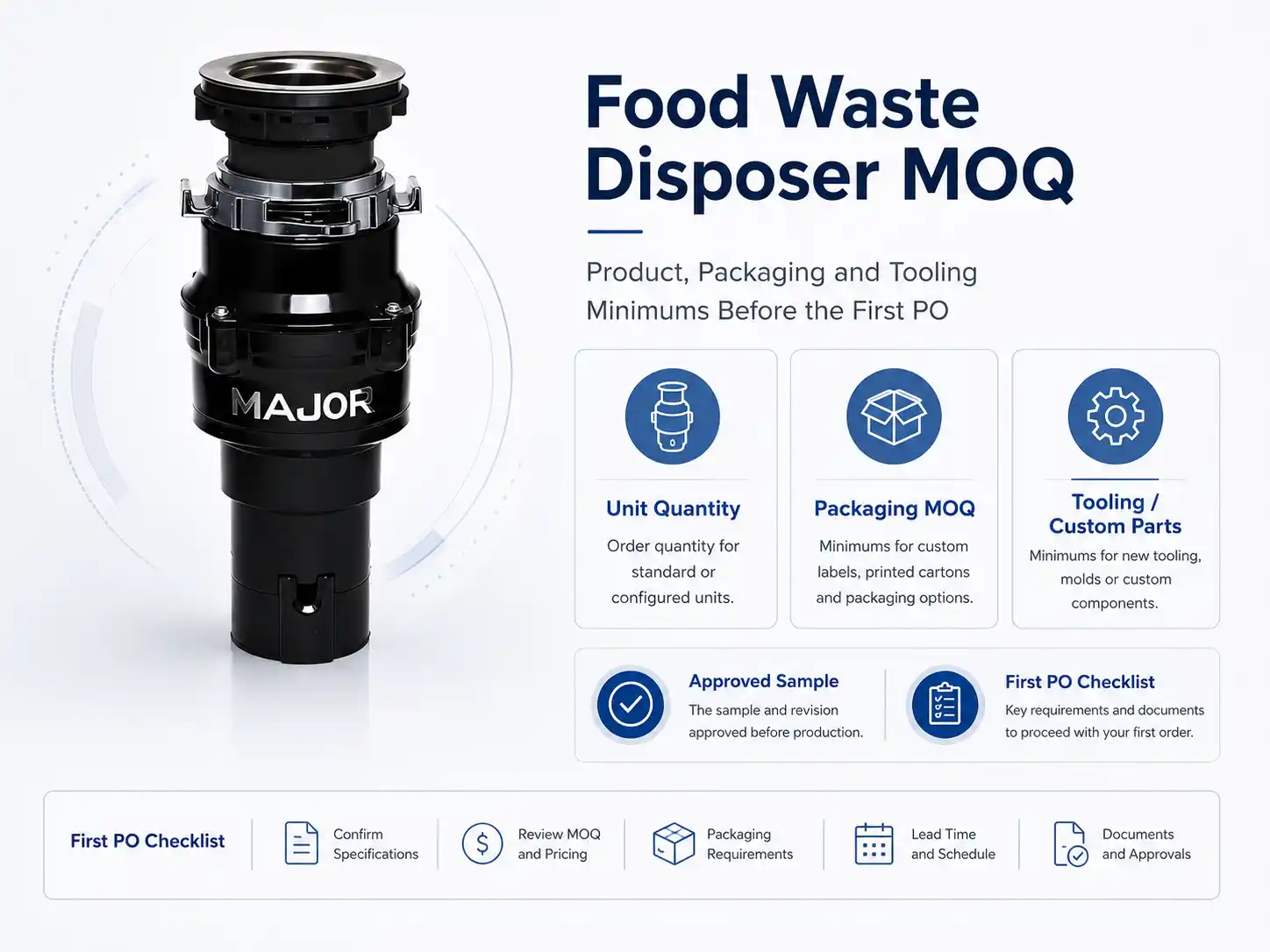
A quote line that reads “MOQ 300–500, samples available, OEM welcome” looks like it settles the minimum-order question. It settles one version of it. A food waste disposer project rarely runs on a single MOQ, a single sample, or a single tooling arrangement. The machine, the printed packaging, the non-standard parts and the mold each sit on a different floor, and they do not move together.
The food waste disposer MOQ on a quote is one number standing in for several. We quote importers, distributors and OEM buyers. Most of what follows is written from the quoting side of the table — the numbers we lock, and the ones buyers assume are locked when they are not.
The standard unit has no floor. The ladder starts at customization
On our line, the food waste disposer MOQ for a standard-configuration unit is not a number we set. Change the motor, the voltage, the mount — still no minimum from us, as long as the order runs on an existing platform.
The floor appears the moment the order stops being standard. Print a logo, and the private-label run starts at 100 units. That is the first rung. It has nothing to do with grinding capacity or motor type. It is the artwork.
Supplier front pages compress all of this into one number. A page shows a single MOQ, a sample lead time of a few working days, and a bulk lead time of a month or so — a spread quoted right across the category. What the single number hides is which rung the buyer is standing on.
A buyer who spends the whole negotiation trying to slip under 500 units is watching the wrong axis. On a standard platform there was no 500 to slip under. On a branded color box the 500 was never the binding number — 300 was, and for a reason that has nothing to do with the machine.
Packaging carries its own minimum, and it usually bites first
Printed retail packaging is a separate print run with its own economics. On our line the color box, the manual and the label sit at 300 units. That number comes from the printing and die-cutting. The disposer inside does not set it.
A buyer orders 100 disposers for a market test, prints a branded box for all 100, and learns the box minimum is 300. Two hundred printed boxes with nothing inside, or a last-minute switch to plain kraft and a launch that looks half-finished on the shelf. Either way it’s the box that caps the first order, not the machine inside it.
This is not a disposer quirk. General packaging suppliers set carton minimums in the low hundreds and up, and packaging planners will say plainly that the box MOQ sets the floor for the whole order. For a branded disposer line the retail box can be the thing that dictates how small a first PO is allowed to be. For a market test, run the first batch in neutral packaging and hold the branded box for the reorder — a packaging split we cover in our B2B sourcing guide. Committing artwork to a quantity the box minimum won’t honor is where the dead stock comes from.
One sample does not approve every layer of the PO
“Did the sample pass?” is the wrong question. A disposer order has more than one kind of sample, and each approves a different slice of the PO. A stock unit shipping cleanly tells you nothing about a color box that has not been printed yet.
| Sample type | What it confirms | What it does not |
|---|---|---|
| Stock sample | Body, running condition and base configuration of an existing SKU | Logo, nameplate, manual and color box that do not exist yet |
| Configured sample | Specified motor, voltage, mount and accessories | Production packaging and final BOM not yet approved |
| Artwork mock-up | Logo, label and carton layout | Real color, print variance, packaging strength |
| Pre-production sample | Final BOM, nameplate, manual, packaging | Consistency across a full batch |
| Batch sample | Product pulled from an actual production run | Automatic carry-over to later runs |
The distinction is not ours alone. Alibaba’s own buyer resources separate factory samples, custom samples, and batch samples drawn from real production — three different things a buyer can hold in hand and mean by the word “sample.”
So the question worth asking before the PO is not whether a sample passed. It is: which sample passed, and which PO fields did it approve? A stock sample can green-light a platform. It cannot approve a private-label unit whose final BOM, nameplate, manual and carton have not been built. Naming the approved sample — and what it covered — is one of the fields the first PO should carry.
Non-standard parts and tooling: the layer you cannot reorder on a whim
A non-standard accessory — a custom flange, a switch variant, a splash guard cut to a size that is not our standard — sits at 500 units on our line. These parts run through a long-term partner factory in production batches. The floor is tied to their run, not only to ours. A buyer can order a small quantity of standard machines and still hit a 500-piece wall on one custom part. The flange-fit case is the clearest example of a custom part carrying its own minimum long after the machines are settled.
Tooling is the layer buyers misread most, because “I paid for the mold” gets treated as the end of the conversation. Payment is one field. Ownership, exclusive use, custody and transfer are four more. Public sourcing and legal references are consistent on this: paying for tooling does not, on its own, settle who owns it or who can move it. A low tooling quote can mean you own cavity inserts running in a base the factory keeps, rather than a complete mold. Terms written into the contract decide the rest. Without them, control sits with whoever holds the steel.
So the fields worth pinning in writing, before a tooling fee is paid, are ownership, exclusive-use scope, who stores the mold, whether it can be transferred, and who maintains it.
Our own arrangement is specific, and worth stating without rounding off the edges. A mold we develop is jointly owned with the buyer who funds it. We produce from that mold only for that buyer — the exclusive-use and platform layers we already separate in our private-label breakdown. We do not sell it on and do not run it for anyone else, and we maintain it for its production life. What this arrangement does not include is a free right to move the mold to another plant: the tooling stays and produces here. So a buyer holds joint ownership and exclusive supply. Moving the mold to another plant is not part of the deal. That is a workable arrangement, but only if it is named as what it is on the PO — buyers who need transfer rights should raise that before the fee is paid, not after.
The tooling quantity itself is a conversation, not a fixed wall. Most of our minimums can be talked through against what the buyer actually needs. The non-standard-part floor flexes least, because it depends on someone else’s batch.
The MOQ is negotiable — the axes just don’t move the same way
Most of the numbers above can be discussed. The standard platform has no floor to start with, so “negotiating the MOQ” there answers a question nobody needed to ask. The logo run at 100 and the packaging run at 300 move under the right conditions: a longer program, a committed reorder, neutral packaging on the first batch. The non-standard part at 500 moves the least.
Trial-friendly minimums and cumulative-volume pricing are ordinary sourcing levers — price breaks tied to a twelve-month total instead of a single order show up across categories. Cutting the unit count on the first PO does not cut the fixed layer under it. Artwork setup, box minimums, non-standard-part floors, certification review — those stay put whether the buyer books 100 machines or 1,000.
A headcount-first negotiation spends its energy on the unit number, which is the part that moves most easily. The fixed layers under it — artwork, box run, non-standard floor, certification — are where the binding minimum actually sits.
One PO across several markets is not one MOQ
A single order shipped to more than one market usually is not a single minimum. A North American version may run on 120V/60Hz. The electrical package alone splits several ways — a factory-fitted cord, a separate cord kit, a hardwired connection, an air switch, wall-switch control. A European-market version may run on 220–240V/50Hz, with a different plug or connection method. Marking and documentation vary by country even inside a shared CE framework — not one uniform plug, language or file set. Whether those changes create a separate certified model scope has to be checked against the exact SKU and destination — the market-side breakdown goes into how destination rules reshape a configuration.
I would have to look at the specific line to say which shared parts survive a market split and which do not. The shell and grind chamber usually carry across. The electrical package and the printed carton usually do not.
What recalculates the working minimum here is the market count. The headcount barely moves it. One PO does not automatically mean one production MOQ once the BOM, the artwork or the covered model designation changes. Two markets on one PO can mean two artwork sets, two nameplate versions and a certification scope that has to be read per SKU.
What the first PO should name
The first PO is where these layers get fixed or left loose. The fields worth naming on it: the approved sample it references and what that sample covered, the drawing and BOM revision, the artwork version, the packaging specification, the certification model scope, the mount and electrical package, and the accessory set with its own minimum.
Lock those and the reorder is a repeat. Leave them loose and the reorder turns back into a negotiation — sometimes with a color box you cannot reprint under 300, or a custom part you cannot reorder under 500. The unit count is rarely the number that decides how the reorder goes.
FAQ
What is the MOQ for a private-label food waste disposer?
On our line, printing a logo starts at 100 units. The machine underneath can stay standard, with no minimum of ours.
Can I order one sample before meeting any MOQ?
Yes. A single stock sample ships on its own. It confirms the platform. It does not approve a private-label unit whose color box, manual and nameplate do not exist yet.
Can the product MOQ and the packaging MOQ be different?
They usually are. Our packaging — color box, manual, label — sits at 300, set by the print run, while the standard machine has no floor of ours. The box is often the number that caps how small a branded first order can be.
Does the standard product have a minimum at all?
No — the ladder starts at customization, not at the machine.
If I pay the tooling fee, do I own the mold?
Payment and ownership are separate fields, and so are exclusive use, custody and transfer. Get all of them in writing before the fee is paid. A mold we develop is jointly owned with the buyer who funds it, produced only for that buyer, never run for anyone else, and maintained for its production life — with production kept here rather than transferred out. A buyer who needs transfer rights should raise that before the fee is paid.
Sources
Public disposer-supplier MOQ figures
These pages are used to show that publicly quoted disposer MOQ figures change by page, model and packaging method. They do not represent Major’s own minimums.
- ZAL OEM/ODM Services — publishes an OEM/ODM MOQ range that shifts by model, alongside separate sample and production lead times.
- ZAL food waste disposer homepage — publishes a different MOQ range on its homepage than on its OEM page. The difference between this page and the OEM/ODM page supports the article’s point that an MOQ number needs a defined model and order layer.
- Babels Garbage Disposal FAQ — states 200 pieces for brown-box packaging and 500 pieces for color-box packaging, and notes that new tooling extends the production lead time.
Custom-packaging setup and minimums
- Packwire FAQ — publishes a 500-unit minimum for rigid and folding boxes and for custom inserts. It is used as a packaging-industry example, not as a disposer-industry rule.
- MakePacks FAQ — explains that tooling and setup affect custom-packaging minimums.
Sample classification and approval scope
- Alibaba Buyer Resources — How to request samples before a wholesale order — separates factory, custom, batch/production and virtual samples, and warns that a sample may differ from mass production. It supports the article’s distinction between sample types and approval scope.
- Alibaba Buyer Resources — Ready to Ship versus customized products — distinguishes stock/as-is products and light customization from products developed or changed through OEM/ODM work. It is used to clarify why a stock sample cannot approve every custom layer of a private-label PO.
Tooling ownership, custody and transfer
The following pages are procurement and supplier-control references, not legal advice. Contract terms and governing law control the actual rights in a specific project.
- China IP Gateway — Who owns the mold or tooling if the buyer paid? — treats ownership, physical possession, exclusive use, storage, return, transfer and final disposition as separate fields that should be written before tooling is made.
- China IP Gateway — How to ask a Chinese factory who owns the mold or tooling — identifies the tooling invoice, PO and manufacturing agreement as the documents that should state ownership, custody, permitted use and transfer terms.
Major internal quoting and production facts
The following statements are based on Wanjiamei Technology Development Co., Ltd. quoting practice, production arrangements and order records: no factory-set MOQ for an unbranded existing-platform configuration; a 100-unit starting point for a private-label logo run; a 300-unit printing run for the color box, manual and label package; a 500-unit minimum for the non-standard accessory examples described in the article; and a tooling arrangement in which a buyer-funded mold is jointly owned, reserved exclusively for that buyer, maintained for its production life and kept in production at Major rather than transferred to another plant.
These are Major-specific commercial terms, not market-wide statistics. The exact quotation still depends on the model, available platform, artwork method, packaging format, component supplier, destination market and written tooling agreement. Sample approval also remains limited to the sample type, BOM, artwork and revision named in the PO.