The button goes in and comes straight back out. Or it holds, the machine runs for a minute, and everything stops again.
Those symptoms tell us the protection path is not staying in a normal running state. The condition that put it there is a separate question, and the button does not answer it.
In March 2026 a Canadian buyer came through our factory and checked several disposer samples. He found the reset button in about four seconds. His real question was whether the machine could come back on its own after protection had stopped the motor.
That is the more useful specification question.
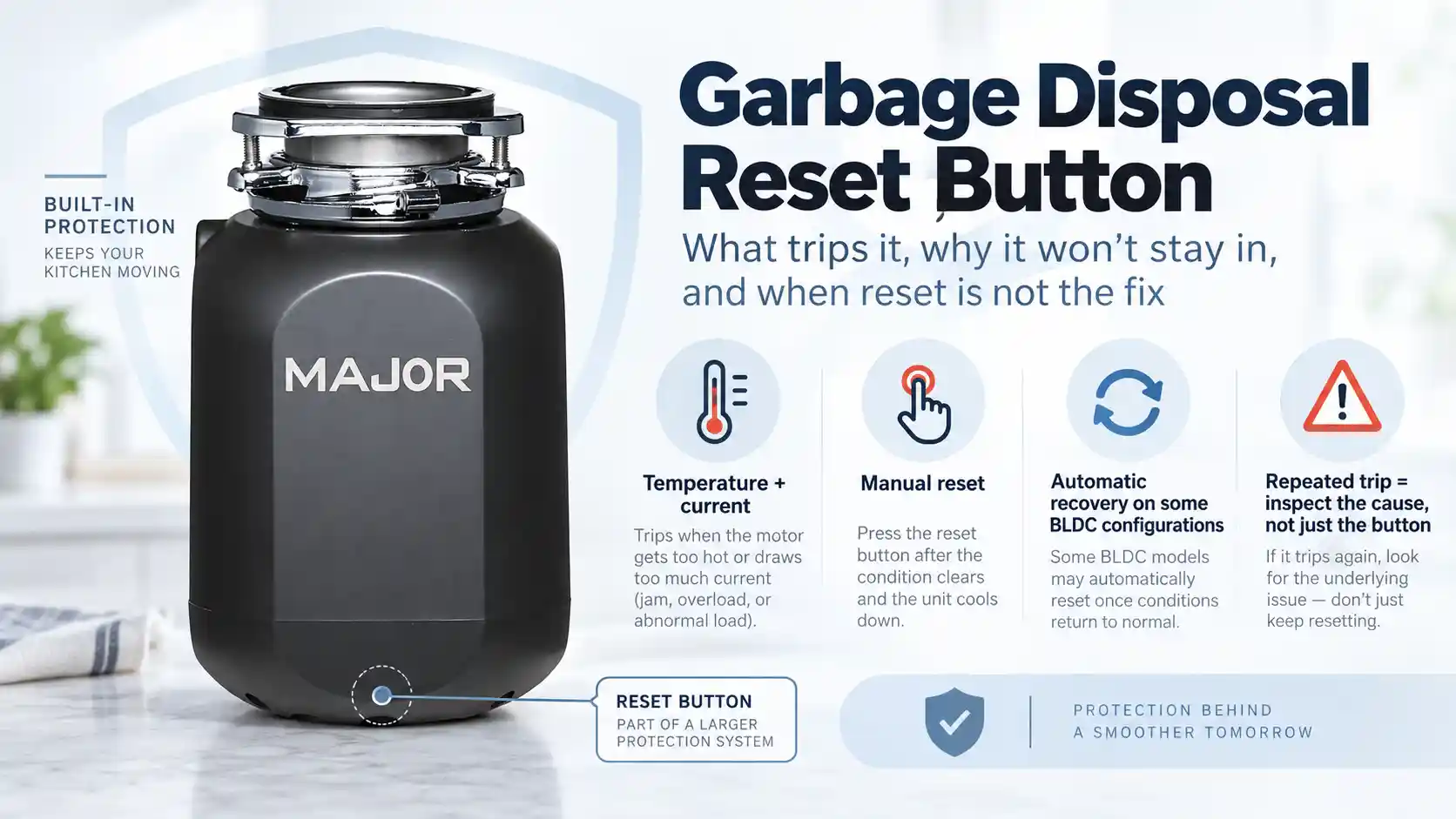
Every Major disposer we currently supply has a manual reset button. Some configurations also carry automatic recovery. On those configurations, the protection system stops the motor when an abnormal condition appears. Once the recovery condition is met, the machine can restart automatically. The manual reset stays on the unit.
What the Button Is Attached To
On our manual-reset designs, the visible button is the mechanical re-arm point for an overload protector. We source that protector externally and control it through a component and application specification.
The protector responds to temperature and current. A jam reaches it indirectly. The locked grinding mechanism changes conditions at the motor, and the protector acts on the heat and current that follow.
UL 60730-2-22 gives a useful public mechanism anchor. Its scope treats a thermal motor protector as an integrated control whose protective function depends on the relevant motor. It describes winding-heat sensing for overload conditions and current sensing for locked-rotor conditions.
The same scope also notes that the motor electromagnetic field can affect arc direction between the contacts. Uneven contact wear can follow and can eventually interfere with operation.
Those public statements describe a motor-protection mechanism. They do not identify the exact protector inside a Major disposer. We use the component specification and application test for the quoted SKU.
What We Test Before It Becomes a Disposer
The first overload check happens before the protection component reaches a finished machine.
We test incoming protection components under overload conditions and confirm that the circuit opens when it should. Load and limit testing on the reset and protection circuit happens at the same stage.
After assembly, we add a second layer. Our long-standing QC practice samples roughly 10% of finished units from the production quantity for a jam or stall check.
- the abnormal load is created;
- protection interrupts operation;
- the condition is removed and the unit cools;
- reset or recovery becomes available;
- the machine returns to normal operation.
A unit that trips has completed only the interruption part of the check. Recovery matters too, because a protection design has to return the machine to normal operation after the abnormal condition is gone.
We record electrical and protection data during development and component testing. I do not have the exact trip-current and temperature values for every protector used across our SKUs. I will not publish numbers from memory.
UL 430 is the U.S. product-standard anchor for motor-operated waste disposers. IEC 60335-2-16:2022 is the international food-waste-disposer safety standard, and Amendment 1 was published in August 2026.
A buyer asking for a certification file should confirm the edition and amendment used for the quoted product. That question affects the technical file, not the location of the red button.
A Jam Sits Upstream of the Trip
A locked grinding mechanism or another abnormal load changes the motor condition. Current rises, heat builds, and the protection system interrupts operation.
Re-arming the protector removes no obstruction. If the chamber is still locked, the motor starts against the same load and can stop again.
Our guide on what should not go into a garbage disposal covers loads that should stay out of the chamber. If the unit hums without turning, the humming-but-not-spinning guide handles that complaint.
A trip is evidence that protection acted. What created the abnormal condition stays open.
What the Button’s Behaviour Narrows Down
We do not read every reset complaint as a dead motor.
| What the unit does | What our engineers check first |
|---|---|
| Button goes in, immediately comes back out | Whether the motor is still extremely hot, and whether an electrical condition such as a motor short is present |
| Grinding mechanism turns freely, reset still will not hold | The protection component and the reset circuit |
| Reset holds, machine starts, trips again | Whether the original abnormal condition remains, and whether the unit completed its cooling and recovery condition |
None of those readings closes the case. A button that will not hold does not identify the failed part. A free grinding chamber also does not clear the protection component of suspicion.
When a button comes straight back out, our engineers first check whether the motor is still extremely hot. They also check for an electrical condition such as a motor short.
We have also serviced units where the disposer itself was usable but the reset and protection component had failed. That changes the repair decision.
If the button holds and the machine trips again after power returns, we treat that differently. The original fault can still be present, or the unit may not have completed its cooling and recovery condition.
Pressing the button a fourth time adds no diagnostic value unless the load or machine state has changed.
Re-arming Cycles the Protection Circuit
Protection contacts are not abstract logic. They are physical electrical components.
UL 60730-2-22 describes how a motor electromagnetic field can affect switching behaviour and contact-arc direction. The scope links that effect to uneven contact-material wear and eventual failure of operation.
Our own component-stage load and limit tests address the same practical concern from the application side. Reset type, contact load and operating-cycle count are specified characteristics, not unlimited values.
A public Sensata thermostat datasheet gives a useful component example. It publishes different electrical and operating-cycle ratings for automatic-reset and manual-reset versions. That component is not identified here as the part used in a Major disposer.
If a chamber is still jammed, pressing reset every thirty seconds puts the machine back against the same abnormal load. We treat repeated resetting as part of the complaint record, not as a repair method.
Automatic Recovery Sits Beside the Manual Reset
This is where the Canadian buyer’s question becomes useful.
On some Major configurations, automatic recovery and the manual reset button live on the same machine. Protection stops operation at an abnormal thermal or electrical condition. Once the recovery condition is met, the machine can restart on its own.
There is no fixed recovery time for every event. Around ten minutes is a familiar interval in our practical checks after an over-temperature stop. Actual recovery still depends on temperature and the shutdown condition.
Automatic recovery is especially convenient on our BLDC configurations, where the control system adjusts power according to load. It is unrelated to auto-reverse, which addresses a different operating problem.
Our auto-reverse disposer guide keeps reversing logic separate from overload recovery.
A catalog line that says only `Reset Button: Yes` describes what the user can touch. It does not describe what happens after an overload event.
When the Protector Is the Failed Part
The reset and protector component in our units can be replaced. We do not supply it as a normal field spare. We also do not advise customers to open the machine and replace it themselves.
That repair belongs at the factory or at an authorized internal-service level.
A discharge gasket or hose is an external service item. A protector sits inside an electrical protection circuit. Replaceable does not mean field-serviceable.
This becomes a cost question when the grinding system is free and the motor checks out while the reset mechanism still behaves abnormally. Replacing the whole machine can turn a component repair into a full-unit warranty claim.
We explain our protection logic, component checks and factory QC. We do not diagnose a field motor, controller or building circuit from the position of a reset button.
If the unit is completely dead rather than repeatedly tripping, use our no-power routing guide. That page covers the outlet, switch, breaker, wiring and motor path.
“Reset Button: Yes” Is Too Small for an OEM Specification
Every Major disposer leaves the factory with a manual reset, so buyers rarely need to request it as an accessory.
For a quoted SKU, the useful fields sit behind the button. They include automatic recovery, overload behaviour, the re-arm method, and whether the internal protection component is field-serviceable.
The technical file should also identify the applicable standard edition for the quoted product.
These are circuit and motor-design decisions. An OEM customer cannot remove the manual reset or swap the protection method while leaving the electrical design unchanged.
A different protection architecture means circuit redesign and a fresh technical review. It can also affect the sample and certification timeline.
The Canadian buyer could see the reset button on our sample in four seconds. What took longer was understanding what the protection system did after an overload.
FAQ
Why does my garbage disposal reset button keep tripping?
The trip means protection interrupted operation. A jam, abnormal motor load, excessive temperature, abnormal current, a control fault or another electrical condition can sit upstream of it. On a Major unit we clear the abnormal condition and let the machine recover before treating a second trip as new evidence.
Why won’t the garbage disposal reset button stay in?
Our first checks are whether the motor is still extremely hot and whether an electrical fault remains. A grinding chamber that turns freely does not rule out a failed protection component. We have serviced units where the disposer was usable and the reset and protection component needed repair.
Does every garbage disposal have a reset button?
Protection architecture varies by product. Every Major disposer currently ships with a manual reset button; some configurations also add automatic recovery.
How long should I wait before trying a reset?
There is no single recovery time for every fault. Around ten minutes is a familiar practical interval for us after an over-temperature stop, but the shutdown condition still matters. A reset will not get a machine past a jam that remains in the chamber.
Can repeatedly pressing reset damage a garbage disposal?
Repeated re-arming while the abnormal condition remains puts the motor and control system back against the same heat, current or locked-load condition. The protection component also has its own electrical and operating-cycle limits. Clear the load or fault first, then confirm that the protection and recovery sequence completes normally. That is why we record repeated trips as a symptom instead of telling a customer to keep pressing the button.
Sources
Public standards and component references
- UL 60730-2-22 — Automatic Electrical Controls, Part 2-22: Particular Requirements for Thermal Motor Protectors — The public scope treats a thermal motor protector as an integrated control whose function depends on installation with the relevant motor. It also describes winding-heat sensing, locked-rotor current sensing, and the effect of the motor electromagnetic field on contact arc direction and wear.
- UL 430 — Waste Disposers — UL Standard 430, Edition 8, covers motor-operated household and commercial waste disposers rated 600 V or less, together with specified field-installed control assemblies and accessories.
- IEC 60335-2-16:2022 — Particular Requirements for Food Waste Disposers — IEC lists this as Edition 6.0, published October 12, 2022, covering the safety of electric food waste disposers for household and similar purposes.
- IEC 60335-2-16:2022/AMD1:2026 — Amendment 1 — IEC lists Amendment 1 to IEC 60335-2-16:2022 as published August 3, 2026.
- Sensata Technologies — 20490–20493 Series Fixed Temperature Thermostats — A public component example showing separate automatic-reset and manual-reset configurations, electrical load ratings, and published operating-cycle ratings. It is not identified here as the protector used in a Major disposer.
Major internal production and after-sales records
The March 2026 Canadian factory visit, manual reset on current Major disposers, configuration-specific automatic recovery, pre-assembly overload testing, component load and limit testing, roughly 10% finished-unit jam sampling, the practical recovery interval, and the service cases described above are Major internal production and after-sales records.
Major uses externally sourced protection components. Exact trip-current and temperature values remain tied to the component and application specification for the relevant SKU and are not generalized across the product line.