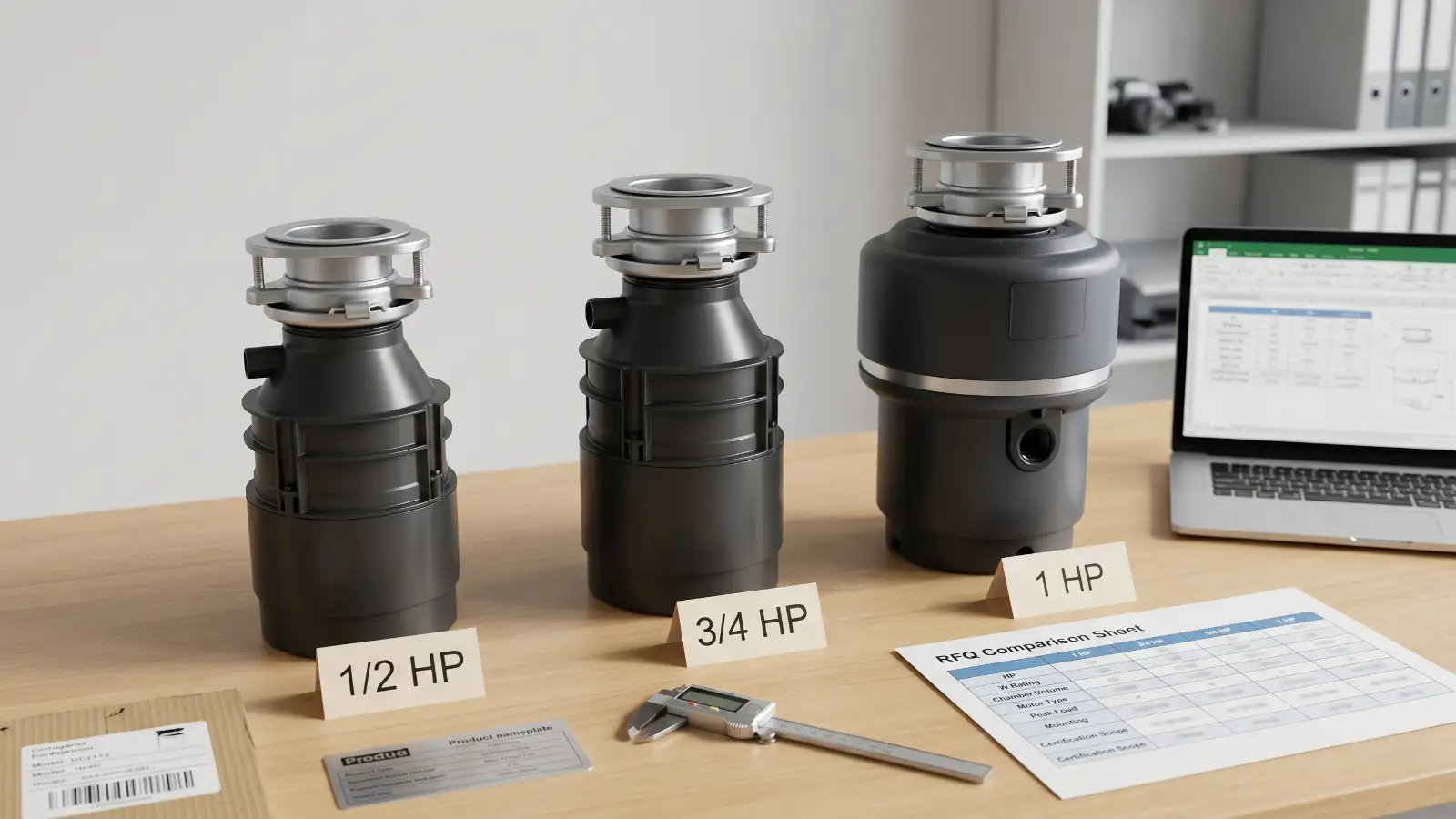
An RFQ that lists 1/2 HP, 3/4 HP, and 1 HP disposers in three line items reads like a clean SKU tree. The disposers behind those numbers rarely line up that cleanly. HP is a price tier. What the unit actually does under load comes from grind chamber volume, motor architecture, and controller spec, none of which is locked by the HP label.
Our line covers 1/2 HP through 1 HP across 20 household models, with most SKUs offered in more than one HP variant. We do not build 1.25 HP or above. We sell OEM and ODM to importers and distributors, not retail, and we do not run kitchen installations.
What HP Actually Sets
The W ratings match the standard HP conversion. 370W for 1/2 HP. 560W for 3/4 HP. 750W for 1 HP. These are the continuous output ratings stamped on the nameplate, and they track 0.5 / 0.75 / 1.0 HP at 746 W/HP within rounding.
Chamber volumes do not line up with HP. Our 1/2 HP variants ship in 800, 900, 1000, and 1100 ml. Our 3/4 HP variants in 800, 900, 1000, and 1200 ml. Our 1 HP variants in 900, 1200, and 1500 ml. A 1100 ml 1/2 HP disposer holds more food waste than a 900 ml 1 HP disposer. All chamber and grinding components in our line are SS304, regardless of HP tier.
Motor architecture does not line up either. We build 3/4 HP units as fixed 560W PMDC, fixed 560W AC induction, and BLDC variable-frequency. The BLDC 3/4 HP controllers operate from 30W idle to 1800W peak. A fixed 1 HP unit runs at 750W continuous, with no peak above that. The three architectures behave differently under load, and we covered the differences in detail in our DC vs AC motor article.
Where 1/2 HP Belongs
At the RFQ stage, the mistake we see most often is an importer bracketing a 1/2 HP unit into a package that competes with mid-tier disposers on the food-waste promise. The 370W motor cannot back the claim. Jam reports, warranty exchanges, and channel returns follow.
1/2 HP fits compact installs, light household use, and price-sensitive channels. Our 1/2 HP range (d100, d200, d300, d400, d600, d700, z200) comes in 800, 900, 1000, and 1100 ml chamber sizes, giving an importer seven SKUs and four chamber positions inside the entry tier.
Bones, fruit pits, fibrous skins, and corn husks fall outside what 370W can handle without strain.
3/4 HP as the Default Position for Mainline Programs
Most of our 20 models include a 3/4 HP option.
3/4 HP at 560W continuous covers the everyday household range without imposing the cost, weight, or housing footprint of 1 HP. It absorbs occasional heavier loads (fibrous waste in small amounts, the occasional fruit pit) without the controller dropping out. For an importer running a single mainline household SKU, 3/4 HP is the safer anchor than either of the two flanking tiers.
Our variable-frequency BLDC line at 3/4 HP rewrites the 1 HP comparison. The m200, m300, and m400 SKUs are 3/4 HP rated for continuous output, but the controllers push to 1800W peak under load. A fixed 1 HP disposer at 750W continuous has no peak above the 750W ceiling. Under burst load, the BLDC 3/4 HP draws more power than a fixed 1 HP can sustain. For an importer who can carry the BLDC controller cost, the “do I need 1 HP” question often points back to 3/4 HP BLDC.
Chamber sizes at 3/4 HP run 800, 900, 1000, and 1200 ml across the line. The X series and Z100 ship with 1200 ml chambers, which sits in the same range as our 1 HP X3 and Z100s. Pairing 3/4 HP with a 1200 ml chamber is a product position for importers wanting capacity language without 1 HP pricing.
Three-bolt and EZ-mount variants both run through the 3/4 HP range. The choice between them depends on what the destination market’s installed base already uses.
When 1 HP Pays Off
Our 1 HP units run at 750W continuous. The BLDC variants (m500, m500s) push to 1580W peak. The fixed-speed variants (d500, x3, x4, z100s) do not exceed the 750W ceiling.
1 HP fits premium channel positioning, heavier or more frequent food waste loads, and use cases where the larger chamber on the X4 (1500 ml) is what the program needs.
An importer comparing a fixed 1 HP unit against a BLDC 3/4 HP unit purely on continuous wattage is reading half the spec. Peak handling is part of what the controller delivers, and the 3/4 HP BLDC carries more peak headroom than the 1 HP BLDC.
For channels where the buying logic is “I want the biggest one,” the X4 at 1 HP and 1500 ml is the right offer. For channels where the buying logic is “I want the unit that handles real-world bursts,” the 3/4 HP variable-frequency wins.
Why 1 HP Can Still Be the Wrong SKU
1 HP is not the default. The “higher HP is better” framing that fills most consumer guides breaks down at the channel and use-case level.
Price-sensitive channels do not recover the 1 HP cost premium in resale margin. The wattage difference does not earn the price gap when the household load profile is light to moderate. Apartment programs and compact-cabinet installs run into install friction. A 1500 ml chamber needs deeper cabinet clearance than most retrofit positions allow, and the additional housing weight shifts the mounting load.
For multi-unit residential and hotel project channels, noise sensitivity tilts against fixed 1 HP units. Higher continuous draw and higher running RPM raise the noise floor inside the unit. The channel-noise calculation is the same one we walked through in the DC vs AC article.
The “higher HP = grinds anything” misunderstanding is the biggest downstream cost. An importer that uses 1 HP language to expand the food-waste promise opens a channel for warranty exchanges and complaint volume that the test scope and product manual do not authorize.
Frequently Asked Questions About Garbage Disposal Horsepower
Can a 1 HP garbage disposal grind bones?
The product manual sets the food-waste boundary, not the HP rating and not the safety listing. UL 430 covers construction and electrical safety for household food waste disposers; it does not authorize claims about what foods the unit can grind. Read the manufacturer’s manual for the specific SKU before printing food-waste claims on the box.
Does higher HP mean fewer jams?
Jam rate is driven by impeller design, chamber size, lug geometry, and what the user puts into the disposer. Higher HP gives more torque to push through partial jams, but it does not prevent a jam from forming. A 1 HP disposer fed corn husks and chicken bones still jams. Auto-reverse on the BLDC line addresses formed jams by reversing rotation until the obstruction clears.
Need Help Choosing the Right Garbage Disposal HP Tier?
Send your target SKU list or RFQ. We can help compare 1/2 HP, 3/4 HP, and 1 HP configurations against chamber size, motor architecture, mounting, and channel positioning.
Sources and references
Primary