
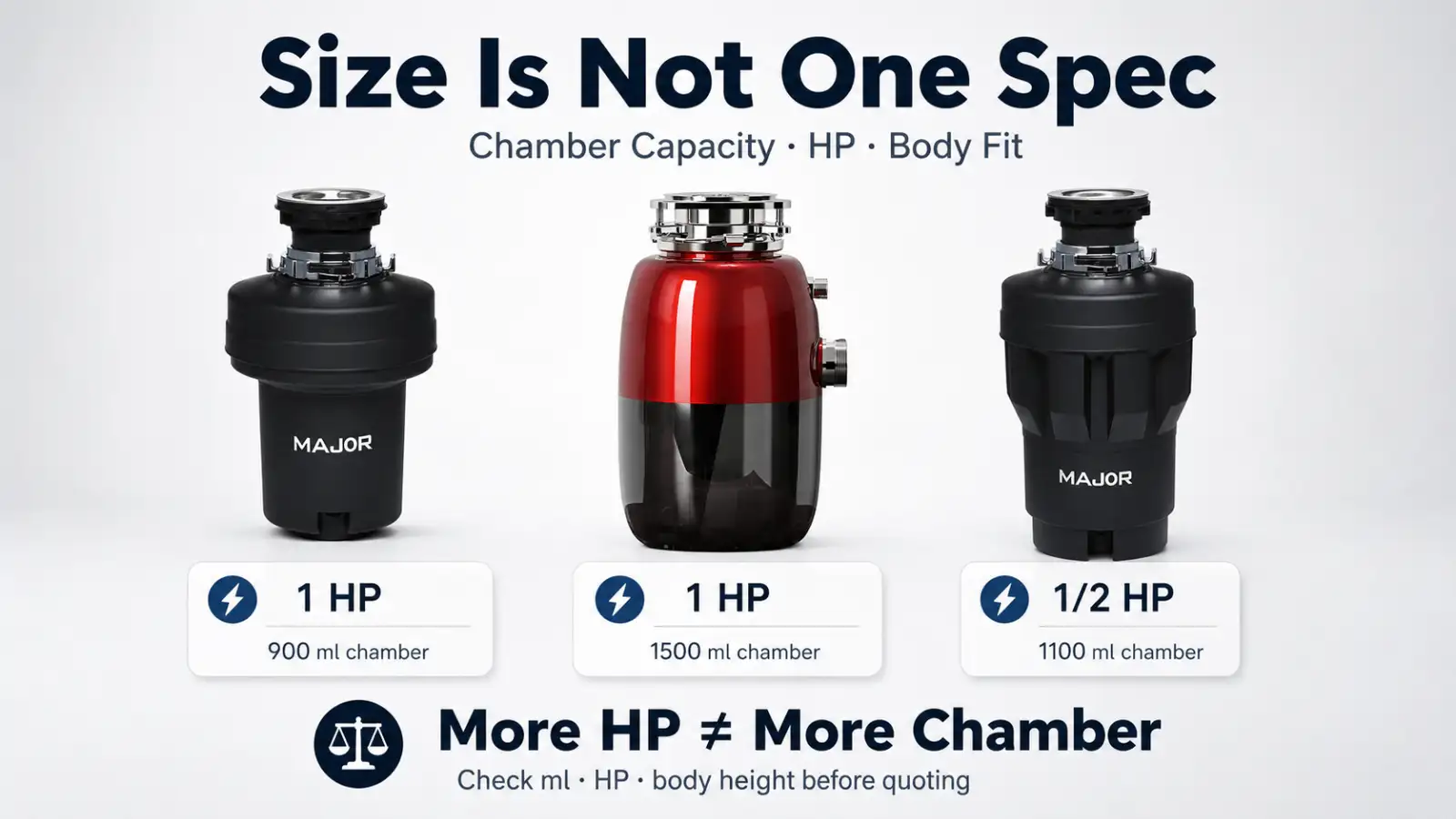
On our own line a 1/2 HP unit holds 1100 ml while a 1 HP unit holds 900 ml, so the size of a garbage disposal and its horsepower are not the same spec — a bigger motor number does not buy a bigger chamber. Search “what size garbage disposal do I need” and the answer comes back as a horsepower ladder tied to household headcount. That answer skips the spec a buyer actually feels at the sink: how much waste the chamber holds in one load, measured in ml or oz.
Here is the size chart for a single supplier line, which is enough to show the two specs move independently:
| Model | HP | Chamber capacity |
|---|---|---|
| D700 | 1/2 HP | 1100 ml |
| Z200 | 1/2 – 3/4 HP | 1000 ml |
| M100 | 3/4 HP | 800 ml |
| Z100 | 3/4 HP | 1200 ml |
| M500 | 1 HP | 900 ml |
| X4 | 1 HP | 1500 ml |
That 1/2 HP model holds 1100 ml; a 1 HP model holds 900 ml; two 3/4 HP models sit 400 ml apart. If horsepower set the chamber, none of those would line up.
Three different fields are hiding inside the word “size,” and a quote has to keep them apart: chamber capacity (ml) is the volume the unit holds in one load; HP is the motor power — broadly, how fast it grinds a load through; body height is whether the unit fits under the sink at all. None of the three predicts the other two.
Household headcount is only the entry question
“Family of four” is where a buyer starts. The spec lands a few questions later. A family cooking rice, peel-heavy vegetables and fibrous greens puts a different one-time load into the chamber than a family rinsing soft plate scraps after takeout. Same headcount, different chamber demand.
The B2C guides collapse that into a number — four people, get 3/4 HP — because they are selling one unit to one kitchen. A buyer building a line for a market can’t price off a headcount. The usable conversion is: who uses it, how the cooking loads the chamber, then what volume and what throughput that pattern needs. Headcount feeds into the use pattern; it doesn’t jump straight to a motor rating.
Whether a particular kitchen needs the extra volume at all, I can’t read off the family size — that judgment belongs to the buyer who knows the cooking pattern in the target market.
What chamber capacity (ml) actually tells the buyer
Chamber capacity is the one-load volume: how much waste the grinding chamber accepts before it is packed tight enough to slow the grind. It says nothing about motor strength. A large chamber on a modest motor holds more per load; a small chamber on a strong motor clears each load fast but takes less at a time.
We work in ml, because it is the unit a spec sheet can carry across markets without rounding drift. When a buyer sends a target in oz, we convert it and quote back in ml so the carton, the catalog and the PI all read the same number. A request for “about 34 oz” becomes 1000 ml on our side, and that is the figure that travels through the order.
This is the field the retail filters already track — Home Depot lists disposals by Grind Chamber Capacity in oz — and the field no household size guide turns into a selection step. It sits in the product spec and never reaches the buyer’s decision.
Why HP and capacity have to be read as separate lines
HP is the power rating: it indicates how much sustained grinding the motor keeps up when fibrous or dense waste loads the chamber, and how fast it clears a load. Capacity decides how much sits in there waiting. A buyer who orders by horsepower alone has set the power and left the one-load volume to chance — which is how a strong unit can still feel small at the sink when its chamber is tight.
The horsepower question has its own answer, and we keep it in the HP selection guide rather than re-deriving it here. The mistake the household ladders build in is reading HP and chamber ml off the same line of a size chart, as if one stands in for the other.
Capacity, body size and the small-kitchen trade-off
Volume comes at a cost the cabinet pays. A larger chamber means a taller, wider body, and under-sink clearance is fixed once the kitchen is built. So capacity is not a free “more is better” dial — past a point it stops fitting.
That is why our compact M-series (M100 through M500s) draws steady demand from buyers selling into apartment and small-kitchen markets: an M500 puts a 1 HP motor in a small body and accepts that the chamber stays at 900 ml. The buyer trades one-load volume for a unit that clears the cabinet. The same physics runs the other way — added sound insulation also grows the body, which is why a quiet build and a high-capacity build both push against the same under-sink space.
Capacity does sometimes lead the spec. One buyer’s brief set the floor in plain terms: every model they listed had to clear 1000 ml, and the horsepower could follow from there rather than drive it. On our line that points at the D700 or the X and Z bodies — chosen for volume, with HP read afterward. We don’t decide that priority for the buyer; we map their floor to the SKUs that meet it.
What to lock before quoting a household line
We sell to importers, distributors and OEM buyers. We hold capacity in ml, convert oz on request, and quote a model against a stated use pattern. We do not measure the buyer’s local cabinets or set the household profile for a market we don’t sell into. With that boundary clear, these fields settle before a household line gets a price:
- Target use pattern, not headcount. Cooking-heavy with fibrous waste, or light plate-scrap rinsing — this drives the next two lines.
- Chamber capacity floor, in ml. The one-load volume the market expects, quoted in ml with the oz equivalent noted, not left to whatever the model happens to have.
- HP as grinding power, read separately. The motor power the waste type needs, decided on its own line, never inferred from the chamber number.
- Body height and under-sink clearance. The spec that kills an install regardless of HP or volume; the mount system and body fit belong here.
- Drain outlet and mount. So the chosen body actually connects to the plumbing in the destination kitchen.
The B2B sourcing guide runs the same discipline across the whole disposer spec. The narrower job here is to stop a size chart from quietly fusing volume, power and fit into one number.
Related sizing checks: HP, mount fit and quiet builds
The horsepower question lives in its own guide, where HP is handled as motor power and grind speed rather than as a proxy for size; this article only borrows it as one of three separate fields. The body-size point ties straight into the quiet build article, because sound insulation and chamber volume both buy a bigger body and both run into the same under-sink limit. And the mount and clearance line connects to the 3-bolt versus EZ mount breakdown, where physical fit is the field that overrides every other spec. Read together, they make one point: a disposer’s “size” is three separate specs wearing a single word.
FAQ
What size garbage disposal do I need?
Read three separate fields, not one: chamber capacity in ml (how much it holds per load), HP (the motor power, roughly how fast it grinds), and body height (whether it fits under the sink). Household headcount only points you toward a use pattern; it doesn’t name a spec by itself.
Is chamber capacity the same as horsepower?
No — capacity is volume held, HP is grind power.
How many ml is a 34 oz garbage disposal?
About 1000 ml. US listings tend to print ounces and international spec sheets print millilitres, so converting once and quoting in ml keeps the carton, the catalog and the PI on one number.
Does grind chamber capacity matter when choosing a garbage disposal?
It sets how much waste goes in per load before the grind slows. For a kitchen that fills the sink in one go, it can decide more than an extra step of horsepower does.
What’s the smallest garbage disposal for a tight cabinet?
A compact body trades chamber volume for fit. Our M-series keeps the body small and the chamber around 800–900 ml even at higher HP, which is what a shallow cabinet or a deep apartment sink tends to need.
Is 1/2 HP enough for daily cooking?
For soft and moderate daily scraps the power handles it; the part that gets skipped is whether the chamber volume on that 1/2 HP model matches how much the kitchen puts in at once.
Is 3/4 HP enough for a family of four?
On power, yes for everyday scraps. The open question is chamber volume — check the ml against how that kitchen actually loads the sink.
Should I choose 1 HP or 3/4 HP?
That’s a power decision, and it sits in the HP guide. It won’t settle chamber volume or body fit, which are separate fields a 1-versus-3/4 comparison leaves open.
Does a larger garbage disposal fit all sinks?
No. Body height varies enough between models that it has to be read off the model sheet before ordering; a high-capacity or heavily insulated unit can be too tall for a shallow cabinet or a deep sink.
Is a bigger garbage disposal always better?
No. A larger chamber means a larger body, and under-sink clearance is fixed — past the point where the unit fits the cabinet, extra volume just blocks the install.
Sources
- The Home Depot — Garbage Disposals filtered by Grind Chamber Capacity (oz.) Referenced for public retail filtering that shows capacity (such as 27, 30 and 34 oz) as a tracked spec field.
- Consumer Reports — Garbage Disposal Buying Guide Referenced for checking under-sink space before buying and the way unit dimensions vary from model to model.
- The Spruce — How to Choose the Best Garbage Disposal Referenced for public buying-guide discussion of grind power, size, under-sink space and the way larger / higher-power units can require more room.
- Angi — What Size Garbage Disposal Do I Need? Referenced as a representative household-headcount-to-HP framing for consumer buying guidance.
Major-specific capacity figures, the ml/oz handling, model designations and SKU-selection judgments in this article are based on Wanjiamei Technology Development Co., Ltd. product information rather than the external public sources listed above.