His faucets were already EU-certified, so he felt that side was covered. I told him some markets are stricter about what the ground output is allowed to put into the sewer. The country matters before we price.
Which country accepts ground food waste in its sewer is its own question. I’ve written that one up separately — see Waste Disposal Unit by Market. Here I’m staying on the part before it: what happens to the food after the grind, and why fine enough to leave the sink doesn’t tell you what the sewer does with it.
I sell food waste disposers for a B2B supplier, the Major Product Team, to importers and distributors. I configure and certify units; I don’t install them and I don’t read anyone’s local sewer code.
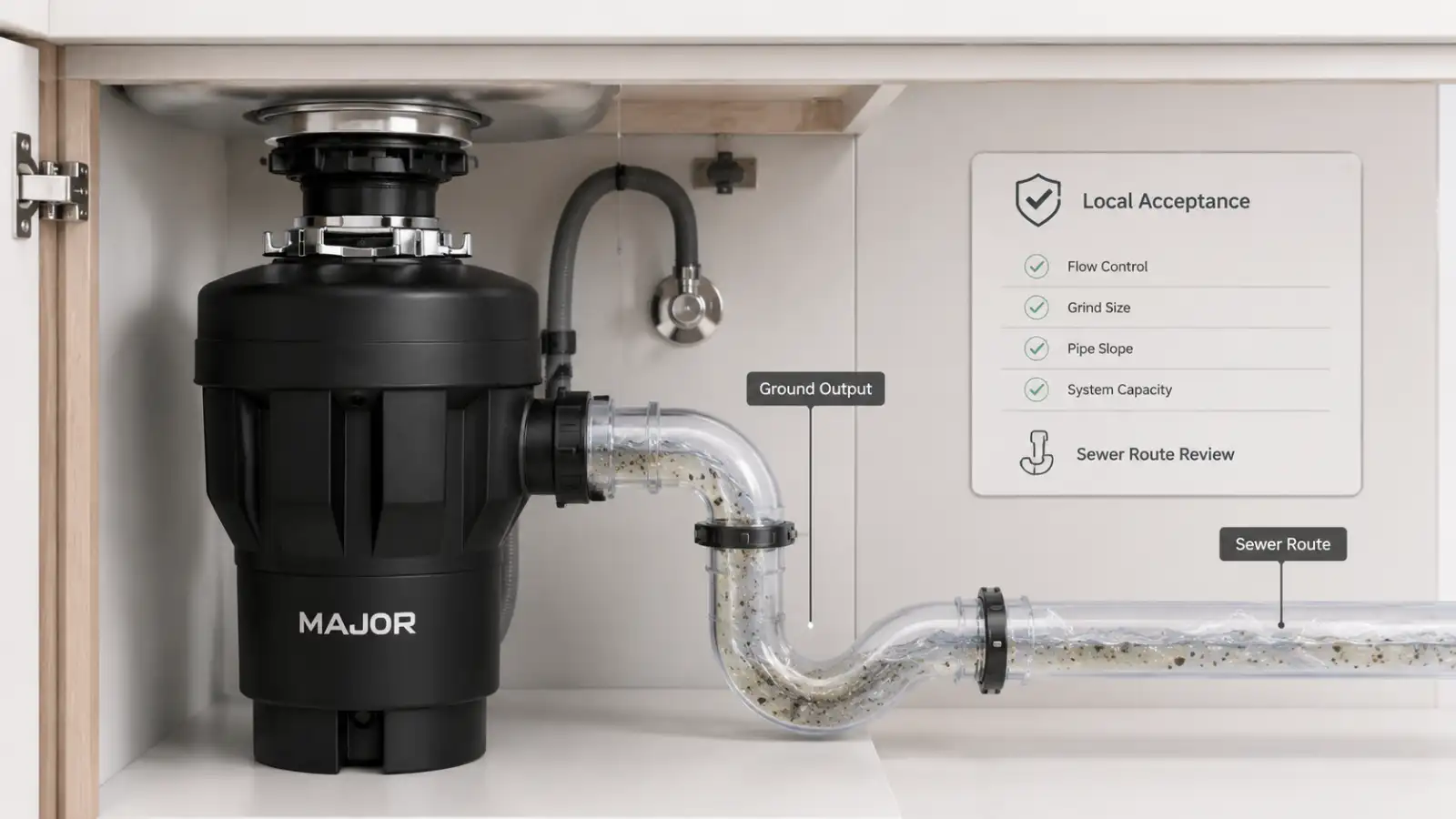
Here’s the path once you switch the unit on:
- Food drops into the chamber and a spinning plate forces it against a stationary grind ring.
- The ring shears it to 1.5–3 mm and water carries the particles out as a slurry.
- The slurry leaves through the P-trap into the building’s drain stack.
- From there it enters the public sewer — pipes, slopes, pump stations.
- Along that route it’s either carried away or it isn’t.
The appliance owns steps 1 and 2. Everything after is plumbing and the sewer, and that’s where “it works” stops being a product question.
What the grind does
No blades. A plate with lugs spins and centrifugal force pushes food against the grind ring. The food shears down until the pieces drop through and flush out. On our line that output sits at 1.5–3 mm.
Water does half the work. Without flow the particles don’t travel — they sit in the trap as a wet pile. We tell buyers the same unglamorous routine. Open the tap, run the unit, then let the water run ten seconds after it sounds clear. A medium household flow is enough. Nobody needs to crank the faucet wide open.
Use cold water. It keeps fats firm so they ride out with the slurry rather than coating the pipe as they cool.
Harder scraps like bone and shell shear slower and lean harder on the motor. That’s a motor decision, and it’s ours to make.
How far the particles travel
Buyers assume that fine enough to leave the sink means gone. It doesn’t.
The science splits here, and the split is the whole point. Lab studies measured how fast the particles settle, including work on indoor pipes in high-rise buildings. Under normal flow, with slopes and bends built to standard, the particles stay moving and rarely pile into a blockage. Eggshell is the one holdout; it’s denser and can leave short-lived deposits.
Wastewater operators report the opposite, because they’re describing different pipe. The same 1.5–3 mm slurry settles wherever the route works against it: low slope, weak flow, older rougher pipe, combined sewers too wide to self-scour, pump stations where paste sticks. Add fats and grease and the deposit hardens into the kind that needs a crew.
My read is plain: the route decides. Fine output is a precondition and nothing more. Whether a given sewer carries that slurry comes down to slope, flow, pipe age, sewer type, and what the plant downstream can take — none of which is printed on the unit.
Telling the unit from the line
This matters in returns, not just theory. When a unit runs but the sink won’t drain, the reflex is to blame the disposer. The drain line is the first thing to check — slope, a trap, a tee, the dishwasher path — none of which the disposer controls. I’ve put the field routing for that in Garbage Disposal Not Draining.
What I can speak to is the unit. The grind chamber, the impeller plate, the outlet, the flush — that’s our side. The trap, the slope, the wall line, and the sewer beyond it are not something we see or design from a factory. I don’t pretend to read a local sewer’s condition from a spec sheet, and I won’t quote one from memory. I’d check it for the specific destination first.
Where the unit’s job ends is also where most field complaints get misrouted. The full sort of which complaints belong to the unit and which don’t is handled separately.
FAQ
How does a waste disposal unit work after food is ground?
The 1.5–3 mm particles leave the chamber as a water-borne slurry, pass the P-trap into the drain stack, and enter the public sewer. Whether they’re carried cleanly from there depends on the pipe and flow, not the unit.
Does a garbage disposal send food particles into the sewer?
Yes — that’s the whole design.
Does finer grinding stop a disposal from clogging the sewer?
Not on its own. Fine particles move well in a well-sloped, well-flowing line and settle in a flat, slow, or aging one. Fineness helps; the route decides the rest.
Is a garburator the same as a waste disposal unit?
Same machine, different name — garburator in Canada, waste disposal unit in the UK. More on the naming in Why One Product Has Five Names.
Will any waste disposal unit be accepted by my local sewer?
Not automatically. Acceptance is set by the local wastewater authority, and some places allow ground food waste, some condition it, some don’t. On a septic system it’s a separate check again. Which markets sit where is covered in the waste-disposal-unit-by-market guide linked above.
Sending an RFQ for a new market? Include the destination country and we’ll configure from there — talk to us.
Sources
- KWR — The Impact of Food Waste Disposers on the Indoor Sewer System Referenced for indoor-sewer transport, particle movement under test conditions, and FOG / large-particle clogging concerns.
- Legge et al. — The characteristics and in-sewer transport potential of solids derived from domestic food waste disposers Referenced for particle-settling and transportability research on solids from domestic food waste disposers.
- CWWA — Residential Food Waste Grinders Issues Analysis Paper Referenced for the difference between product use and municipal sewer-use limits, including jurisdiction-level handling of food waste grinders.
- U.S. EPA — Frequent Questions on Septic Systems Referenced for septic-system caution where garbage disposals add solid material to a septic tank and can affect pumping frequency and drainfield risk.
- Los Angeles Municipal Code Sec. 64.30 — Industrial Wastewater Disposal Referenced as an example of a local sewer-use rule that can prohibit or condition grinder waste discharge to the public treatment works.
The 1.5–3 mm ground-output statement, the October 2025 Canton Fair buyer context, and the boundary between Major configuration work and local sewer-rule review are based on Wanjiamei Technology Development Co., Ltd. product information and sales records. Public references above support the sewer-route, septic, indoor-pipe and code-acceptance context.