In May 2022, a Korean buyer of ours sent over a complaint. Two disposers from a recent shipment were leaking in the homeowners’ kitchens. We picked up the phone the same day, told the buyer we would cover the failure end-to-end — replacement units shipped at our cost, the rework absorbed on our side, and asked for one thing back: photos and video of where the water was coming out, on the units installed in those homes. The buyer turned the footage around quickly.
We watched the video several times. We could not see the leak source. The buyer offered to bring the failed units back when he came to the factory in June. We took the two units apart on the test bench. Both had the same finding. During installation, the rubber gasket had been nicked. The cuts were not large, and the gasket is black, so the nick did not show against the gasket body when looked at with a flashlight from underneath the sink. Water was coming through the gasket cut, not through the unit housing.
A “the unit is defective, ship two more” call on the first email would have sent the next two units to a buyer who would have installed them, possibly with the same nicked-gasket result. The two units we eventually replaced under warranty would not have stopped the actual problem. The garbage disposal repair or replacement decision needed evidence the first email did not contain.
A “the unit is leaking” message is not a replacement signal
The pattern from that 2022 complaint is the pattern across the leak claims that come into our team. The complaint message is short. The actual cause is not in the message.
A leaking disposer can come from at least four different places. The four are handled by different fixes, and the cost difference between the lightest fix and a full unit swap is the cost of the disposer itself. A reply that says “we’ll ship a new unit” before establishing which source is involved is making the heaviest call on every complaint.
For an importer reviewing a homeowner complaint coming up through a distributor, the first question back is what the leak source looks like in the photo.
Discharge, mounting, dishwasher inlet, or housing — the leak source decides the fix
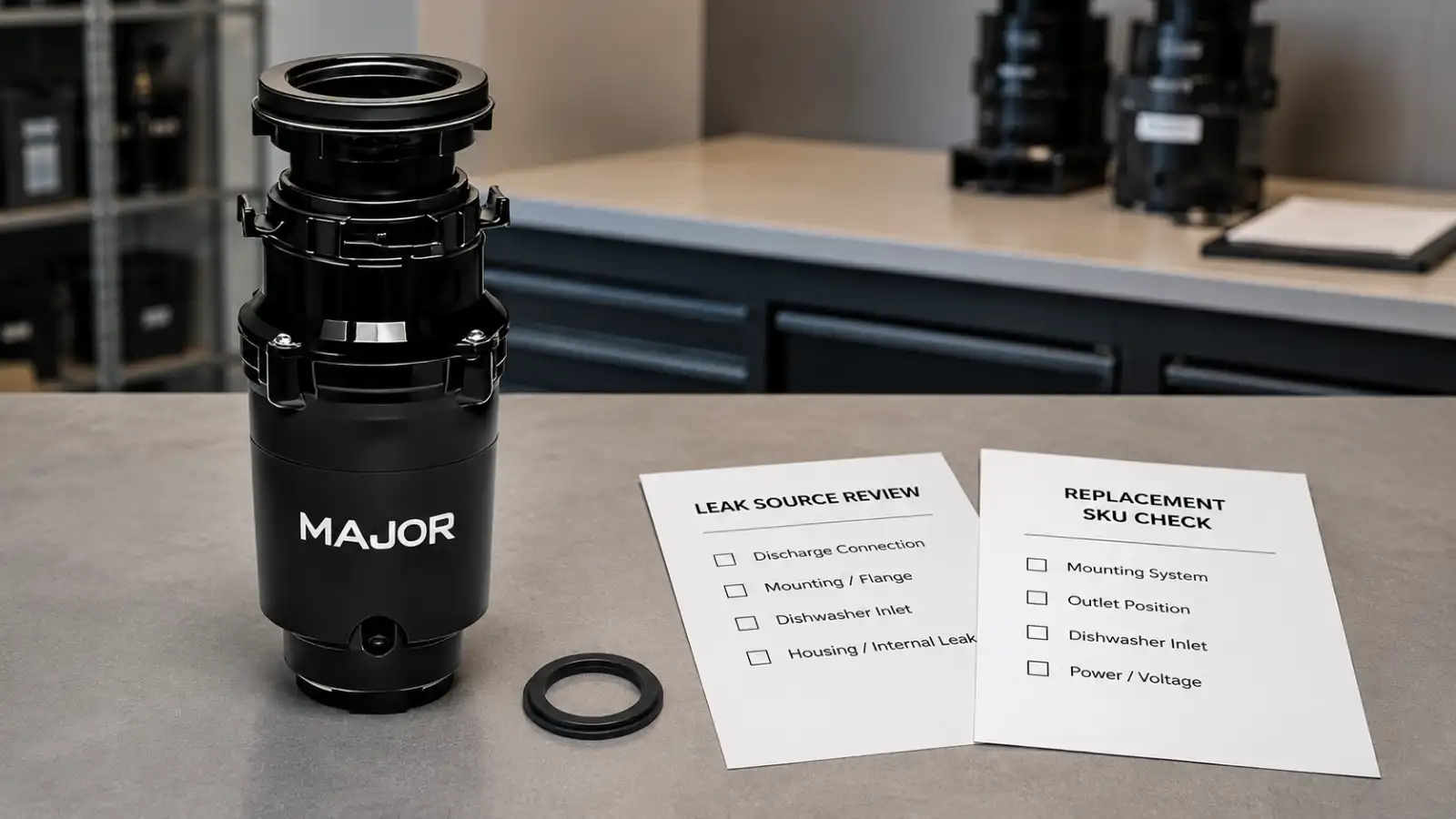
Connection leak at the drain side. The disposer joins the drain line through a discharge tube or elbow secured by a gasket. Water visible at the joint between the disposer body and the drain line, dry above and below the joint, points to the discharge gasket or to a connection that has worked loose under vibration. A new gasket or a re-tightened connection handles it. The wrenchette ships in the box with the unit, alongside the standard set of consumable spare parts.
Mounting / flange leak at the top. The disposer hangs from the sink by a mounting assembly. A flange seats against the sink drain hole and is held by plumber’s putty, with a gasket between the flange and the unit body. Water visible at the top of the disposer, inside the cabinet near where the sink drain meets the unit — that is the flange seal, a loose mounting screw, or the gasket between the flange and the unit. The fix is at the flange or at the mount.
Dishwasher inlet leak. On units shipped with a dishwasher connection, the inlet nipple has a knockout plug inside. The plug is removed at install if a dishwasher will be connected, and left in if not. An incorrectly removed knockout, or a hose clamp that was not seated properly, leaks at the inlet.
Housing leak. Water emerging from the bottom of the disposer, from the seam between the upper and lower housing, or from a point on the housing that is not a documented connection — this is at the unit itself. The seal between the motor section and the grind chamber has failed, the housing has cracked, or the lower bearing seal has let go. The unit goes to replacement.
On our line, the parts that handle the first three categories ship as separately orderable items. Discharge gasket, mounting kit (3-bolt or EZ), flange, splash guard, sink baffle, dishwasher inlet kit, wrenchette, power cord — the full spare-part list is in the SKU sheet. Beyond the standard order, we ship an additional one percent of spare parts as backup with every bulk shipment. A buyer ordering one hundred units receives a full set of consumable spare parts on top of the order, so a single gasket failure in the field does not require a new RFQ. The fitment side of mounting choices is in 3-Bolt vs EZ Mount Garbage Disposals, where the question is which mounting kit ships with the SKU and which spare mounting parts the distributor can install in the field.
The line between a serviceable connection failure and a confirmed housing failure is not always clean. A unit that leaks intermittently from a location that disappears under a flashlight check, or a leak that the buyer’s photo cannot quite frame, goes on a second review pass. The 2022 case is an example: even with video, the cut on the black gasket did not show until the unit was on the test bench.
A jam complaint is not a replacement event until basic checks fail
A separate class of complaint that gets pushed into the replacement queue is “the unit hums but won’t spin,” or “the unit won’t turn on at all.” These complaints are recoverable when the diagnostic chain has been walked — the hex-key turn from below, the reset button, the impeller check from above, the verification that the SKU’s reset position was actually found. Approving a replacement on this pattern before the diagnostic chain has been walked is the same category of error as approving on an undefined leak. The full review of the layers behind this pattern is in Garbage Disposal Humming But Not Spinning, and the importer-side checks it implies.
When replacement is justified, the old unit still defines the new SKU
Confirming the unit body has failed is the start of the replacement conversation. The new SKU has to fit the existing installation, or the homeowner’s plumber has to be told ahead of time what will change. A replacement disposer that ships in a different mounting system, or with a discharge in a different position, or without the dishwasher inlet that the old unit had, creates a second installation visit and a second round of complaints.
The fields the buyer confirms before the replacement SKU is selected:
Mounting system. Three-bolt mount and EZ-style quick-lock mount are not interchangeable in the cabinet. A SKU with a different mounting system means the old mounting hardware comes out and the new one goes in — a longer install. A SKU with the same mounting system twists on where the old one twisted off.
Discharge outlet position and height. The discharge tube exits at a fixed angle and height relative to the bottom of the unit. A new SKU that exits at a different height will not align with the existing drain trap geometry. Repiping under the sink is rework the homeowner did not plan for.
Dishwasher inlet. If the old unit was connected to a dishwasher, the new SKU needs a dishwasher inlet with the knockout intact, or the installer has to plan for the difference. Shipping a unit without the inlet to a kitchen that has a dishwasher hose connected to the disposer means a callback.
Power connection and control method. Wall switch, air switch (integrated or external), wireless switch. The control side has to match. A unit that ships with a cord to a home wired for direct hardwire is a wiring job. The country-by-country pattern on control choices is in Garbage Disposal Air Switch by Market. For destinations where auto-reverse sits in the SKU spec, the trigger logic and buyer-market expectations are in Auto Reverse on a Garbage Disposal.
Destination voltage. The replacement SKU must match the supply voltage for the destination market — 110-120V or 220-240V as specified for the destination. A SKU with the wrong voltage cannot be commissioned on site; the installer will reject it on first inspection.
HP and motor architecture. Horsepower and motor type — DC, BLDC, or AC induction — enter the selection after the five fields above are confirmed. A higher-HP SKU that does not fit the existing installation is not a usable upgrade.
What an importer’s intake covers before recommending the replacement
The intake that pulls these questions into one place is short. A few photos and one document:
- Photo or video of the leak location obtained under the inspection procedure specified for that SKU, with power isolated where required. Any powered test needed to reproduce the leak should follow the applicable product instructions or be handled by a qualified local installer.
- Photo of the mounting system from below.
- Photo of the discharge outlet and its current pipe connection.
- Confirmation of whether a dishwasher is connected, and a photo of the inlet if yes.
- Photo of the current power connection — cord, hardwire, switch type.
- The old unit’s model label or SKU number, from the label on the side of the housing.
With these on file, the supplier-side review separates a connection-level failure from a unit-level failure within minutes, and the replacement SKU recommendation, if one is needed, goes to a unit that fits.
In the post-sale claims that have come back to our team, the cause has tended to sit at installation handling or at a consumable part rather than at the disposer body. The Korean case from 2022 is one of those — the unit was sound and the gasket was the failure point.
A leak claim is one lane of the same triage. For the full picture of how an importer routes a complaint before it becomes a return, the master routing sits one level up.
We do the factory-side configuration on these SKUs and we ship them, with the consumable spare parts shipping alongside and the one percent backup set on top. We do not handle B2C service, and we do not send technicians to consumer kitchens. The review described above is what we apply when a distributor sends us a return claim with photos, video, and a model number. It is not a substitute for a licensed plumber at the install location.
FAQ
How often should a garbage disposal be replaced?
Age, on its own, is not failure evidence. A unit that has run for years and still passes inspection at each connection point — no housing leak, no internal seal failure, no bearing damage from the motor section — does not need replacement on a calendar basis. A unit that fails any one of those checks needs replacement when the failure is confirmed. Replacement decisions sit at the failure-mode level. Lifespan numbers from retail guides are background context, not a service trigger.
Can a garbage disposal leaking from the bottom be repaired?
Whether a bottom leak is repairable comes down to where the water is actually exiting. Water dripping from the joint where the discharge tube exits the disposer is at the discharge gasket and the gasket can be replaced. Water visible at the seam between the upper and lower housing, or weeping from the housing body itself, is at the internal seals or at the housing, and the unit gets replaced. A photo or short video of the actual dripping location — taken with the power off at the breaker, and again with water running through the unit from a safe distance — distinguishes the two cases. “From the bottom” in a homeowner message covers fixes that range from a single rubber gasket to a full unit swap.
How hard is it to replace a garbage disposal with a different model?
The difficulty depends on whether the new model matches the old model’s mounting system, discharge outlet position and height, dishwasher inlet configuration, and power connection. A new model that matches all four can twist on where the old one twisted off — the install is short. A new model that differs on mounting requires removing and installing new mounting hardware on the sink. A new model with the discharge in a different position requires repiping the drain trap. A new model without a dishwasher inlet shipped to a kitchen with a connected dishwasher requires either ordering the inlet kit or capping the dishwasher line. On a matched SKU, the replacement is a job a competent homeowner can follow through using the installation video and the install guide that ship with the unit. On a mismatched SKU, plumbing work is involved.
How much does it cost to repair a garbage disposal?
The cost is driven by which leak category the actual fix sits in. A connection-level leak fixed by a new discharge gasket and a re-tightened clamp uses parts that are individually orderable from the supplier. A flange leak fixed by re-seating the flange with new plumber’s putty uses the same scale of part. A dishwasher inlet leak fixed at the connection sits in the same range. A confirmed housing failure is not a repair — it is a replacement, and the cost is the cost of the replacement unit plus install labor. Local plumber rates apply to the labor side, and those vary by market.
Should I repair or replace my garbage disposal?
Repair is the path when the leak source is at a connection, at the mounting, at the discharge gasket, at the dishwasher inlet, or when the complaint is a jam that has not been worked through the standard hex-key and reset diagnostic chain. Replacement is the path when the housing itself has cracked or weeped, when the internal seal between the motor section and the grind chamber has failed, or when the diagnostic chain on a jam complaint returns a confirmed motor or controller failure. The question to answer before either decision is which category the actual evidence sits in. A photo and a model number assign the category in most intake reviews.
For a copy of the Major intake checklist used in the review above, the full spare-parts list orderable separately from a complete unit, or a replacement SKU compatibility sheet matched to your current installation, contact the Major Product Team.
Sources and references
Public manufacturer support materials used for the external leakage-location and replacement-installation comparisons in this article:
InSinkErator — Garbage Disposal Leaking
Referenced for its public troubleshooting separation of mounting assembly, discharge and dishwasher inlet leak locations.
InSinkErator — Garbage Disposal Leaking at the Discharge
Referenced for the published discharge-connection inspection path.
InSinkErator — Garbage Disposal Leaking at the Dishwasher Inlet
Referenced for the published dishwasher-inlet inspection category.
InSinkErator — Garbage Disposal Leaking from the Mounting Assembly
Referenced for the published mounting-assembly leak category.
InSinkErator — Installing a Replacement Garbage Disposal
Referenced for replacement-installation checks involving the mounting assembly, discharge connection, dishwasher connection and electrical supply.
Major-specific product statements, spare-parts supply policy, buyer-order details and post-sale claim review observations in this article are based on Wanjiamei Technology Development Co., Ltd. product documentation and internal sales and service records rather than the external public sources listed above.