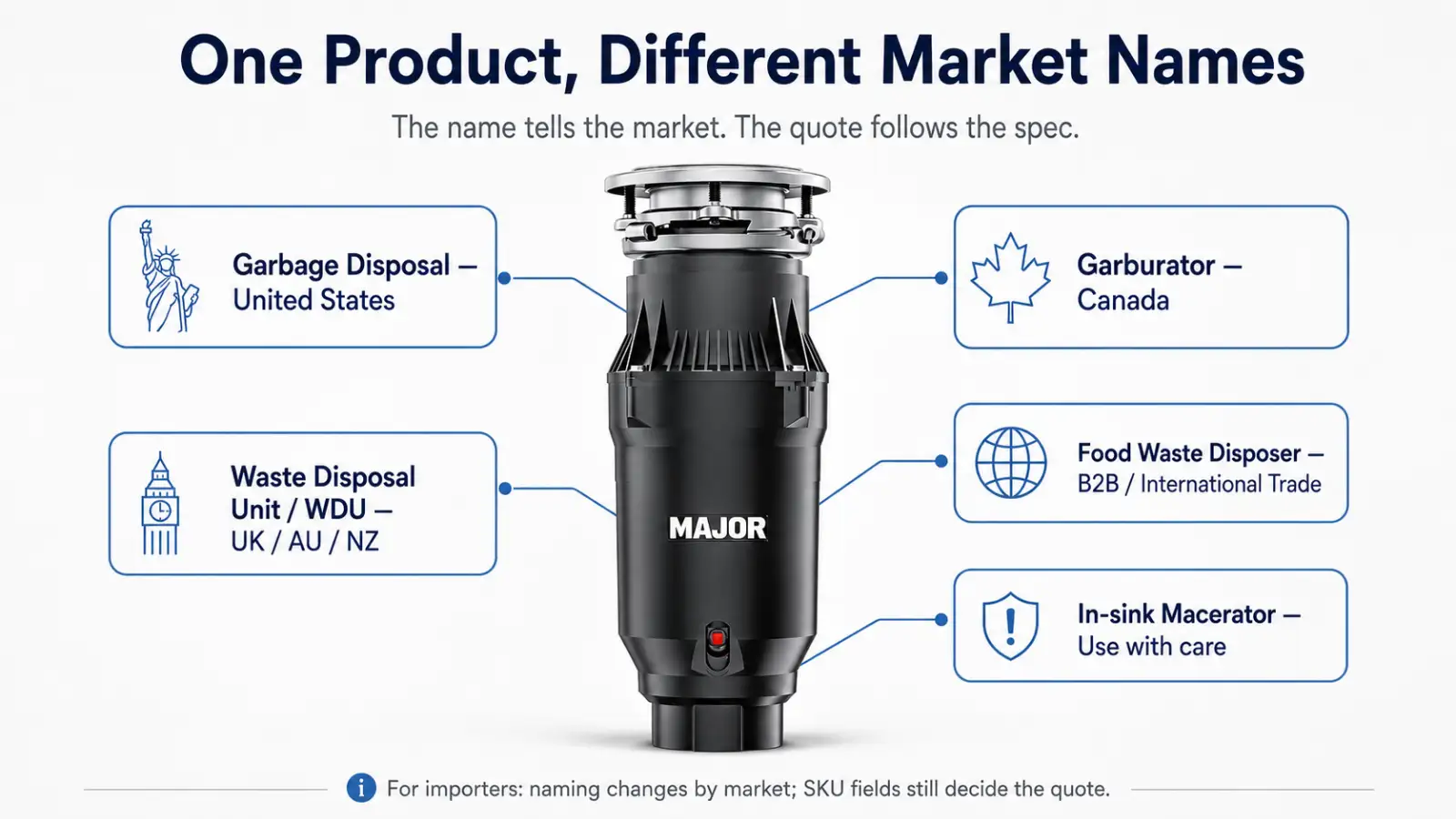
Garburator, waste disposal unit, food waste disposer, garbage disposal, disposer: one machine under the kitchen sink, named differently by country and channel. The table sorts which word tends to come from where.
| Name | Where it’s used | What it refers to |
|---|---|---|
| Garbage disposal / garbage disposer | United States | The US consumer and search term |
| Garburator | Canada | The everyday Canadian word |
| Waste disposal unit (WDU) | UK, Australia, New Zealand | The Commonwealth retail term |
| Food waste disposer | Manufacturing / international trade | The spec and B2B term |
| In-sink macerator | UK, occasional | The same kitchen machine when written in full; “macerator” alone can point elsewhere |
Back in 2017, three years into selling these, I got an inquiry on Alibaba that opened with “I am interested in your garburator, pls send me your catalog.” I wrote back that we’re a manufacturer specialized in waste disposal and carried on, without registering that a garburator was the exact thing I make. He replied, “yes, it’s disposal.” That’s when it clicked. When he later came to see the factory, he still teased me with the word.
The lesson wasn’t that “garburator” told me his market. It was that I nearly talked past my own core product because I was reading the word instead of the machine. The name is how a buyer says hello. It isn’t the spec.
The name is habit; the spec is the order
Every word in that table points to the same thing: a motor under the sink that grinds food waste fine enough to go down the drain. Which word a buyer reaches for is mostly where they grew up or what their local store puts on the box. None of that changes the order.
What changes the order is horsepower and motor type, the mount, the feed type, and the voltage and cord for the destination. A buyer who writes “garburator” and a buyer who writes “garbage disposal” get quoted on the same fields. Building a different quote because the word is different adds nothing.
| SKU field | What it sets | Changes with the name? |
|---|---|---|
| Horsepower + motor type | Grind capacity and cost | No |
| Mount (3-bolt / EZ) | Flange and splash guard | No |
| Feed type (continuous / batch) | How the unit starts | No |
| Voltage, cord, plug | Destination electrical fit | By market, not by name |
| Certification | Market access | By market, not by name |
| The name a buyer uses | Nothing on the spec | — |
So the useful move on a naming inquiry is to get past the greeting and onto the spec, where buyers actually differ: the horsepower question, the motor choice, and the rest of the configuration set out in the B2B sourcing guide. The few things that genuinely shift by market are voltage, cord and certification, covered in power cord by market.
The one name you can’t treat as a free synonym
Most of these words get read as the same machine. “Macerator” is the exception. On its own, a macerator can point to a toilet or sewage pump, a unit that grinds bathroom waste and pumps it up to the sewer line. That’s a different machine for a different job. The kitchen device only carries the name when it’s spelled out in full as an “in-sink macerator.”
I won’t pretend the regional lines are always clean, and the same buyer can use two of these words in one message. But macerator is the single word that can point to another product entirely, so it’s the one where you stop and confirm what the buyer is actually holding before you quote, rather than just confirming the wording.
Where the word does earn attention: the page that faces a market
The catalog and quote need one stable product term. A market-facing page has more room to use the word buyers search with. The catalog, the spec sheet and the quote say food waste disposer. A page that faces a particular market can lead with the word that market searches for, as long as the machine behind it is identical and the quote term stays the same. One large manufacturer runs its Canada storefront under “Garburators” and its US storefront under “Garbage Disposal” for the same products; the entry word changes, the product does not.
| Page or context | Lead word | Term on the quote and spec sheet |
|---|---|---|
| B2B catalog, spec sheet, quote | Food waste disposer | Food waste disposer |
| US-facing page | Garbage disposal | Food waste disposer |
| Canada-facing page | Garburator | Food waste disposer |
| UK / Australia / NZ page | Waste disposal unit (WDU) | Food waste disposer |
| Any page | Not “macerator” as the headline word | Food waste disposer |
| Any page | Not a competitor brand name | Food waste disposer |
How we handle the names
A buyer can call it whatever their market calls it, and we read it as the same disposer and move the conversation to the spec. On our pages the regional word leads where it matches the audience, while food waste disposer stays the product term on the quote and the spec sheet. The machine behind every one of those words is the same. We do not change the product identity for a search word.
We also don’t borrow another company’s brand name as if it were the generic product, even when a buyer uses it that way in an email. The generic product is a food waste disposer, and that’s what goes on the quote.
| Step | Check before building a market page |
|---|---|
| 1 | Define the spec first: HP, motor, mount, feed type, voltage and cord — the product, not the word. |
| 2 | Lead the page with the word that market searches: garbage disposal in the US, garburator in Canada, WDU in the UK, Australia and New Zealand. |
| 3 | Keep food waste disposer as the term on the quote, spec sheet and catalog. |
| 4 | Don’t headline macerator; if a buyer uses it, confirm the product, not just the wording. |
| 5 | Don’t use a competitor brand name as the generic product. |
| 6 | Confirm voltage, cord and certification for the market — the real by-market variables. |
The garburator and the disposer are the same order. The spec is the part worth reading.
FAQ
Is a garburator the same as a garbage disposal?
Yes. Garburator is the everyday Canadian word for it. The machine is the same one a US buyer calls a garbage disposal.
What is a waste disposal unit (WDU)?
It’s the UK, Australian and New Zealand term for the same under-sink machine. In manufacturing and international trade it’s usually called a food waste disposer.
Is a macerator the same as a garbage disposal?
Not by default. On its own, “macerator” can point to a toilet or sewage pump. The kitchen version is an “in-sink macerator,” and it’s clearer to call it a food waste disposer to avoid the mix-up.
What is the difference between a food waste disposer and a garbage disposal?
They are the same machine. “Garbage disposal” is the US term; “food waste disposer” is the term manufacturers and importers use.
Does the name a buyer uses change the product to quote?
No. The quote follows the spec — horsepower, motor, mount, feed type, voltage and cord — not the word the buyer happened to use.
Should a supplier use “garburator” on a Canada page?
Yes, when the page faces Canadian search behavior. The quote and specification should still use food waste disposer as the stable product term.
Should “macerator” be used as a product category name?
No. It is better kept as a clarification term, not the main category name. “Macerator” alone can pull the buyer toward toilet or sewage pump language.
What term should importers use in an RFQ?
Use food waste disposer for the product name, then lock the SKU fields: HP, motor, mount, feed type, voltage, cord and certification. Regional words can appear in the message, but the RFQ has to land on the specification.
How this article connects to the rest of the Major library
This article handles the naming layer above the configuration work in the B2B sourcing guide. A buyer can say garburator, WDU, garbage disposal or food waste disposer, but the SKU still moves through HP, motor, mount, feed type and cord decisions. The market language points toward the buyer’s search habit; the real by-market fields sit in power cord by market and certifications by market. For the company and product range behind these terms, see About Major.
Sources
- Garbage disposal unit — Wikipedia Referenced for the list of names including garbage disposal unit, waste disposal unit, food waste disposer, in-sink macerator, garbage disposer and garburator.
- Garburator — Dictionary of Canadianisms on Historical Principles, University of British Columbia Referenced for the Canadian usage of garburator and the kitchen-sink disposer definition.
- InSinkErator Canada — Garburators Referenced as a manufacturer’s Canadian storefront using Garburators as the market-facing entry word.
- InSinkErator US — Garbage Disposals Referenced as the same manufacturer’s US storefront using Garbage Disposals as the market-facing entry word.
- Grand Designs Magazine — What is a waste-disposal unit? Referenced for UK-style use of waste-disposal unit and food waste disposer for the same kitchen appliance.
- Macerator — Wikipedia Referenced for the broader non-kitchen meanings of macerator, including sewage maceration and pumping contexts.
The 2017 inquiry, the by-spec quoting practice, the page-naming practice and the product-line boundary in this article are based on Wanjiamei Technology Development Co., Ltd. sales records and product information, not on the external sources above.