In 2023, a customer asked us for 50 custom sink flanges.
Our standard ODM minimum is 500 sets. The goods had already shipped.
Nothing had failed. The disposers were correct. The flanges were correct. The purchase order had been filled exactly as written. One installation downstream had a sink the standard flange would not serve. What that installer needed was an extended garbage disposal flange, and it was sitting in a container that had already sailed.
The gap between a correct order and an unservable installation is a quantity-and-timing problem wearing a specification costume. The spec sheet everyone reads gives no warning that it is coming.
The 3-1/2 inch figure measures the wrong axis
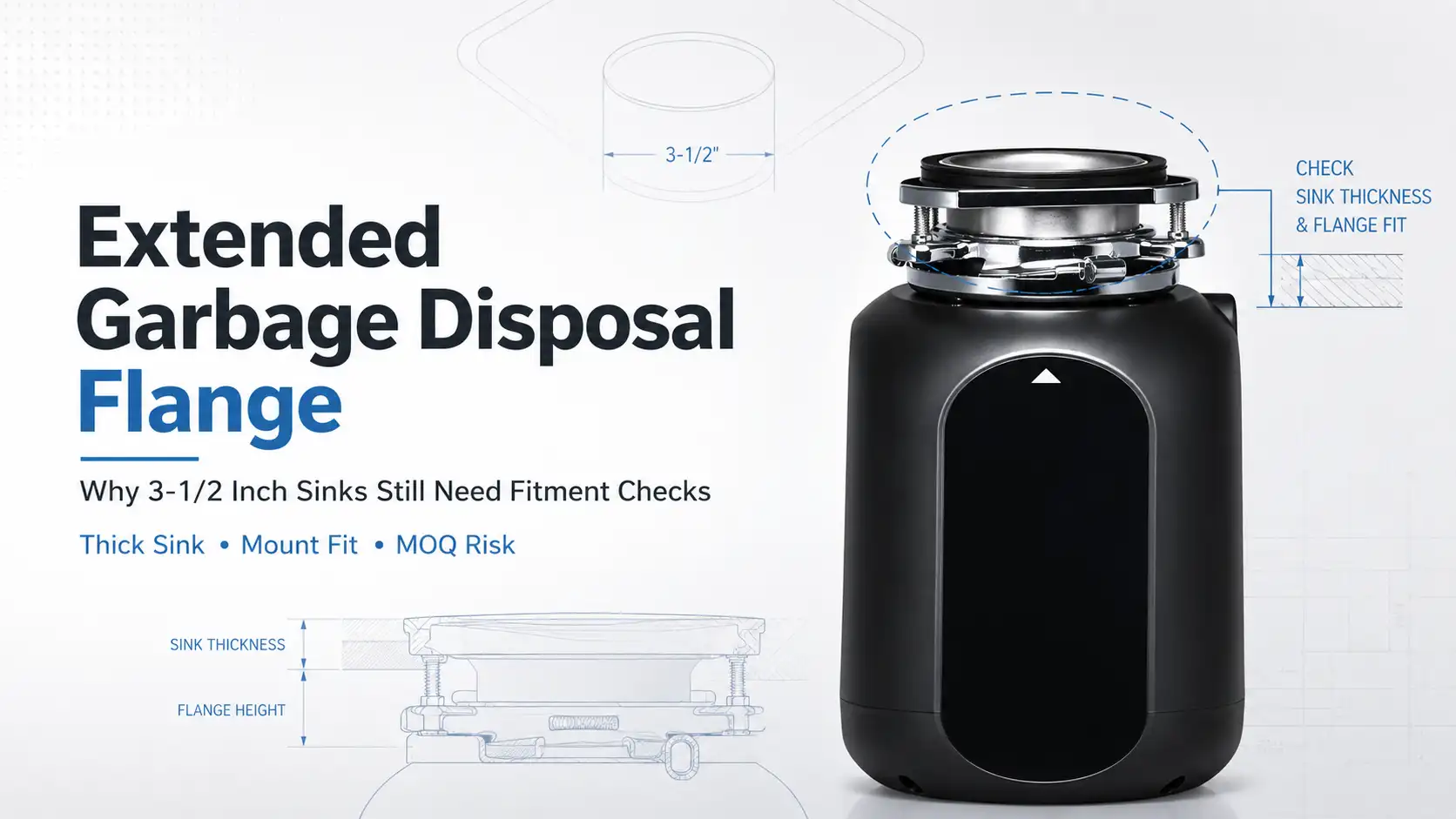
The 3-1/2 inch drain opening carries almost every page written about disposal flanges. It confirms that the flange body passes through the hole. It confirms nothing about what happens underneath.
That opening is measured across the top face of the sink. Every fitment failure below this line happens on the vertical axis, through the sink wall and down into the mounting stack. A sink can have a textbook 3-1/2 inch opening and still be too thick for the flange that shipped in the carton.
One dimension gets treated as the whole answer, and the field that decides the outcome never enters the conversation. We ran into the identical structure writing about what size garbage disposal you actually need. Chamber capacity gets quoted. Body height decides whether the unit clears the trap.
The field here is sink thickness at the drain.
What a thickness window is actually measuring
A flange is not a washer. It is the top of a stack.
The flange body drops through the sink hole. Below the sink, the assembly builds back up: a gasket, a backup ring, and then the fasteners or collar that pull everything tight against the underside. The flange has a finite length of usable travel below the sink deck. Whatever the sink itself consumes is subtracted from that travel.
A thickness window is the published range of that subtraction. The lower bound exists because too thin a sink leaves the fasteners nothing to bite. The upper bound exists because too thick a sink swallows the travel, and the parts underneath run out of thread before they run out of gap.
So an extended flange is a longer body. It is not a different concept.
Which explains the next problem. The mount system decides how much of that travel the assembly itself eats, and different mount systems eat different amounts. A 3-bolt assembly stacks a fiber gasket, a backup flange, a snap ring and three screws under the deck. A twist-lock collar builds a different stack with different geometry.
Same sink, different remaining budget. That is why “extended” does not mean one thing.
Three makers, three windows
There is a category of part built for this problem. Extended flange, deep flange, extended sink flange.
We pulled three manufacturer product pages in July 2026.
| Manufacturer product | Stated sink thickness range |
|---|---|
| InSinkErator Extended Sink Flange (FLG-SSLG) | 3/4″ – 1-3/4″ (19–44.45 mm) |
| Waste King Extended 3-Bolt Mount Sink Flange (3140AMC) | 1/2″ – 1-3/8″ |
| Ruvati Extended Disposal Flange (RVA1049ST) | up to 2″ (fireclay and ceramic) |
The windows do not line up. A sink measuring 1-1/2 inches at the drain falls inside the first range and outside the second. Both parts are sold as extended flanges.
Several aftermarket kits in the same sample publish no thickness range whatsoever. They list the flange body dimensions and leave the buyer to reason backwards from the hardware.
The word “extended” therefore discloses nothing about the thickness window, and nothing about which mount family the part is bound to. Whether the matched gasket and splash guard travel with it is a separate question again.
An importer quoting three suppliers on “extended flange” is comparing three different parts under one line item. That is the same shape of problem we mapped in food waste disposer B2B sourcing.
The mount family narrows the field further
Our July 2026 review covered InSinkErator, Waste King, Whirlaway, Moen, Ruvati, and several aftermarket flange kits on major retail platforms.
| Mount system | Extended option with a published thickness range, in the sources reviewed |
|---|---|
| 3-Bolt | Found. InSinkErator and Waste King each publish one. Multiple aftermarket kits are labelled for 3-bolt mounts. |
| EZ Mount | Not found. The EZ Mount kits in our sample publish no thickness range, and we did not locate an extended variant. |
Read that second row carefully. We are reporting what our sample did and did not publish, on the date we reviewed it. Somebody may have a part we never saw.
The practical shape holds anyway. A product line running on EZ Mount, meeting a thick sink downstream, has no stocked answer to reach for. The request travels back up the chain. Distributor, then importer, then factory.
Which is roughly what happened to our 2023 customer.
The mount choice gets made for entirely different reasons, and we walked through those reasons in 3-bolt vs EZ mount. What we left out of that piece: the same choice quietly decides whether a thick-sink request has a retail answer, or only a factory answer.
Thickness is a measurement, not a material name
Fireclay sinks run thick. Farmhouse sinks run thick. Composite sinks land all over the range, and Stainless sits at the thin end.
Material names correlate with thickness. They do not define it. A correlation will not tell you which flange to ship.
| Measured thickness at the drain | What it settles |
|---|---|
| Inside the standard flange’s published window | The standard configuration fits, once the mount and the complete kit are confirmed. |
| Inside a published extended-flange window | Check which mount that extended part is bound to, and whether the gasket and splash guard match it. |
| Outside every published window | Manufacturer review, or a custom part. This is where MOQ enters. |
Take the measurement at the drain, not at the rim. Sinks are not uniform in section. Many are deliberately thicker where the drain punches through, because that is where the load sits.
Why the same mismatch costs an importer more
A homeowner facing a thick sink walks into a store and buys a compatible part, if one exists for their mount.
An importer facing the same mismatch after shipment is somewhere else entirely.
The request arrives from a downstream installer, which makes it late. It covers one installation, which makes the quantity small. A non-standard flange is a tooling-and-run decision at the factory, and a small quantity will not pay for the setup. Meanwhile the production run that could have carried the part is already on the water.
Each of those four is just how the chain works. Stacked together, they turn a hardware-store errand into a purchase-order negotiation.
Our 2023 customer was an Indian wholesaler operating in the North American market. We resolved it commercially rather than technically. He placed an additional order for 100 disposers, and we produced the custom flanges at no charge against that order.
That worked because there was an ongoing relationship, and enough order volume to absorb it. It is not a process, and no importer should plan around it. We have no systematic count of how frequently this pattern shows up. It has not happened enough for us to track it as a category.
What we can say is that the exception path was never defined anywhere. It was not in the PI. Nobody raised it in the quotation, and no email before the container left mentioned it. The standard flange price was never the expensive part. The expensive part was leaving the MOQ, the exception path and the replenishment timing undefined until an exception arrived.
What we can put in the quotation
Major does not manufacture the sink flange. We buy it from a partner factory we have worked with for many years. That relationship is what makes custom flange work possible for us at all. It is also why custom work carries a minimum quantity instead of being free.
Our standard configuration makes no special thick-sink claim. We quote the actual thickness window supplied for that mount, as a number.
Here is what an importer can have fixed in writing before the order is placed.
| Field | What it settles |
|---|---|
| Mount system on this SKU | Whether a thick-sink request has any stocked answer downstream |
| Thickness window of the flange being shipped | The actual range, instead of the word “standard” |
| Whether an extended or custom variant is quoted at the same time | Riding the same production run costs a line item. Adding it later costs a run. |
| MOQ for a non-standard flange | The number that decides whether a later exception is solvable |
| Spare allocation for flange, gasket and splash guard | These three move as an assembly, even when the BOM shows three lines |
| Whether accessories ship as a set or in part | We ship them as a set by default. Some customers take only part of the kit. Say which. |
The splash guard deserves its own line. It does not follow the flange automatically. Our EZ Mount and 3-Bolt configurations use different splash guard diameters, 80 mm and 87 mm. So a flange decision quietly becomes a spare parts decision, which is the chain we traced in splash guard replacement.
Here is our line. We quote the thickness window, we quote the MOQ, and we tell you what ships in the kit. We cannot see the underside profile of an end customer’s sink. We cannot confirm how a third-party flange behaves on a Major mount. Those are site conditions and third-party parts, and they belong to the installer. What we do is put the numbers we control into the quotation before an exception arrives, rather than after.
FAQ
What sink thickness does a standard garbage disposal flange support?
It varies by manufacturer, and the number is published. InSinkErator gives 3/4 inch as the lower bound of its extended flange, which tells you where extended begins. It does not tell you what any standard flange covers. Ask your supplier for that window as a number.
Is an extended garbage disposal flange universal?
No. Three manufacturer pages, three different thickness windows, each part bound to a specific mount family.
Is there an extended flange for EZ Mount disposers?
We did not find one with a published thickness range among the manufacturer and aftermarket sources we reviewed in July 2026. That is a statement about our sample, not a claim about the whole market. For sourcing purposes, treat a thick-sink request on an EZ Mount line as a factory question rather than a retail one.
Do fireclay or farmhouse sinks always need a deep disposal flange?
Not by definition. The material name tells you where to look. The measurement at the drain tells you the answer.
Can a factory produce 50 custom flanges?
Not as a standalone order. Custom flange work is a tooling-and-run decision, and our standard ODM minimum is 500 sets. It becomes workable when it rides an existing production run. Which is why the question belongs in the PI, and not in an email sent after the container has left.
Sources
Manufacturer and product specifications
- InSinkErator — Extended Sink Flange, stainless steel (manufacturer product page, accessed July 2026). Cited for the published 3/4″–1-3/4″ sink-thickness range and the metric range of 19–44.45 mm.
- Waste King 3140AMC — Extended 3-Bolt Mount Sink Flange (retail listing carrying Waste King product information, accessed July 2026). Cited for the 1/2″–1-3/8″ range, the 3-bolt mount limitation, Waste King unit compatibility and the statement that the listing contains the extended flange rather than the complete mounting assembly. No current manufacturer technical page was located during this review.
- Ruvati RVA1049ST — Extended Garbage Disposal Flange (manufacturer product page, accessed July 2026). Cited for thick fireclay and ceramic sink fitment up to 2″, the 3.5″ drain-opening statement, included deep basket strainer and stated InSinkErator compatibility boundary.
- Ruvati RVA1049 specification sheet (manufacturer PDF). Used as the supporting technical document for the 3.5″ standard drain-opening statement and the extended deep disposal-flange configuration.
Scope of the EZ Mount and aftermarket review
The July 2026 review covered InSinkErator, Waste King, Whirlaway/Moen model 1030, Ruvati and marketplace flange kits. The sample was used to test whether an extended EZ Mount option carried a published sink-thickness window. No such window was found in this sample. This is a bounded search result, not evidence that no such product exists in the market. Marketplace copy is treated as secondary evidence and does not override manufacturer documentation.
- Waste King / Moen model 1030 EZ Mount Sink Flange Kit — identifies the twist-and-lock EZ Mount system, compatibility with Waste King and Whirlaway units and the included mounting components. The reviewed listing does not publish a sink-thickness range.
- Mr. Scrappy extended-depth 3-bolt mount listing — reviewed as an aftermarket example that states a thickness range and binds the part to a 3-bolt mounting family.
- Aftermarket EZ Mount kit sample 1 and aftermarket EZ Mount kit sample 2 — reviewed for mount-family wording, supplied components and whether a sink-thickness window was published.
Major internal facts
The 2023 Indian-wholesaler order, the request for 50 custom flanges after shipment, Major’s standard ODM minimum of 500 sets, the additional order for 100 disposers, the no-charge custom-flange resolution, the 80 mm EZ Mount and 87 mm 3-Bolt splash-guard diameters, the long-term partner-factory relationship and the MOQ-bound custom-flange capability are internal Wanjiamei Technology Development Co., Ltd. (Major) order and product-configuration records. They are not presented as market-wide statistics.