If you import garbage disposals, you know cert is the gate. The product spec only matters once the cert covers your destination market.
The garbage disposal certification you need is set by the destination market, not by the product spec. The cert decides which SKU you can ship; the spec decides which SKU you’d want to ship.
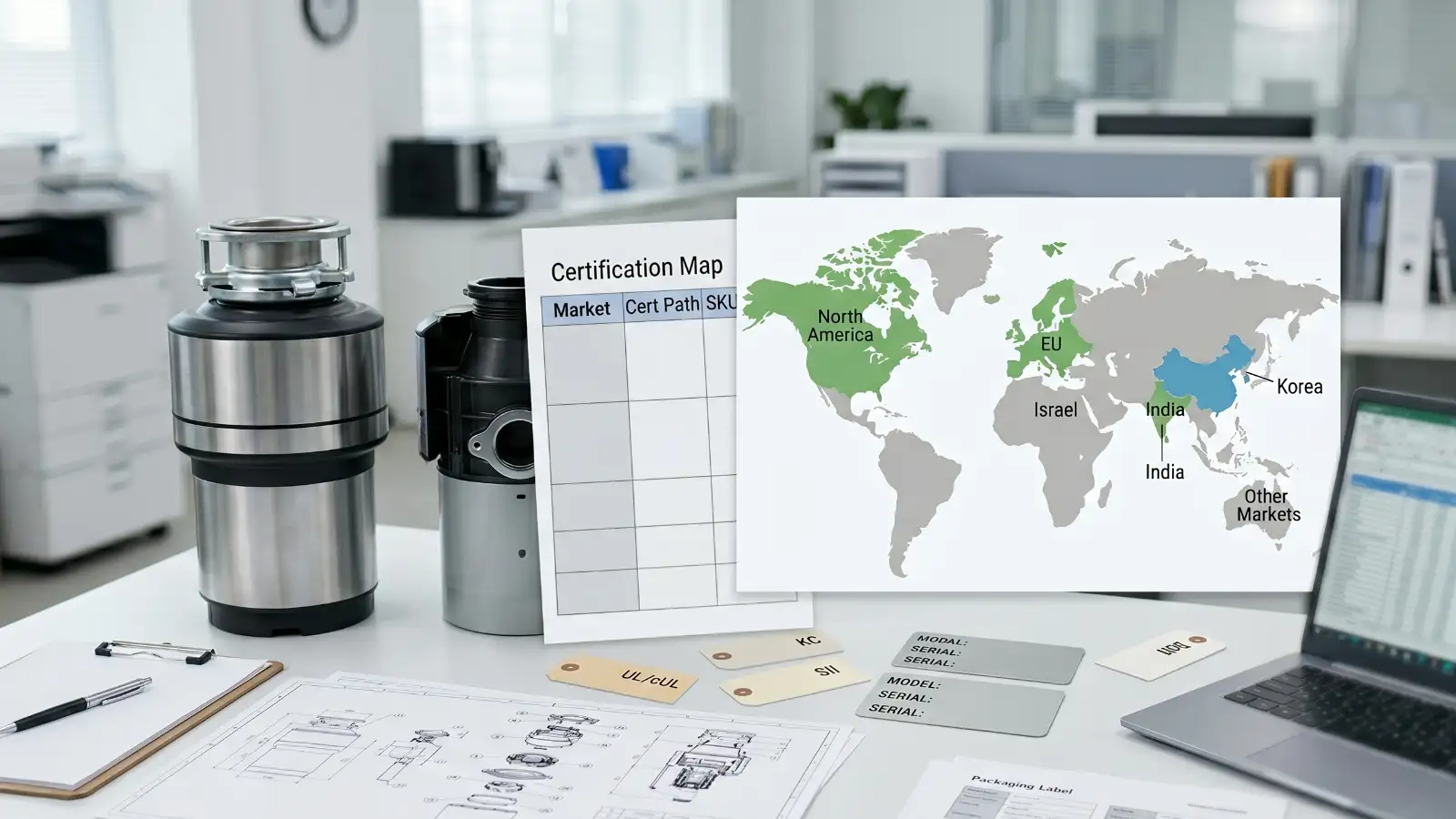
Our 20 household SKUs split unevenly across eight cert paths. Z series carries UL/cUL for North America. D and X series carry KC, SII, and BIS for Korea, Israel, and India. CE covers the EU across the full line. CB covers IEC 60335-2-16 across the full line. The M series, our BLDC variable-frequency line, carries CE and CB only.
The cert distribution is the SKU map. Pick by destination market first, then by HP and chamber configuration.
Major is a household food waste disposer brand under Wanjiamei Technology. We do OEM and ODM for importers and distributors. We do not sell retail, we do not run kitchen installations, and we do not stand in for local plumbing or electrical code review.
What Importers Ask First, by Market
The first email from a new importer is almost never about chamber size or motor architecture. It is about certifications, and the question shifts by where you’re shipping to.
If you write from Israel, you ask about SII. If the SII question doesn’t come in the first email, it comes in the second. SII coverage decides whether the container clears Israeli customs and what your distributor puts on the shelf. We hold SII on D100 through D700 and X1 through X4: 11 SKUs.
If you write from Korea, you ask about KC. Same 11 SKUs. The overlap is not coincidence. We built KC and SII coverage on the same models because the two markets came online for us in the same window, and the CB scheme test path made parallel application efficient.
If you write from India, you ask about BIS. Also the same 11 SKUs. The BIS question has gotten harder since 2025. BIS power cord certifications have become very difficult to obtain in India since 2025, and a wave of existing BIS power cord certs expired during 2026. A new PO from a long-term Indian customer in early 2026 surfaced the problem on our side: the disposer carried BIS, but the cord coverage was lapsing. We sourced BIS-certified cords from Thailand that were still inside their validity window to keep the PO moving. The unit cert and the component certs have to both be live; one without the other doesn’t clear the port.
If you write from the EU, you ask whether the CE technical file is complete. CE covers all 20 SKUs. The technical file is the document the EU importer needs on hand if a market surveillance authority asks.
If you write from North America, you ask about UL. UL/cUL covers three SKUs: Z100, Z100S, and Z200. Some importers also ask about cUPC, the IAPMO mark seen on faucets and fittings. cUPC is available for disposers (it requires UL 430 plus ASSE 1008), but it isn’t the cert North American buyers actually look for on a disposer. UL listing is. Z series is what we market into the US and Canada under our own cert; the other 17 SKUs do not have UL listing and we don’t push them into North America. For North American garbage disposal certification, UL listing is the practical gate. cUPC sits in a different layer of the plumbing market and isn’t where US disposer buyers spend their attention.
If you write from Saudi Arabia, Russia, Australia, or another market we have not directly certified, you ask about CB. CB covers our full line under IEC 60335-2-16. Your local NCB uses the CB report as the basis for converting to SASO, EAC, RCM, or whichever national mark applies. CB shortens the testing path and avoids duplicate test fees. The conversion isn’t automatic — national differences sometimes call for additional testing, and some markets require factory inspection or importer documentation that sits outside CB scope.
When the Cert Map Forces the SKU Choice
The cert distribution decides the SKU before the product spec discussion in several cases.
If you are sourcing for India, Israel, or Korea, the BLDC variable-frequency line (M series) is not on the table. M series carries CE and CB only. To put M series into India, your side would have to take the CB report and run BIS conversion locally. That process takes months and isn’t always granted on the first submission. If your timeline is short, you pick from D or X series instead.
If you are sourcing for North America, you pick from Z series. There is no other option in our line that carries UL/cUL. If you want auto-reverse BLDC behavior for the US market, our current line doesn’t have it. We say this directly so you don’t quote a model and discover the gap after the PO is signed.
If you are sourcing for the EU, the line is open. All 20 SKUs are CE-marked. The decision goes back to motor architecture and chamber size, not cert.
A spec sheet with the right HP and chamber size is useless if the SKU does not carry the cert your customs broker needs.
After the PO: Where We Stay In
Cert work does not end when the container ships.
A long-term Israeli customer of ours had their product pulled from the Israeli market in 2022 after selling without issue for an extended stretch. The exact trigger wasn’t communicated to us in full; the practical situation was clear enough: stop-sale, distributor stuck. We provided the product test data, the manufacturing records, the bill of materials, and the production line documentation needed for re-certification. The customer got the product back into market within weeks rather than months. We stay in for this kind of post-sale cert work because the alternative is your channel goes dark.
The India BIS power cord situation above is the second pattern. Cert validity on a component changes the cert validity on the finished product. We track component certs the same way we track unit certs. When the cord supply market shifted, we sourced from a region where the cert was still live to keep the unit shippable.
The third pattern is voltage conversion. We can build 110-120V or 220-240V on the same model platform. What we cannot do is move the UL listing with the voltage change. UL listing on a Z series unit is tied to the tested voltage. If you take a 110V Z200 and request a 220V build, you cannot ship that 220V build into North America under the existing UL listing. The cert follows the test scope, not the model number.
What We Do and Don’t Do in the Cert Process
The certifications are held under Major and Wanjiamei. Your SKU naming on top of our base model does not affect cert validity, because the cert references our test report and our model platform, not your private-label SKU number. Steel stamping on the housing is customizable to your specification.
For the cert application files in your market (BIS application, SASO submission, EAC paperwork, whichever local process applies), your side takes the lead. We provide all supporting materials: test reports, technical drawings, BOM, factory audit information, sample units, photos in the format the local NCB asks for. If your team isn’t familiar with the local process, we prepare the materials in the format the local NCB asks for. We don’t file the application under your importer-of-record status because we aren’t the importer of record.
UL co-listing is a real option for North American customers. If your company name needs to appear on the UL certificate alongside ours, the fee is modest and the timeline is short. We recommend it for any customer planning to scale Z series volume.
Additional listee requests on the UL certificate are a separate conversation. For customers with multi-year history with us, we work the additional listee process. For brand-new customers asking for additional listee on the first PO, we decline. The cert is our asset; we put it on customer relationships that have shown they will outlast a single order.
The cert does not replace local code review, AHJ judgment, or the licensed installer’s call on a specific kitchen. UL covers electrical safety on the unit. It does not authorize claims about what foods the unit can grind, and it does not substitute for local plumbing code compliance on the install side. The product manual and the test scope set the food-waste boundary. Local code sets the install boundary. The cert sits between those two, covering electrical and structural safety on the unit itself, And in some markets the gate sits even above the cert — whether ground food waste is permitted into the local sewer at all, which we cover in waste disposal unit by market.
If you’re sizing up a new market and want to know whether our line covers it, the answer is in the cert distribution above. If your market isn’t there and you don’t see CB working for you, write to us. Sometimes the CB-to-local conversion is workable, sometimes it isn’t, and we can tell you which before you commit time to the application.
Need to Check Which Garbage Disposal SKU Fits Your Market?
Send your destination market, target voltage, required certification path, and preferred disposer configuration. We can help check which Major SKU is already covered and where local conversion may be needed.