That case is extreme, and the lesson under it is ordinary. An odor has a source, and swapping parts before you find it is how a smell survives a full parts replacement.
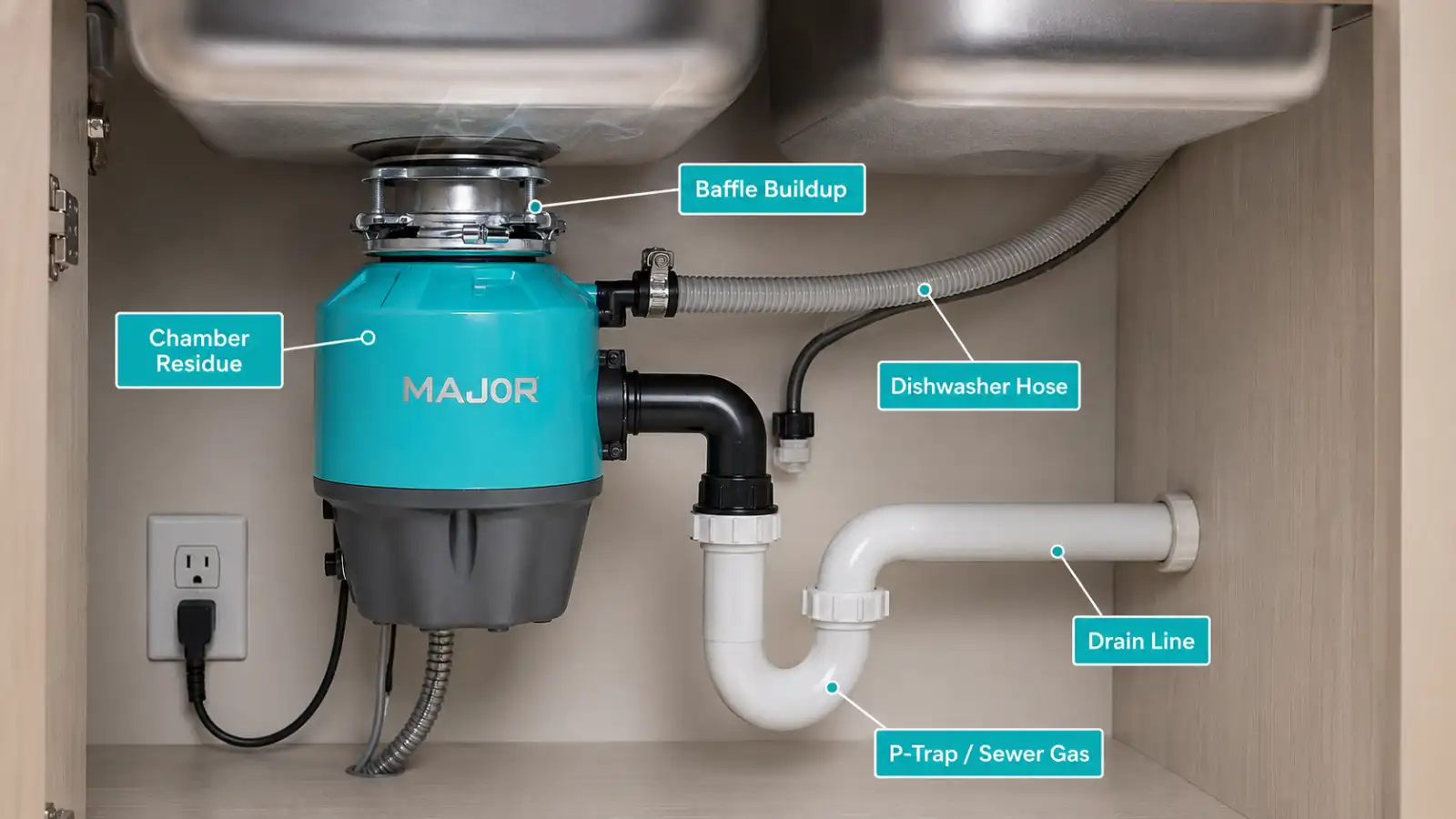
I sell food waste disposers for a B2B supplier, the Major Product Team, to importers and distributors. Odor is one of the after-sales complaints I handle, and it’s easy to misroute. A sink-area smell can come from the grind chamber, the underside of the baffle, the dishwasher hose, a dry or clogged P-trap, or the drain line past it. Each is fixed differently. I’ve laid out the same source-first approach for drainage complaints in Garbage Disposal Not Draining.
Three symptoms point to three different sources. Here’s how to tell them apart.
Why the smell comes back in days
Baking soda, vinegar, ice, citrus. Most odor advice stops there. Those clear surface scent without reaching the surfaces that hold it.
Manufacturer support pages give a specific cause: odor is food buildup from too little water flow. The fix is to physically scrub the underside of the baffle and the inside upper lip of the grind chamber. A poured-in deodorizer reaches neither spot.
The drain line is the second hideout. Plumbing crews note that baking soda, vinegar, and store-bought gels don’t reach the biofilm that builds further down the line. The scent fades within a day while the film stays put, so the smell comes back on schedule.
A smell that returns means the source is still sitting there. The Korean unit was that in the extreme — the source was cemented in place, and no cleaning or part-swap moved it.
When it smells like sewage, look past the unit
A rotten-food smell and a sewer-gas smell are different complaints. Rotten food is the chamber or the baffle. Sewer gas is the plumbing.
When sewer gas reaches the kitchen through the disposal, the problem is in the plumbing system rather than a dirty unit. A dry P-trap, a partly clogged trap, a blocked vent stack, or worn seals each let gas up the line. If a thorough clean changes nothing, the trap or the seals are the next place to look, and both sit outside the appliance.
This is the boundary I hold with buyers. We can speak to the grind chamber, the baffle, and the outlet, because that’s what we build. The trap, the vent, and the wall line are not something we diagnose from a factory. I can’t separate a dry trap from a vent fault over email, and I won’t guess at one.
A sewer smell, on its own, doesn’t make the unit defective.
When it only smells with the dishwasher
Timing is the tell. If the kitchen smells only when the dishwasher drains, the disposal is just where the smell exits.
Dishwasher water leaves through a dedicated inlet on the side of the disposal, so a smell riding that water shows up at the unit even when it began elsewhere. The hose path is where to start. A drain hose without a proper high loop or air gap can let dirty water sit or flow back the wrong way. Plumbing write-ups link a smell that worsens with the dishwasher to standing water in the hose and to biofilm in the drain line.
On our side, the dishwasher connection is a known set of parts: a removable knockout plug and a 7/8-inch hose interface. Whether the installer set a high loop or an air gap is not on the unit, and that’s where a dishwasher-only smell hides. The connection details are in Dishwasher Connection on a Food Waste Disposer.
What’s actually ours to fix
Two of the smell’s homes are ours, and both are serviceable without replacing the unit. The grind chamber cleans. The baffle comes off.
The splash guard is a removable, replaceable part. On our line it’s stocked in two fittings — an 80 mm EZ Mount and an 87 mm 3-Bolt — and held as a standard spare. When the smell lives on the baffle underside, the fix is to pull it, scrub it, or swap it. That’s a spare-part conversation, not a warranty claim. The fitment and spare details are in Splash Guard Replacement and Fitment.
When an odor complaint reaches an importer, a short triage routes it faster than a return. Ask for a photo of the baffle. Ask when the smell happens — at idle, after grinding, or only with the dishwasher. Ask whether the install is new, and whether the baffle has been pulled and cleaned. Those answers point to cleaning, a spare baffle, or a plumbing check before they point to the motor.
When the unit itself is at fault — a cracked chamber, a failed seal — that’s the repair-or-replace decision, handled on its own. The Korean teardown ended there: parts replaced, glue cleared, no defect to claim. A smell that keeps returning, by itself, rarely lands on the motor. The repair-or-replace call is laid out in Repair or Replacement.
Odor is one source among several an importer has to separate. The wider habit — route a field complaint before opening a return — covers the silent, humming, leaking, and draining cases too.
FAQ
Why does my garbage disposal stink even after I clean it?
The deodorizer only masked the scent; the source stayed. Food sits on the baffle underside and the upper lip of the chamber, and biofilm sits deeper in the drain line. Until those are cleaned or the part is swapped, the smell returns.
Why does my garbage disposal smell like sewage?
A sewer-gas smell points to the plumbing system rather than unit dirt: a dry or clogged P-trap, a blocked vent stack, or worn seals. Run water to refill a dry trap. If it persists, the trap, vent, or seals need a look.
Why does it only smell when the dishwasher runs?
The dishwasher drains through the disposal, so a smell carried by that water shows up at the unit. Start with the hose path: a drain hose without a proper high loop or air gap can let dirty water sit or flow back the wrong way. The unit body is rarely the source when the smell tracks the dishwasher.
Does a returning smell mean the disposal is broken?
No. It points to a source the cleaning never reached.
Is a smelly garburator a different problem from a smelly waste disposal unit?
No — same machine, different market word. Garburator is the Canadian term, waste disposal unit the British one. The smell routes the same way.
Getting odor complaints on units you’ve imported? Send a baffle photo and when the smell happens, and we’ll help route it — talk to us.
Sources
- InSinkErator — There’s an Odor Coming From Garbage Disposal Manufacturer guidance that odor is food buildup in the grind chamber and baffle; clean the baffle underside and the chamber’s upper lip, then run cold water.
- Total Mechanical — Garbage Disposal Smells Like Rotten Eggs Referenced for sewer-gas odor routing where a dry P-trap, vent blockage, P-trap issue or main-line problem can sit outside the disposal body.
- Bedrock Plumbing — Why Does My Garbage Disposal Smell Like Sewage Referenced for dry P-trap and plumbing-side odor sources when sewage smell persists beyond basic disposal cleaning.
- Ben Franklin Plumbing — Why Does My Garbage Disposal Smell Referenced for drain pipe and P-trap odor sources where a partial clog or standing wastewater can keep smell in the line.
- Whirlpool — What Is a Dishwasher Air Gap Referenced for the dishwasher air gap’s function in preventing dirty water from flowing into or out of the dishwasher during a wash cycle.
- D&G Floors — Dishwasher Installation: Complete DIY Guide Referenced for dishwasher drain hose routing, high loop / air gap backflow prevention, and knockout plug removal when connecting to a garbage disposal inlet.
The splash guard fitment (80 mm EZ Mount and 87 mm 3-Bolt), the dishwasher removable plug and 7/8-inch hose interface, the standard spare allocation, and the May 2025 factory teardown are based on Wanjiamei Technology Development Co., Ltd. (Major) product information and service records.