The market sets how fine the output has to be — not the spec sheet
We don’t write “liquefies” on a quote. We don’t print a particle size on an RFQ either. Those numbers aren’t ours to assign in the abstract.
Here’s why. Each model we build has fixed specs — motor power, the grind components, the chamber. A buyer doesn’t tune those per order. They pick a model, and the model’s grind comes with it. So the real question isn’t “how fine do you want it.” It’s whether this model’s grind clears the rule in the market you’re selling into.
And the grind itself can’t be turned up like a setting. How fine a model runs comes from its grind ring geometry, its motor speed, and the chamber shape. Those are fixed when the model is designed, and a buyer can’t dial them at order time. So asking for a finer result moves the buyer to a different build. It means a different model — one engineered around a finer result from the start.
When a buyer chooses a model, we check that model’s output against the target market. If the market asks for finer output than the model delivers, we don’t tell the buyer to live with it. We point to other models at the same spec tier that fit that market, and the buyer moves across to one of those.
That order matters. Lock the model before naming the market, and the fineness check lands too late — after the model is chosen, sometimes after the box art is drawn. A swap at that point isn’t only a different grind. It can move the plug, the cord rating, the mounting kit, and the carton with it.
When a buyer is quoting one SKU into more than one market, naming the markets first — before the model is locked — keeps the output-fineness check from turning into a late repackaging job.
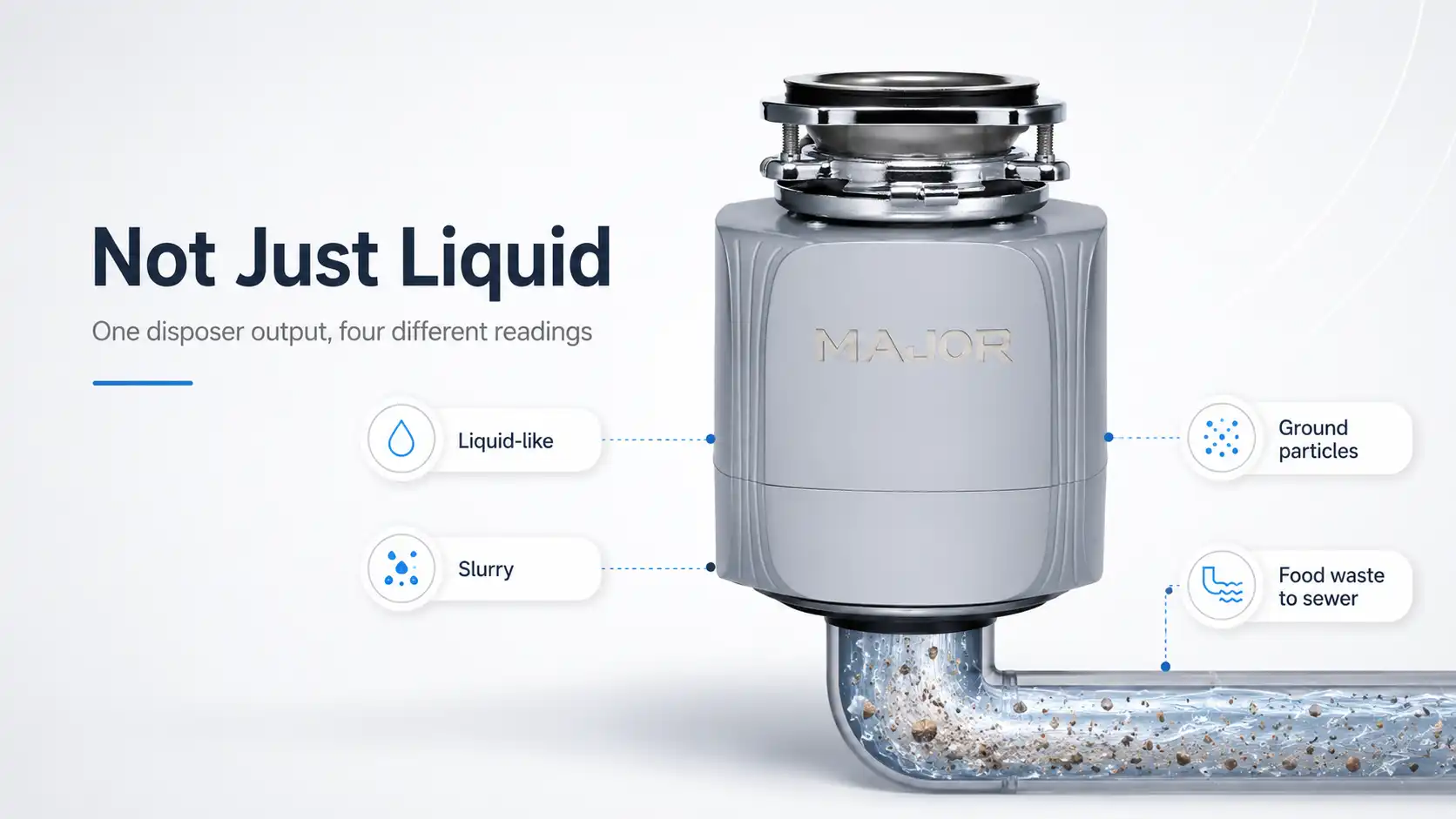
Same output, four names
A consumer page wants you to feel good about putting food down a sink, so it reaches for the friendliest word it has. InSinkErator describes its grind ring breaking food into very fine particles, “virtually liquefying” them. Read it closely, and even that line says particles first and liquid second.
Move to the people who run the pipes, and the word changes. A Canadian water-utility paper on residential food waste grinders calls the discharge a slurry, and worries about solids settling inside the conveyance system.
Move again to the researchers. A 2021 study in Water Science & Technology measured disposer particles across eighteen food types. The modal size came out between 0.59 and 4.76 mm. At that size they settle about like very fine sand, and under normal flow they mostly keep moving. Particles — measured, with a number you can put on a page.
Then the regulators, who don’t care what it feels like at the sink. A Welsh workplace rule bans food waste from going down a sink or drain into the sewer. Maceration units can’t be used to send it there either. To that reader the word is food waste, and food waste has a route it is allowed to take — or not.
| Who’s describing it | What they call the output | What they’re actually asking |
|---|---|---|
| Marketing / retail page | “liquid” / “virtually liquefied” | Will a homeowner feel okay using it |
| Wastewater utility | “slurry” | Will solids settle in our pipes |
| Sewer-transport research | “particles, 0.59–4.76 mm” | Does it move or deposit in a sewer |
| Workplace regulation | “food waste to sewer” | Is this route permitted here |
A quote that carries only the marketing word can’t answer the bottom three rows. The buyer who inherits “liquid output” from a supplier inherits a word that a lab and a customs officer will both push back on.
The same machine picks up different names in different regions too — garburator, waste disposal unit, macerator, disposer. We’ve pulled those apart in why one product has five names. The naming is a market doorway, not a change in what the unit does.
“Liquid” is a feel. A real output claim rests on something you can test.
“Liquid” is what the grind looks like from above the sink. Run the tap, feed in peelings, watch it go — it reads as liquid. The measured thing underneath is still particles, the same 0.59-to-4.76 mm range the sewer researchers work with.
Our own check happens in a kitchen setup, with a tap and real food. We run a model under three water temperatures — room temperature, warm at 37 to 40°C, and hot — at the flow a person actually uses: tap open, sink cleared of the waste, tap off. The food is what a kitchen produces — fruit and vegetable peelings, and the harder load, bones and fish bones.
I’ll be straight about the limit of that. I can’t hand a buyer a lab particle-size curve for a given run. We test to how a real kitchen uses the machine — tap, water, peelings, bones — and report what we see there. What I can speak to is whether a model clears that load the way a customer will.
We publish a figure for our own ground output. Where it sits against the sewer side, we’ve laid out separately in how a waste disposal unit works after the grind.
The kitchen test and the sewer study answer two different questions. One asks whether the machine clears a real load at a real sink. The other asks whether the particles travel once they’re in the pipe. A buyer needs the first to keep a customer happy and the second to keep a market open.
Fine enough to leave the unit doesn’t decide where it’s welcome
Particle size is the appliance side of the story. Whether ground food waste is allowed into a sewer is the route side, and the route side belongs to the local rule. The pipe mechanics we’ve covered already. The way a market’s rules outrank certification and configuration we’ve laid out in waste disposal unit by market.
Markets split on this. Wales bars workplaces from sending food waste to the sewer through a sink. Vancouver has proposed prohibiting garburators in its building by-law. Same ground output, opposite answers, decided by the jurisdiction, not the grind.
When the target market is a commercial or workplace setting in a place that restricts food waste to sewer, a finer grind doesn’t reopen the door. The route classification is what’s shut.
This is the part where guessing gets expensive, and where we’d rather you ask than assume. Name the market you’re aiming at. Bring it to us. We’ll map the certification, the plug, the local rule, and the output fineness that market expects. Then we point you to the models that fit it. Talk to us about a market.
Where “virtually liquefying” comes from
The marketing word describes a feel, and it’s a fair one. Inside the chamber there are no blades. Impellers on a spinning plate throw food outward against a stationary grind ring. The ring breaks it down, and running water carries the particles out into the waste pipe. From the top of the sink, fast-moving fine particles in a stream of water read as liquid. The word follows the experience at the sink.
For a buyer, the word and the spec point in different directions. The word describes what a homeowner sees. The spec a buyer needs describes the model and whether it fits the destination market. That thread runs through our DC-motor food waste disposers and every model page behind them.
Common questions
Does a garbage disposal turn food into liquid?
No. It grinds food into fine particles and water carries them out. “Liquid” is how it looks at the sink, not what travels down the pipe.
Is disposer output liquid or solid?
Particles in water. Fine ones — sewer-transport research puts the modal size between 0.59 and 4.76 mm — but particles, moving in a stream.
Does how fine the output is change from one market to another?
The grind itself is fixed by the model. Its motor and grind components don’t change per order. What changes is the bar it’s measured against. A market that restricts food waste to sewer, or asks for finer output, can rule a model in or out. So when a buyer sells one model into several markets, the fineness gets judged several times, once per market.
Why won’t you write “liquid output” on a quote or spec sheet?
Because the word answers a homeowner’s question, not a buyer’s. A quote that says “liquid” tells a lab nothing. A customs desk gets nothing from it either. And it says nothing about whether the next market’s route is open. We’d rather ask which market you’re selling into and answer the questions that market will actually raise.
How does Major test grinding?
With water and real food. Three water temperatures — room temperature, 37 to 40°C, and hot. The flow copies normal use: tap on, sink cleared, tap off. The food is what a kitchen makes — peelings, and the harder load of bones and fish bones.
Sources
- InSinkErator — How a Garbage Disposal Works Referenced for the impeller / grind ring mechanism, the “virtually liquefying” wording, and the statement that running water flushes particles into the wastewater pipe.
- CWWA — Residential Food Waste Grinders Issues Analysis Paper Referenced for wastewater-side language describing food waste grinder discharge as slurry and for concern about solids settling within conveyance systems.
- Legge, Nichols, Jensen et al. — The Characteristics and In-Sewer Transport Potential of Solids Derived from Domestic Food Waste Disposers Referenced for the 2021 Water Science & Technology study: 18 food types, modal particle size range of 0.59–4.76 mm, most particles with apparent densities close to water, and low likelihood of significant in-sewer deposition under normal operational flows, with egg shell noted as an exception.
- GOV.WALES — Workplace Recycling Regulations: Hospitality and Food Sector Referenced for the workplace rule in force from 6 April 2024, including the ban on disposing of food waste down a sink or drain into the sewer and the restriction on using in-sink maceration units to send food waste to sewer.
- City of Vancouver — FOI Proactive Release 2020-282 Referenced for city documents describing a proposed prohibition on garburators and food waste disposers under Vancouver Building By-Law update discussions.
Major-specific model selection, kitchen-load testing, water-temperature checks, output-fineness review, and market-configuration handling are based on Wanjiamei Technology Development Co., Ltd. (Major) product information and internal review practice. Major’s own published ground-output figure is referenced through the linked Major article on how a waste disposal unit works after the grind, rather than restated as a universal industry value here.