| Rating | Rated Voltage | Hz | Amps (avg load) | Motor type | RPM |
|---|---|---|---|---|---|
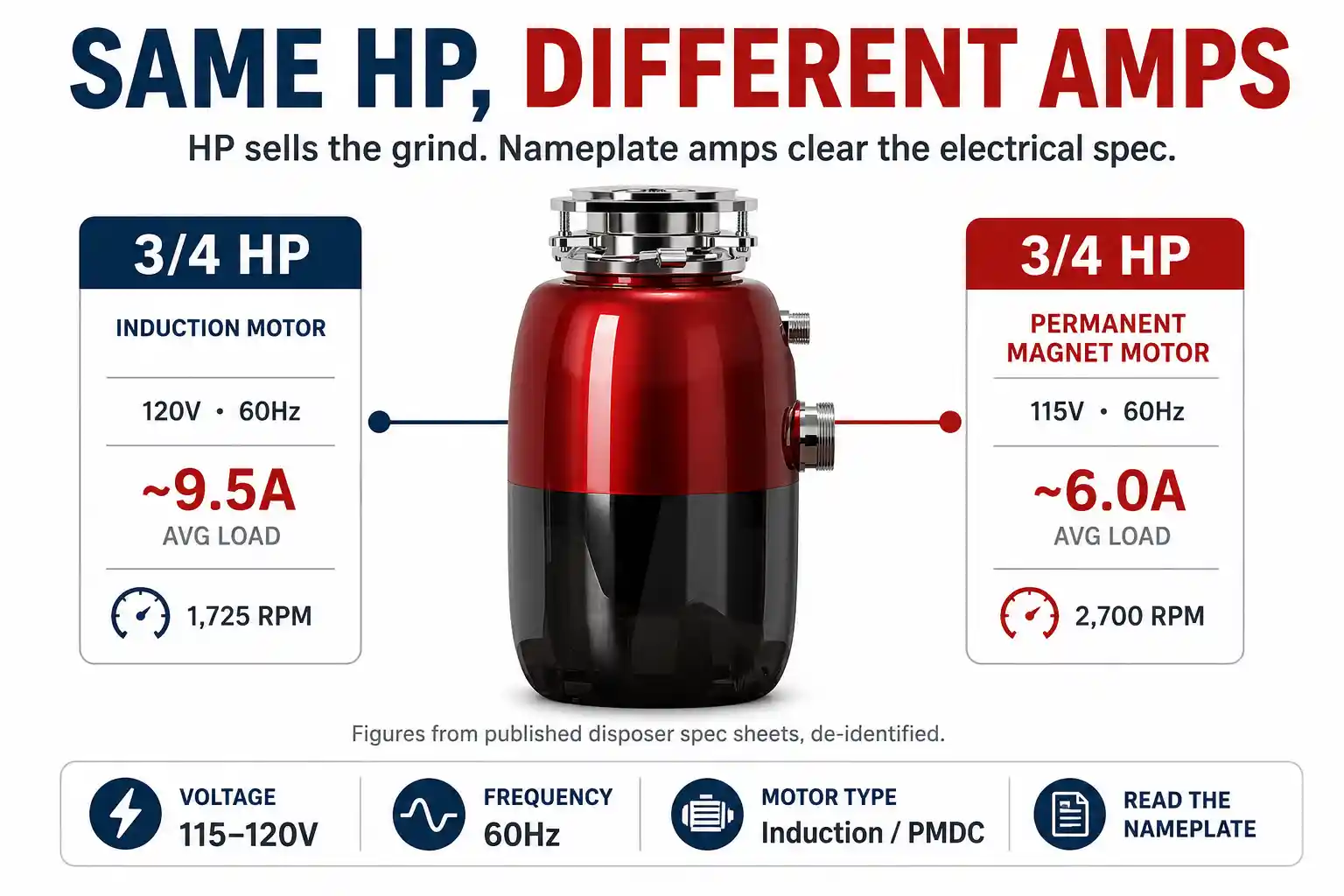
| 3/4 HP | 120V | 60 | ~9.5 | Induction | 1,725 |
| 3/4 HP | 115V | 60 | ~6.0 | Permanent magnet | 2,700 |
| 1 HP | 120V | 60 | ~10.2 | Induction | — |
Figures from published disposer spec sheets, de-identified.
For a buyer who quotes by horsepower, that gap is a daily problem. The label that sells the unit downstream isn’t the label that clears it through a circuit, a customs desk, or a breaker complaint.
The downstream complaint speaks in amps, not horsepower
Downstream, the complaint never arrives in horsepower. It arrives in amps. The breaker trips. The dishwasher shares the circuit. The homeowner asks whether the unit is “too powerful.” None of those words is on the sales page that led with HP.
A breaker trip has several causes. Startup surge, a shared circuit, a jam, a wiring fault, a GFCI/AFCI device — each can trip a breaker. Motor size is only one of them. A common forum move is to size the circuit with the 80% rule — a 15A circuit treated as 12A usable. That rule is written for continuous loads, the kind that run three hours or more. A disposer is rated for intermittent duty, so the rule doesn’t fall on the unit itself. What loads a kitchen circuit is the always-on neighbour sharing it — a dishwasher mid-cycle — plus the local code, confirmed by an electrician. We mapped the no-power and trip paths in why a disposal won’t turn on.
A buyer can’t tell a unit fault from a circuit fault from across an ocean. The fast move is to get the supplier’s running amps and startup behaviour in writing, then check them against the target market’s circuit. Bring the model and the market to us and that’s the first thing we line up.
The same HP, different amps — and the reason is the motor
Quote the same 3/4 HP to three suppliers and three different amp figures can come back. The horsepower is identical; the current isn’t. The reason is the motor.
Across the published 3/4 HP samples here, the average-load amp rating runs from roughly 6.0A to 9.5A. In those samples, the induction motor turns near 1,725 RPM and pulls more current; the permanent-magnet and BLDC motors turn faster and pull less for the same rated horsepower. The HP badge is shared; the motor underneath it is the variable.
The spread widens once a single supplier offers more than one motor. A disposer rated 3/4 HP can ship with an AC, a DC, or a BLDC motor, and the whole-unit power differs across them:
| Rated Motor | Whole-unit power | RPM | Current behaviour |
|---|---|---|---|
| 3/4 HP AC | 560 W | ~1,700 | steady, low |
| 3/4 HP DC | 560 W | ~3,800 | steady, low, higher speed |
| 3/4 HP BLDC | 30–1,380 W, self-adjusting | 1,200–3,200 | dynamic, follows the load |
The AC and DC versions hold a steady 560 W. The BLDC version is different in kind: it doesn’t sit at one figure. Rinsing soft scraps, it idles near the bottom of its range, drawing almost nothing. Hit a load of fiber or a small bone, and it climbs toward 1,380 W in real time, then drops back. Its amp draw is a curve that follows the load, not a point on a spec line. Sizing a circuit from one BLDC number misreads the unit at both ends.
A word on the watts, because the wall figure gets misquoted. One mechanical horsepower equals 746 watts of output. A 1 HP disposer can read about 10.2A at 120V — but 120V × 10.2A is 1,224 VA, the apparent power, not the real watts. Real watts are lower: VA × power factor. Even “input power” isn’t a single clean number, which is the whole point about reading amps off an HP badge.
The rulebook reads voltage and frequency, not HP
Motor type is one axis. Voltage is the second, and it moves the same machine.
Take one of those 560 W units. At 120V it draws about 4.7A; wired for a 230V market, the same 560 W draws about 2.4A. Nothing about the grinding changed — the voltage alone nearly halved the current. So “same HP, different amps” has two independent sources stacked on each other: the motor on one axis, the market voltage on the other. These amp figures are computed from whole-unit power, not read off a nameplate. We ship without a stamped amp value, so treat them as the shape of a range, not a spec.
Frequency is the third, and it reaches deeper than a label. An induction motor’s speed tracks the supply frequency, so moving a unit from 60Hz to 50Hz drops its speed by about a sixth. To hold the grind, the frequency change isn’t a sticker swap — the motor windings or pole count are rebuilt for the target market. Frequency re-specs the motor itself.
Stack the three, and one 3/4 HP label can sit over a range from roughly 2.4A to past 11A, with a BLDC unit refusing to hold still inside it. Which fields move with the market and which stay is the configuration map behind waste disposal unit by market.
What the spec should carry instead of HP alone
Step back, and the amp confusion isn’t really an amp problem. It’s a sequence problem. The buyer asked for a price before naming where the unit would be sold. A horsepower number was the only thing both sides could agree on without that answer.
Horsepower has a real job. It’s the grinding class — the figure that matches a unit to household load, and we covered choosing it in what HP you actually need. It belongs on the sales page. What it can’t do is set the electrical package, because that package is decided by the market, not the badge.
So once the market is named, the buyer’s spec carries motor type, rated voltage, frequency, running amps, plug and cord, and certification. HP sits beside them as the grinding class, not standing in for them. A BLDC auto-reverse unit and an AC unit can wear the same 3/4 HP and still need different lines on that sheet. Tell us the model and the market, and the electrical fields get filled against it — the first question on the quote anyway. Our auto-reverse disposers run on BLDC motors, so the amp behaviour there is the load-following kind, not a single stamped figure.
How to read a quote sheet now
None of this needs an electrical degree to act on. It needs an order of operations.
See HP on a quote, ask for the amps. See amps, ask for the voltage, the frequency, and the motor type. See a breaker complaint, separate the machine from the circuit before anyone ships a replacement. And before any of it, name the market — because the amps, the plug, and the certification are all waiting on that one answer.
Common questions
How many amps does a garbage disposal use?
The motor and the voltage set it, not the horsepower alone. In the published samples here, 3/4 HP units run from about 6.0A to 9.5A at 120V; a 1 HP unit can read about 10.2A. Wired for a 230V market, the same unit draws roughly half.
Why does the same HP draw different amps?
Three things, none of them the HP. The motor type sets a baseline — induction draws more, permanent-magnet and BLDC draw less in the samples here. The market voltage scales it — 120V to 230V nearly halves the amps. And a BLDC unit adjusts to the load, so it isn’t a fixed figure at all.
Is garbage disposal wattage the same as horsepower?
No. One mechanical horsepower is 746 watts of output. The wall draw is input, and volts times amps gives VA, not real watts — real watts are VA times power factor, and lower.
Does a 3/4 HP disposal need a 15A or 20A circuit?
The nameplate amps, the shared loads, and the local code decide it — not the HP. The 80% rule people quote is for continuous loads — three hours or more. A disposer is rated for intermittent duty, so it doesn’t apply to the unit itself. A licensed electrician sizes the circuit against everything else on it.
Why does a garbage disposal trip the breaker?
Several reasons, and motor size is only one. A startup surge, a shared circuit, a jam, a wiring fault, or a GFCI/AFCI device can each cause it. The first check is the circuit and the install, not a replacement unit.
Sources
- InSinkErator — Evolution .75HP Specification Sheet
Referenced for the 3/4 HP, 120V, 60Hz, 1,725 RPM, approximately 9.5A average-load figure, single-phase induction motor listing, and intermittent time rating. - Waste King — L-3200 Legend Series Specification Sheet
Referenced for the 3/4 HP, 115V, 60Hz, 6.0 current-amps figure, permanent-magnet motor type, and 2,700 RPM listing, showing a lower amp figure under the same rated horsepower class. - InSinkErator — Evolution 1.0HP Specification Sheet
Referenced for the 1 HP, 120V, 60Hz, 1,725 RPM, approximately 10.2A average-load figure, intermittent time rating, and the comparison between 1 HP mechanical output and apparent power calculated from volts times amps. - National Electrical Code (NFPA 70), continuous-load provisions
Referenced for the North American continuous-load concept: a load expected to continue at maximum current for three hours or more is treated differently from an intermittent-rated appliance. This source is used only for the continuous-load boundary discussed in the article; local code and a licensed electrician govern final circuit sizing.
Major-specific points — that a 3/4 HP rating is offered with AC, DC, or BLDC motors; that the AC and DC versions draw a steady 560 W while the BLDC version self-adjusts between 30 W and 1,380 W with current that follows the load; the listed RPM ranges; that the same unit’s amp draw scales with market voltage (about 4.7A at 120V versus about 2.4A at 230V for a 560 W unit); that a 60Hz-to-50Hz market change is met by rebuilding the motor windings or pole count rather than relabeling; that units ship without a stamped amp value; and that the auto-reverse line runs on BLDC motors — are based on Wanjiamei Technology Development Co., Ltd. (Major) product data. Amp values computed from whole-unit power are approximate and stated as such, not as nameplate ratings.