| Field | Continuous feed | Batch feed |
|---|---|---|
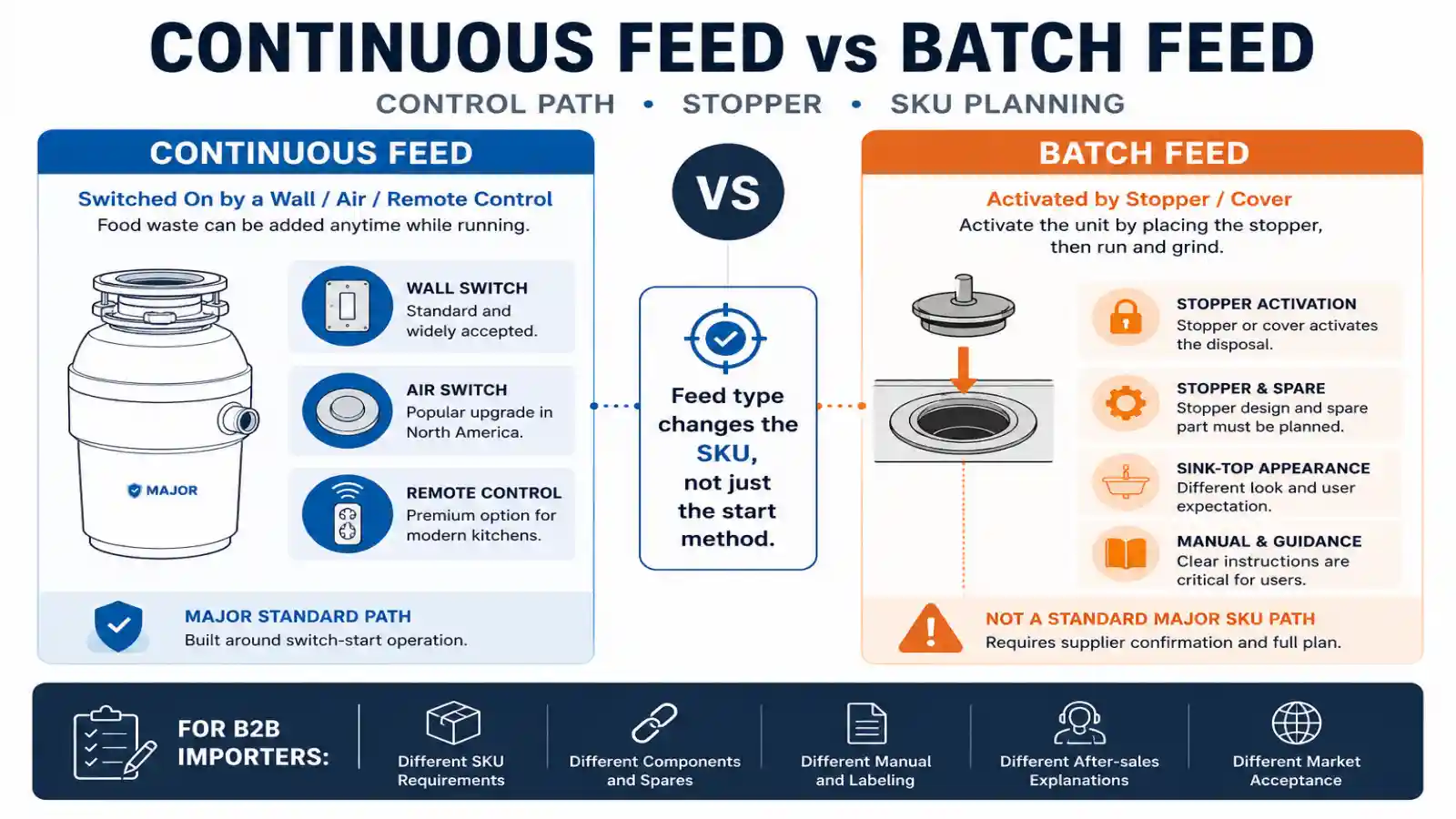
| How it starts | A wall switch, air switch, or remote; runs while you feed it | A cover or stopper is seated in the drain to activate; runs one load at a time |
| Use rhythm | Scraps go in as they come, unit running | Load, cover, run, then load again |
| Control part shipped | Switch path specified separately: wall / air / remote | The stopper or cover is the activation part |
| Major standard path | Household continuous-feed disposers on our current line | Outside the standard Major SKU path |
| Inquiry signal in our channel | Requests handled so far have been for continuous-feed disposers | No batch-feed SKU request has come through our inquiry flow |
| Sourcing question | Which switch path will start the unit? | Who specifies the stopper, spare ratio and activation tolerance? |
An importer reading consumer buying guides sees batch feed described as the safer choice, and adding a “premium safety” model looks like an easy line extension. Consumer buying guides answer a homeowner problem. A sourcing line has a different problem.
For a sourcing line, the useful question is where the demand actually shows up: in your own channel, or only in the buying-guide copy.
Why the buying guides keep leading with batch feed
The safety story is real, and worth stating plainly. A batch feed unit runs only when the cover or stopper is seated, so a hand can’t be inside the chamber while it grinds. That suits homes with young children, island kitchens, and remodels that never ran a wall switch. Consumer guides put it forward because it answers a homeowner’s worry in one line, and they line it up next to horsepower and price as if all three were the same kind of choice. The horsepower side of that is its own decision, covered in the HP question.
That copy gives feed type equal space on the page. An importer still has to check whether the same demand exists in the channel they sell into.
What our inquiry flow shows
On our current line, we build household continuous-feed disposers. The design assumes the way a kitchen sink actually gets used: scraps go in as they appear, the unit runs while you work, and nobody paces the cooking to the disposer’s rhythm. That is the comfort case continuous feed is built around.
In the inquiries we have handled so far, requests have been for continuous-feed disposers, not batch-feed SKUs.
I can’t read the whole market off our own inquiries. Public retail listings still show batch-feed models, so the category is current. Our channel signal matters for one narrower reason: a SKU plan built from buying-guide prominence alone can add a model that the channel has not asked for.
Batch feed adds a part and a habit to the SKU
The stopper or cover on a batch feed unit is the activation control. Treating it as a generic drain plug creates the first sourcing error. It can be lost, it changes how the sink top looks, and it changes how the unit gets used: load, cover, run, then load again.
On a sourcing line that becomes stopper replacement stock, manual wording, and an after-sales conversation the first time a buyer’s customer expects a switch and finds a cover instead.
In older-kitchen replacements the activation question gets tangled with other things on the same wiring — the dishwasher inlet, the under-sink outlet, whether the old unit was hardwired. Feed type does not settle any of that; the dishwasher connection is its own field to confirm.
Batch feed sits outside the standard Major product line. The stopper design, the spare ratio, and the activation tolerance sit with whoever makes it, and an importer adding a batch SKU should get those in writing from that supplier rather than assume them.
The “no wall switch” reason already has a continuous-feed answer
Part of what pulls a homeowner toward batch feed is wanting a controlled start without a wall switch — island counters, remodels with no switch run, a preference for not reaching under the cabinet. On the continuous side that same want is covered by an air switch or a remote.
Our range fits the second path. When a buyer’s real driver is “no wall switch” or “a deliberate start,” a continuous-feed unit with the air-switch or remote path specified covers it, without taking on stopper-start operation and a second spare part to stock. The forms that path can take, and what they do to the carton and the after-sales picture, sit in the air switch breakdown by market. The field to lock is the control method, and it belongs in the RFQ alongside everything else covered in the B2B sourcing guide.
Where we can speak, and where the installer takes over
We build household continuous-feed units and specify the control and power path to the buyer’s market. We do not build batch feed, and the wiring behind the wall stays with the local installer.
Before a batch SKU goes on the plan
Two checks come before price and model choice. Has your own channel actually asked for batch feed? And will the batch supplier put the stopper, spare ratio, and activation tolerance in writing?
Where there is no pull in the channel and the target market already runs continuous feed on a switch, a batch SKU mostly adds cost and after-sales explanation.
FAQ
What is the difference between batch feed and continuous feed garbage disposals?
Continuous feed runs while you keep adding waste, started by a wall switch, air switch, or remote. Batch feed runs one load at a time and starts only once a cover or stopper is seated in the drain. The split also changes what ships: a continuous unit needs its switch path specified, while the stopper is a batch unit’s activation part.
What is a continuous feed garbage disposal?
A unit that grinds while it’s switched on, so you keep adding waste as you go.
Is batch feed safer than continuous feed?
Its cover-start design means the unit won’t run with the drain open, which is the safety case the buying guides make for it. Whether that matters enough to stock depends on the buyer’s market and household profile, not on the label by itself.
Why does a batch feed garbage disposal need a stopper?
The stopper or cover is the activation control. The unit powers on only once it’s seated, so it is not an accessory you can leave out or replace with a generic plug.
Can a batch feed garbage disposal be converted to continuous feed?
That’s an activation and switch change, not a small swap, and it sits with the installer. From a sourcing view it is a sign the control method should be settled before the order rather than after.
Does a continuous feed garbage disposal need a wall switch or air switch?
It needs one of them: wall switch, air switch, or remote. Which one is an RFQ field, because the unit can’t be run until the control path is decided.
What should an importer confirm before ordering batch feed waste disposers?
Two things first: whether your own channel has actually asked for batch feed, and what the batch supplier specifies for the stopper, its spare ratio, and the activation tolerance. Price and model choice come after that.
Are batch feed garbage disposals harder to sell where wall switches are normal?
Where kitchens already run continuous feed on a switch, batch feed asks the user to change how they operate the sink, and that turns into after-sales explanation. It is a market-habit question worth checking before the SKU goes on the plan.
Can Major advise on local electrical installation for continuous feed disposers?
No. We build the units and specify the control and power path; whether a specific kitchen and circuit can take a unit is the local installer’s call.
How this article connects to the rest of the Major library
This piece sits under the B2B sourcing guide, where feed type is one field among the ones an importer locks before a price is comparable. The control-method point — that the “no wall switch” reason for batch feed is answered on the continuous side — runs straight into the air switch breakdown, and the older-kitchen tangle of activation, outlet and inlet connects to the dishwasher connection write-up. For the company and product range behind these, see About Major.
Sources
- GE Appliances — Disposer Continuous Feed and Batch Feed Differences Referenced for public definitions of continuous feed as switch-started operation with running water, and batch feed as cover / stopper activation.
- Consumer Reports — Pros and Cons of Batch-Feed Garbage Disposals Referenced for the homeowner buying-guide framing around batch feed, including safety, wall-switch and noise considerations.
- Home Depot — Batch Feed Garbage Disposals Referenced as a public retail listing showing batch-feed garbage disposal models remain actively sold.
- Home Depot — Continuous Feed Garbage Disposals Referenced as a public retail listing showing continuous-feed models as a separate product-type path.
Major-specific product statements, product-line boundary, inquiry-flow observations, control-path positioning and SKU planning judgments in this article are based on Wanjiamei Technology Development Co., Ltd. product information and sales communication records rather than the external public sources listed above.