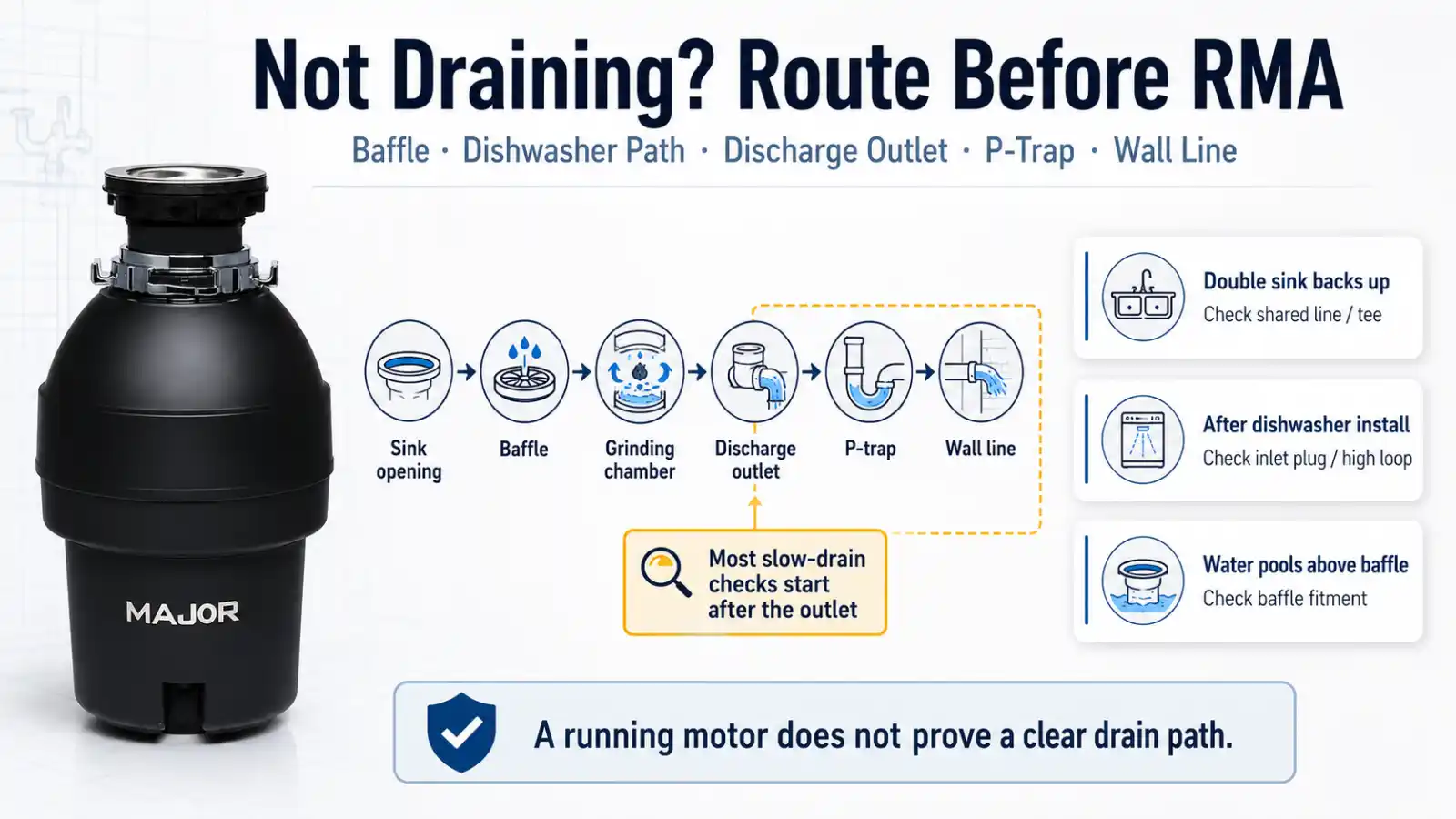
- Switch it on — does it run?
- Silent, or only humming → that’s power or a jam, not a drain clog. (See humming but not spinning.)
- It runs → step 2.
- Run it with water — does water rise in the other half of a double sink, or just sit in a single bowl?
- Backs up into the other side → the blockage is in the shared line past both drains, not the unit.
- Single bowl, water sits → step 3.
- Did this start right after install, or after a dishwasher was connected?
- After a dishwasher hookup or a fresh install → look at the dishwasher inlet plug and its high loop, not the motor. (See dishwasher connection.)
- No → step 4.
- Does water pool above the rubber baffle, then drop once it pushes through?
- Yes → the baffle is holding it, not a clog. (See splash guard and baffle fitment.)
- No → the residue is sitting in the discharge tube, the P-trap, or the wall line.
Every branch but the first ends in the same place — the drain path beyond the disposer’s outlet. That is the part importers keep getting backwards, so the rest of this is written as the places it goes wrong.
The expensive wrong turn: logging a working unit as a product failure
A slow-drain complaint lands with the word “disposer” in it, and it gets filed as a defect. A unit that grinds and spins gets pulled or replaced — and the new one drains exactly as slowly.
We build the grind chamber, the impeller plate, and the outlet that hands ground waste to the plumbing — and that is where our part ends. We don’t lay the drain line, cut the trap, set the slope, or wire the dishwasher behind the sink. When the blockage is in the line, the disposer is only the name the complaint arrived under. Pull a working unit over it and you’ve spent a good machine on a pipe.
“It runs fine, so the unit can’t help”
The unit grinds, so attention jumps straight to the pipes, and the two things the disposer does control get skipped.
There are exactly two: how fine it grinds, and how hard it flushes the ground waste through on the way out. Coarse fragments settle in the trap and build up; a finer grind and a stronger flush carry more of them past before they can.
On the BLDC models where we build in a flush boost — it isn’t standard to every BLDC, it’s something we add — the motor lifts the flush force as it runs and pushes more of the ground waste through. That is the whole of what a motor can do for drainage. It does nothing for a trap already packed with grease, a back-graded line, or a tee shared with a second sink. The lever is real; it’s also narrow.
The plug nobody removed
A new disposer goes in, the dishwasher gets connected, and within a day the dishwasher won’t drain. The complaint reads as a faulty new unit.
The dishwasher inlet on a disposer ships with a knockout plug in place. If it isn’t punched out before the hose goes on, the dishwasher has nowhere to drain — the disposer is fine, the path is just closed. Whirlpool’s own product help puts a newly installed dishwasher that won’t drain first on the knockout plug, then on the high loop or air gap that keeps sink water from siphoning back. None of it is the motor.
Whether this failure mode shows up at all depends on the market: routing a dishwasher’s drain through the disposer is far more common in some kitchens than others, which is one reason the same complaint reads differently by destination (market differences). Either way it belongs in the install note and the after-sales script, and the path itself is covered in the dishwasher connection article.
The baffle that looks like a clog
Water sits in the sink, drains slowly, and clears only when the disposer runs — read as a clog, logged against the unit.
A tight rubber baffle, including the kind fitted to quieter builds, can hold water above the opening until enough pressure pushes the flaps open. The water is draining; it’s just metered by the baffle. A standard baffle and a quiet, tighter baffle behave differently here, and the spare has to match the mount and the build — covered in splash guard and baffle fitment. Swapping the unit does nothing; the baffle is the part in question.
What we tell dealers, and what we ship
When a dealer raises a slow-drain case, the sequence is short. Restart the unit and confirm it runs and isn’t jammed. Check that the water supply is on and the pressure is normal. If both are clean, the discharge line is the suspect — pull the discharge run, clear it, or replace the section, which is why we ship a portion of spare discharge parts with the order so the dealer can do it without waiting on us.
Which segment of the line holds the residue, we can’t see from the factory, and we don’t pretend to. We build to the outlet and stock the spare that meets it; the trap, the tee, and the wall line are read at the sink, by whoever is under it. A box that ships without those spares is the quiet failure here — the dealer reaches the one real fix and has no part to finish it.
Related checks: the motor, the dishwasher path, and the baffle
The first split in the flow — does the unit run — is the humming-but-not-spinning question, handled there at the motor level rather than the drain level. The dishwasher branch runs into the dishwasher-connection article, and the baffle branch into splash-guard fitment, because both are symptom locations this routing points to rather than re-explains. Read together, they keep one complaint — “it won’t drain” — from collapsing into one wrong cause. Slow drainage is one exit on the complaint-routing map these branches hang off, alongside no-power, humming, leaking, and odor.
FAQ
Why is my garbage disposal not draining?
If it runs, the blockage is almost always past its outlet — the discharge tube, the trap, or the line behind the wall. Check whether the other side of a double sink backs up (downstream line), whether a dishwasher was just connected (inlet plug), and whether a tight baffle is holding the water, before treating the unit as the fault.
Why is my garbage disposal running but not draining?
A spinning motor only proves the motor works. Water leaving the unit depends on the path after the outlet, so a unit that runs and still won’t drain is pointing at the line beyond it.
Why is my garbage disposal backing up into the other sink?
That points at the shared line or the tee that joins both bowls, past the disposer. The unit on one side is just the thing running when the downstream blockage shows itself.
Why won’t my dishwasher drain after a new garbage disposal was installed?
Usually the inlet knockout plug was left in place, so the dishwasher has no open path into the disposer. The high loop or air gap is the other half. Neither is a motor fault.
Can a splash guard make a garbage disposal drain slowly?
Yes. A tight baffle can hold water above the opening until pressure pushes it through, which looks like a slow drain but is the baffle metering the flow.
Is a clogged garburator the same problem as a clogged garbage disposal?
Same unit, different market word — “garburator” is Canadian, “food waste disposer” the international term, and the naming changes nothing about the routing.
Can drain cleaner be used in a garbage disposal?
Be careful here: chemical drain cleaners can damage seals and pipes, and Consumer Reports advises against putting lye or chemical cleaners in a disposal. Since the residue usually sits past the outlet, a chemical poured in rarely reaches it anyway.
Is slow draining caused by the disposer or the plumbing?
In most cases the plumbing past the outlet. The disposer’s only influence is grind fineness and flush force, both of which end at its outlet; everything beyond is the drain line.
Before a slow-drain complaint becomes an RMA, route it by location first: does the unit run, does the other bowl back up, was a dishwasher just connected, is the baffle holding water. When it lands at the discharge line, that’s the part we stock — send us the model and we’ll get the spare discharge parts to your dealer, so the fix happens at the sink instead of on the warranty file.
Sources
- InSinkErator — Fixing a Clogged Garbage Disposal Referenced for checking the disposer versus the drain line and clearing a double-sink/discharge blockage.
- Whirlpool — Newly Installed Dishwasher Not Draining Referenced for post-install drain problems tied to the disposer knockout plug, high loop or air gap.
- Better Homes & Gardens — Why Is My Dishwasher Not Draining Referenced for dishwasher drain connection types, including high loop to disposal and air gap to disposal, and related drainage issues.
- Consumer Reports — How to Clean Your Garbage Disposal Referenced for ground particles settling in the P-trap until flushed, and the advice against putting lye or chemical drain cleaners in a disposal.
- Consumer Reports — Best Garbage Disposals Referenced for lab grading of grind fineness, where coarser fragments raise the chance of a sink-drain clog.
The product boundary, the BLDC flush behavior, the dealer-support sequence and the spare-parts practice in this article are based on Wanjiamei Technology Development Co., Ltd. records and product information. The drainage and cleaning references are drawn from the public sources above.