In early July an importer wrote in through Alibaba with one question. Our M100 is listed at 60–1380 W. He wanted to know how the power got selected. Could he adjust it himself, or would we set it at the factory before shipping?
He had read the range as a menu.
The range is the machine responding, not a setting
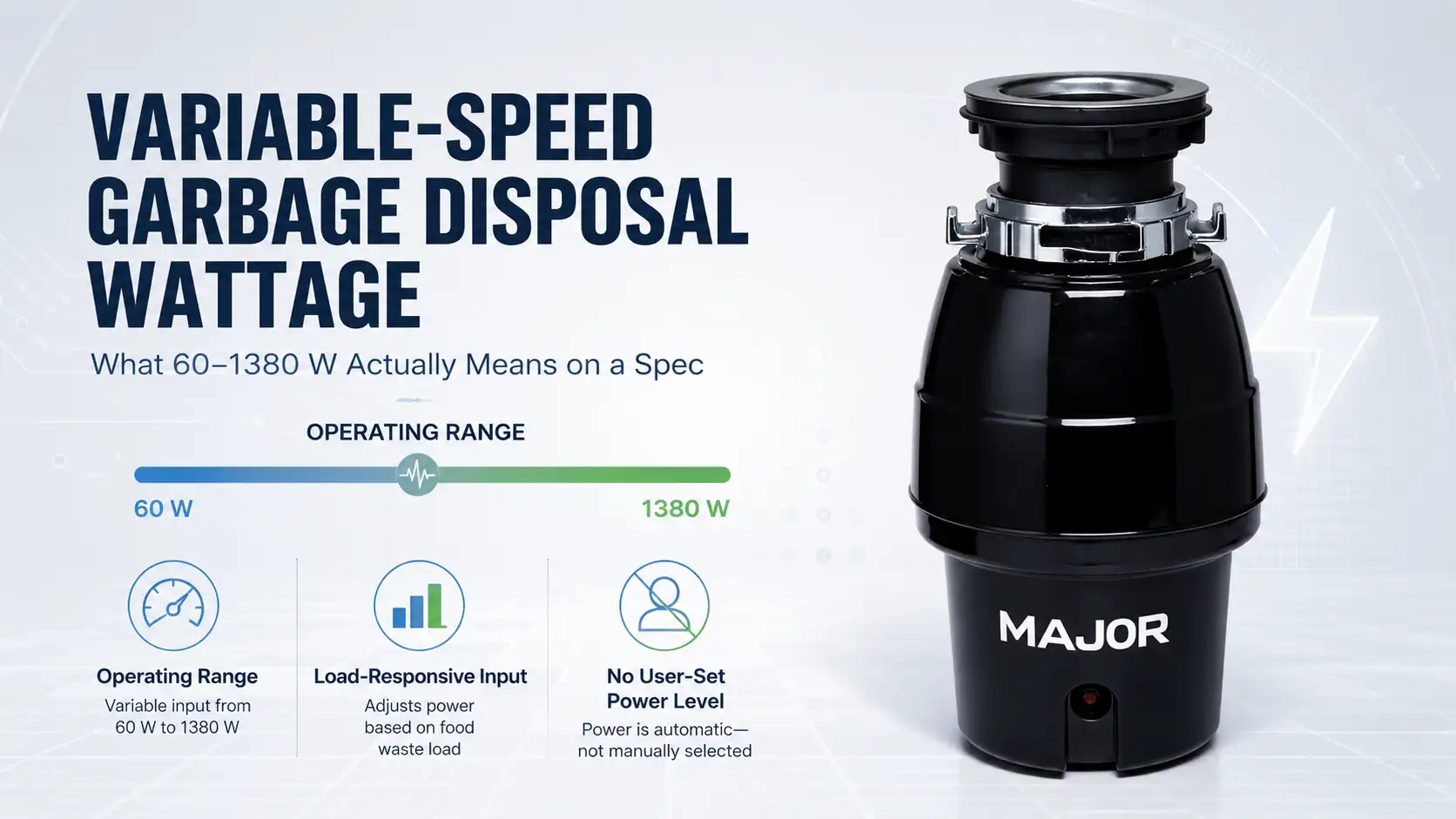
Nobody selects that number. The unit is variable-speed, and the draw follows the load in front of it. Light waste sits near the bottom of the band. A dense load pushes it up. Between those points the controller moves on its own while the machine runs.
He understood it as soon as we explained it, and went on to order samples. His comment was that he liked the control behaviour. That was a preference about how the machine runs, not an energy-efficiency result.
Why one motor architecture holds a flatter figure and another moves across a band is motor-side detail. It sits in our wattage and horsepower article and in the DC versus AC comparison.
Three different fields, often collapsed into one word
A buyer asking for “the wattage” is asking for one of three things at once, without separating them.
A declared rating is the figure that goes in the product file and on the rating plate. Appliance safety standards set out how power input and current are measured, including how to handle equipment whose input varies through an operating cycle. A variable-speed disposer can still carry a declared rated input or rated current under its applicable product file.
An operating range is what the machine actually does across load. Our M100 runs across 60–1380 W and the M300 across 30–1800 W. Both figures are the measured AC input envelope recorded under our stated test conditions.
A single measured reading is what a meter shows at one moment, on one machine, with one thing in the chamber.
Those three answer different questions. A machine can hold a declared rating and still swing across a wide operating band. Neither figure predicts what a plug-in meter reads during one grind.
A range like that only travels with its conditions attached. Ours are the test voltage and frequency the envelope was recorded at, the fact that the low figure is a no-load reading, and whether the upper figure is a sustained input or a short controller response. Those conditions belong next to the number on any energy column, and they are quoted per SKU.
One figure is cleaner than the rest. On the switched configuration we tested, the supply is physically interrupted when the unit is off. There is no off-mode draw to account for. Remote-control and air-switch variants carry their own control electronics and should be confirmed separately.
I don’t have a figure for how much of that 1380 W a normal load calls for. That varies with what goes into the chamber.
The published figures were never built the same way
A buyer filling in an energy column has to source numbers from somewhere. Here is what a search of the open web currently returns for household disposers, and how each page arrived at its figure.
| Published figure | Source | How the page produced it | Voltage stated | Chamber load stated | Steady, startup or unspecified |
|---|---|---|---|---|---|
| 350–750 W range; 474.5 W meter reading | Cornwall Solar Company | HP conversion (1 HP treated as 750 W), plus a plug-in meter reading on the author’s own unit | No | No | Described as a live reading |
| 500–1500 W range; 804 W at 6.7 A for a named model | Sepura Home | Brand guide comparing disposers with its own 60 W product | Yes, 120 V for the named model | No | Unspecified |
| 412 W for 1/2 HP, ~600 W for 3/4 HP; 1500–4500 W at startup | Ideal Home Advice | Figures presented by HP class | No | No | Running and startup separated |
| 412 W for 1/2 HP, 605 W for 3/4 HP, 840 W for 1 HP; 2145 W startup | HomeApricot | HP-class presentation, figures matching the previous page | No | No | Running and startup separated |
| 500–700 W for 1/2 HP; 800–1000 W for 3/4–1 HP | EasyBear | Tied to circuit sizing rather than to consumption | Yes, 120 V stated generally | No | Running |
| 246 W | Cockeyed power-use database | A measured entry in a household appliance power database | No | No | Unspecified |
| 746 W for 1 HP | Galvin Power | HP conversion, then used for an annual kWh calculation | No | No | Unspecified |
Same product class, and the spread runs better than three to one. One of those pages states outright that the 700 W figure circulating in comparison tables is wrong.
Two of the pages do give a voltage. What none gives is the load in the chamber when the number was produced. Several are HP conversions rather than measurements. A number without its load condition can show that published figures disagree. It cannot be lifted into a spec sheet and compared with another supplier’s.
A figure arriving without its measurement conditions is a familiar problem. We worked through it for dB ratings.
Lower watts is not the same as using less energy
The reasoning on those pages runs in one direction. Smaller number, more efficient machine, lower running cost.
Efficiency doesn’t work that way. It compares energy used against work delivered, so the work has to be held still before the input figure means anything. Two machines only compare if they take the same food, reduce it to the same state, and are timed while they do it. A lower input reading does not prove lower cycle energy if the machine needs more time or another pass to finish the same defined load.
We don’t publish an efficiency claim for our units, and the reason is specific. That comparison needs a defined cycle: fixed load weight, fixed food mixture, fixed completion condition, energy measured across the whole run. We don’t run that test. We checked the ENERGY STAR, EU energy-labelling and Australian GEMS product materials. None sets out a comparative energy-efficiency test cycle for household food waste disposers. Safety standards do specify how power input and current are measured for this product type. Ranking two machines against each other is a different exercise.
What we will describe is what the hardware does. The draw follows the load, and a light load draws near the bottom of the band. That is a mechanism, not a performance ranking.
The category has no energy label to give
Buyers in energy-conscious markets sometimes ask for a rating or a star band. It helps to know how those schemes decide what gets one.
In the United States, ENERGY STAR certifies by product category. The appliance categories listed cover air cleaners, clothes dryers, clothes washers, dehumidifiers, dishwashers, electric cooking products, freezers and refrigerators. Food waste disposers do not appear in the categories we checked. The Canadian programme’s appliance listing covers a comparable set.
In the European Union, the Commission publishes the product groups covered by Ecodesign and Energy Labelling legislation. A product carries an EU energy label when a delegated act specifically covers it, and covered models are registered in the EPREL database. We did not find a food waste disposer category in the current list.
Australia runs the same logic through different machinery. Under the GEMS Act, a product is labelled once a product determination brings it in, and registered models sit in the Energy Rating database. The in-store label is mandatory for the products a determination covers.
Three schemes, one shared mechanism. A label exists where a category has been defined and a test method written for it. A low input figure earns nothing on its own.
That covers the public product lists we checked. It is not a statement that no market anywhere asks for energy documentation, and a buyer should confirm what their own destination requires.
What the question can actually be answered with
When there is no rating to hand over, the useful answer is a hardware description with its conditions attached. For our units that covers the declared rating in the product file. The operating band, and what each end of it represents. Whether the model is fixed-speed or variable. The voltage and frequency it was built for. A buyer who needs those figures held against a branch circuit will find the electrical side in our dedicated circuit article.
We give the operating range for the model, the rating-plate data, and the electrical package it ships with. We don’t publish a comparative efficiency claim, and we don’t determine what energy documentation a destination market requires.
The importer in July got a straight answer and ordered samples on it. The answer was that he couldn’t set the power, and that the machine would keep setting it for him every time it ran.
FAQ
How much electricity does a garbage disposal use?
That varies with the motor type and with how long the unit runs. A fixed-speed disposer holds a fixed speed target, but its electrical input still changes as the grinding load changes. A variable-speed machine moves across a wider band — our M100 is published at 60–1380 W and the M300 at 30–1800 W. Neither figure converts into an annual total without the number of runs and their length. That is why published yearly costs vary so widely.
Is a lower-wattage disposer more energy efficient?
Not on the number alone. Efficiency compares energy used for the same work done. The food load, the finished result and the run time all have to be fixed before two machines can be ranked.
Does a variable-speed disposer have a rated power?
It can carry a declared rated input in its product file. What it doesn’t hold is a single constant draw in use.
Does a disposer draw power when it’s off?
On the switched configuration we tested, the supply is interrupted when the unit is off, so there is nothing to draw. Remote and air-switch versions carry their own control electronics and need confirming separately.
Does a food waste disposer have an ENERGY STAR or EU energy label?
We checked the ENERGY STAR categories, the EU delegated acts and the Australian GEMS determinations. The category was not in any of them. Those schemes label a product once a category and a test method exist for it. Confirm your own destination’s requirements before relying on that.
Sources
Energy-efficiency definition
- U.S. Department of Energy — Take Five: What Is Energy Efficiency?
— defines energy efficiency by comparing the service or output delivered with the energy input required to produce it. This supports the article’s position that two disposer wattage figures cannot establish comparative efficiency unless the work performed is held constant.
Energy labelling and efficiency-scheme scope
- ENERGY STAR — List of ENERGY STAR Energy Efficient Products
— lists the current U.S. certified product categories, including dishwashers, refrigerators, freezers, clothes washers and electric cooking products. A household food waste disposer category does not appear in the list reviewed for this article. - Natural Resources Canada — List of ENERGY STAR Certified Products
— lists the product types eligible for ENERGY STAR certification in Canada. Residential appliances include air cleaners, dryers, washers, dishwashers, cooking products, freezers and refrigerators; food waste disposers are not listed. - European Commission — Energy Efficient Products: Product List
— identifies the product groups covered by Directive 2009/125/EC and Regulation (EU) 2017/1369 and links each covered group to its Ecodesign and Energy Labelling requirements. The published list reviewed does not contain a food waste disposer category. - Your Europe — EU Energy Labelling Requirements
— explains that energy-label obligations are product-specific and that models covered by energy-labelling rules must be registered in EPREL before sale in the European Union. - Energy Rating Australia — Labelling
— explains that the GEMS Act and individual product determinations establish whether a regulated product must display an Energy Rating Label or other information. Its in-store label list includes specified appliance categories and does not list food waste disposers. - Energy Rating Australia — Registered Appliance and Equipment Data
— describes the public database containing products registered with the GEMS Regulator for sale in Australia or New Zealand. - Australian Department of Climate Change, Energy, the Environment and Water — Appliances, Lighting and Equipment
— describes the GEMS Act framework, the Equipment Energy Efficiency Program and the role of standardised testing in Australian appliance energy-efficiency standards and labelling.
Published wattage figures, cited to show that open-web figures are not built on a common basis
These pages are used only to document how widely published disposer wattage figures differ and how the figures were produced. They are not used as evidence of a Major product’s actual energy consumption, as evidence of an industry average or as a basis for comparing product efficiency.
- Cornwall Solar Company — How Many Watts Does a Garbage Disposal Use?
— presents a 350–750 W range through HP conversion and separately reports a 474.5 W live reading from a plug-in meter. It does not state the chamber load used for the measurement. - Sepura Home — Garbage Disposal Power: How Many Watts Do You Need?
— presents a general 500–1500 W range and cites a named 120 V model at 804 W while comparing conventional disposers with Sepura’s own product. - Ideal Home Advice — How Many Amps and Watts Does a Garbage Disposal Need?
— publishes running and startup figures by HP class without stating a food load or measurement method. - HomeApricot — How Many Amps and Watts Does a Garbage Disposal Use?
— publishes running and startup wattage figures by HP class but does not state the chamber load or test method used to produce them. - EasyBear Appliance Repair — Garbage Disposal Amps, Watts and Breaker Size
— presents wattage ranges in the context of circuit sizing rather than a controlled disposer energy-consumption test. - Cockeyed — Power Use Database: Garbage Disposal
— records a measured household-appliance entry of 246 W without identifying a chamber load or whether the reading represents a steady, average or peak operating condition. - Galvin Power — How Many Amps Does a Garbage Disposal Use?
— converts HP into watts and uses the converted value in an annual electricity-use calculation rather than reporting a controlled product measurement.
Product-safety standards referenced for power-input measurement
- IEC 60335-2-16:2022 — Particular Requirements for Food Waste Disposers
— covers the safety of electric food waste disposers for household and similar purposes and is applied together with the relevant requirements of IEC 60335-1. - IEC 60335-1:2020 — General Requirements for Household and Similar Electrical Appliances
— contains the general appliance-safety framework. The current edition specifically notes clarified requirements for measuring power input and rated current when they vary throughout an operating cycle.
Major internal product records
The published operating ranges for the M100 and M300, the description of variable-speed load-following behaviour, the off-state condition on the tested switched configuration, and the July 2026 buyer enquiry are Major records. The operating-range figures for the M100 and M300 have been confirmed against the controlled product file, together with the test conditions and the basis of each end of the range. Figures for any other model must be taken from that model’s own product file rather than carried across.
Major supplies the operating range, the rating-plate data and the shipped electrical package for a quoted model. Major does not publish comparative energy-efficiency claims and does not determine what energy documentation a destination market requires.