Importers send us RFQs for “DC motor garbage disposals” without specifying whether they mean brushed permanent-magnet DC, brushless DC (BLDC), or just the high-RPM unit they saw on a competitor’s page. We walk back a step and align on terminology before the quote can become anything useful.
The market has built up a layer of motor-type marketing: branded “permanent magnet” names, “heavy-duty induction” claims, “high-speed magnet” labels, “auto-reverse” terminology. None of it maps cleanly onto the three motor architectures actually used in household disposers.
What sits behind a “3/4 HP DC motor, 3,800 RPM” RFQ line is a specific noise profile, a specific service obligation, a specific weight class, and a specific mounting and packaging configuration. None of that is visible in the headline numbers.
Our team at Major makes household food waste disposers for OEM and ODM buyers. We don’t sell retail, we don’t install in kitchens, and we don’t certify branch circuits. What we can speak to is the production side, the spec-review conversation, and what gets misunderstood about motor architecture between the two.
The Three Motor Families We Build
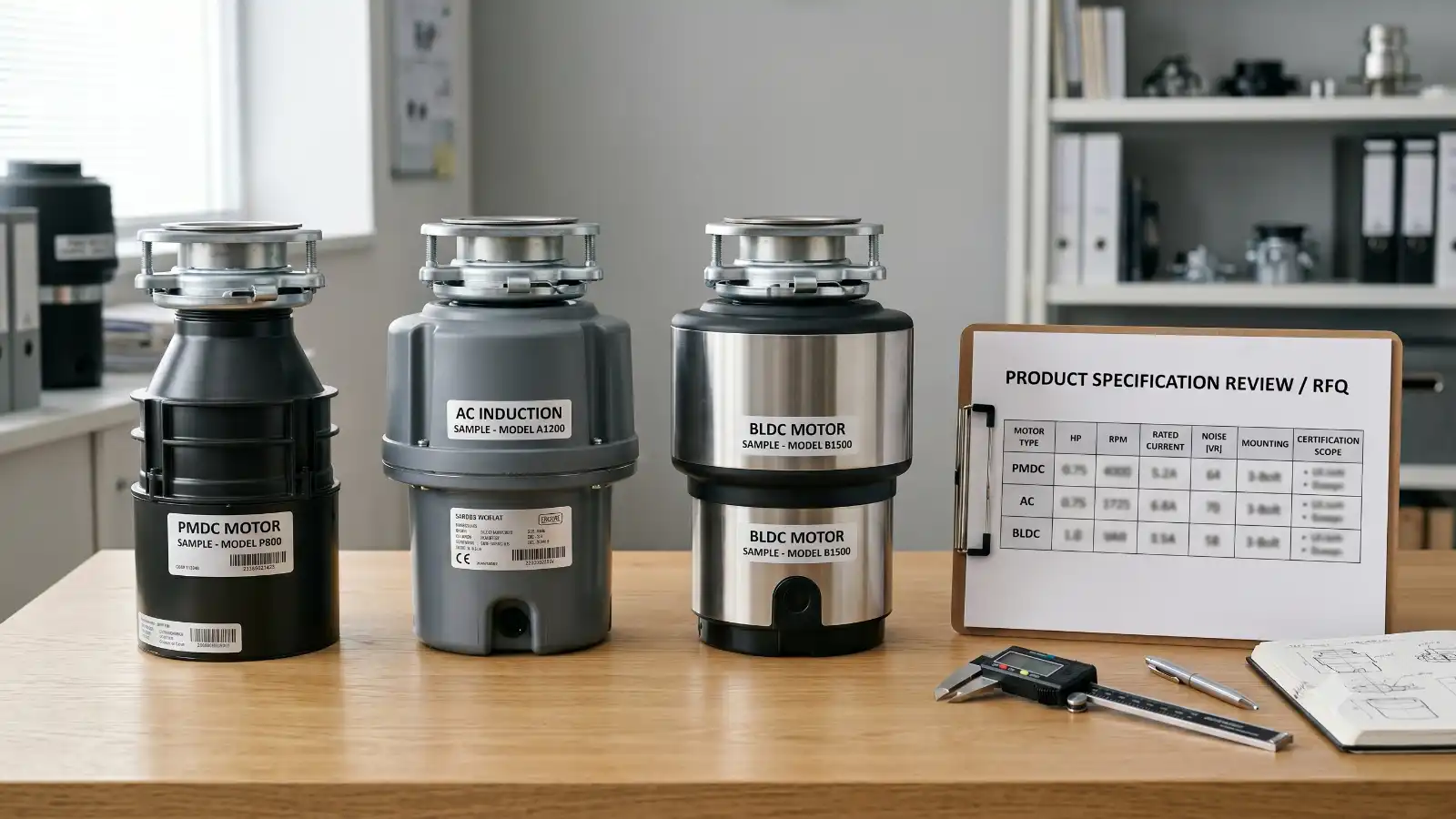
Major produces three household disposer architectures: permanent-magnet brushed DC (PMDC), AC induction, and BLDC (auto-reverse). The product line splits roughly twelve PMDC SKUs, three AC, and six BLDC across 1/2 HP, 3/4 HP, and 1 HP, covering both 110–120V and 220–240V supply at 50 Hz and 60 Hz. One of the three AC models is itself a variable-frequency design: brushless mechanical behavior similar to BLDC, but built on AC architecture. The moment a quote says “AC motor” without that distinction, the conversation can go in two completely different directions.
PMDC runs at higher no-load RPM. Industry references commonly cite something in the 2,600 to 3,800 RPM range for PM motors in disposer applications. PMDC units are lighter than comparable-HP induction units. The brushes do wear. On our PMDC line, brush replacement becomes a service consideration around the eight-year mark under normal household use, and the brushes are user-serviceable with a short procedure. Our own PMDC units run louder than our AC induction and BLDC units at similar HP, because brush contact and higher running speed both contribute to the noise floor. Other manufacturers tune their PMDC differently and market it as quiet operation; we can only speak for what our units do.
AC induction in this category runs slower than PMDC, closer to 1,400 to 1,800 RPM. The unit weighs more for the same horsepower. There is no commutator and no brush wear path. Induction motors also take longer to reach rated speed, which is why faster-grinding marketing language tends to belong to PMDC pages rather than induction pages.
BLDC adjusts speed and power draw based on grind load in real time. Soft loads spin slow and quiet. Harder loads ramp up. No brushes to wear. The cost lives in the controller: BLDC carries a more complex electronics package, which is part of why it does not yet dominate the segment despite the obvious functional appeal.
An RFQ that says only “DC motor disposer” brings the brush story, the lighter housing, the higher RPM, and the simpler electrical package bundled together. The higher noise floor and the eight-year brush service come with it. When the RFQ later adds “we also want quiet running and no brush service,” we usually rewrite the SKU into a BLDC or AC variant. The earlier this happens in the quote workflow, the less rework lands on packaging, labeling, and certification documentation downstream.
I don’t actually know how often that rewrite would have been avoided by sharper upstream specs. Our view only covers the RFQs that reach us, not the ones that went to other factories. The pattern is consistent on our end. The sample isn’t the whole market.
Why HP Alone Is a Marketing Number
Horsepower labels (1/2, 3/4, 1) are useful as coarse SKU groupings. They don’t carry enough information to compare two factories’ offers head to head. How much HP a disposer actually needs?
Peak HP, continuous HP, and the HP stamped on the front of a disposer housing aren’t always the same number. Two 3/4 HP disposers from two different factories can pull noticeably different rated current at the nameplate, run at different RPM, sit in different chamber sizes, and use different impeller geometries. The HP printed on the housing is marketing convenience; the numbers that determine the unit’s real behavior are rated current, motor architecture, and grind chamber design.
An importer building a price-comparison spreadsheet across three factories that all quote “3/4 HP” tends to assume the units are equivalent. They usually aren’t. The cheapest 3/4 HP on the spreadsheet may carry a heavier housing (induction), a lower starting torque ramp, different rated current, and a different mounting kit than the second-cheapest. Those differences get caught during packaging design, because that’s when a real importer review reads the spec sheet line by line. By then the SKU has been quoted into the channel, and changing it back costs more than catching it at the RFQ would have.
For buyers running mixed product lines that cover both 110–120V / 60 Hz markets and 220–240V / 50 Hz markets, HP alone gets less reliable still. The same nominal HP at the two voltages can imply different motor wiring, different starting behavior, and different rated current values that matter for branch-circuit conversations on the installer side. We don’t sit in those installer conversations. We do see what gets sent back as questions, and the pattern is consistent. HP made the quote possible. Rated current and motor type are what made it real.
Where Each Motor Family Fits Best
Noise-sensitive channels (apartment fit-outs, mid-tier hotel projects, multi-unit residential) push us toward our AC induction line or our BLDC SKUs rather than our PMDC line. Our PMDC units run noticeably louder under load. In apartment-density environments, noise complaints don’t stay at unit level; they become property-management complaints, then channel-level resistance, then reorder pressure on the importer. Other manufacturers tune PMDC differently and market it as quiet operation, and that’s their business. We can only recommend our own units honestly.
Importers without a parts-and-service operation, which is most of them in our experience, get less long-tail risk from brushless motors. Eight-year brush replacement on PMDC isn’t difficult and the guide is short, but “not difficult” still means a service workflow exists. Channels without that workflow are better off moving the long-tail risk into the product choice up front, rather than absorbing it later as customer-service load.
Mixed fibrous loads (citrus peel, vegetable scraps, corn husks, small bones) are where our auto-reverse BLDC line earns its place. Load-adaptive RPM responds to grind resistance directly, rather than relying on impeller mass and chamber geometry to compensate. Whether that justifies the controller cost is a line-economics question for the importer. The technical advantage stands either way.
Sea-freight importers shipping 1,000-unit-plus POs care about weight. PMDC is lighter than comparable-HP induction. On a long enough order, that ripples through container utilization. The noise trade-off doesn’t go away, but in volume programs into apartment-density markets, the lighter build sometimes earns the slot for reasons that aren’t visible on a spec sheet.
For a general 1/2 HP household residential SKU into a mixed online channel, with no obvious channel pressure dominant, motor architecture matters less than build quality. A well-built PMDC and a well-built AC induction at the same HP differ less from each other than a well-built and a poorly-built unit of either family.
What to Pin Down Before AC vs DC Even Becomes the Question
When the quote gets motor type right but leaves the rest of the configuration late, the rework lands in packaging design and certification review.
Items worth pinning down before motor architecture becomes the deciding question:
- Voltage and frequency. 110–120V / 60 Hz for North America. 220–240V / 50 Hz for most of the rest of the addressable market. We cover both. The SKU picks one, and the plug, cord rating, and certification package follow that choice.
- Rated current at the nameplate voltage. The number that matters for installer-side conversations and circuit-sharing questions with dishwashers. The HP label on the housing doesn’t tell you that. The nameplate does.
- Mounting system. Three-bolt and EZ-mount (twist-lock) are both common in this category. Some of our SKUs support both, some support only one. Compatibility with whatever the destination market’s installed base expects is a packaging question that catches importers off-guard when it’s treated as a late-stage detail.
- Air switch. We build some SKUs with the air switch built in. For most, the air switch is sourced separately. Whether the destination market expects an air switch in the box at all varies by channel: some retail channels expect it, some project channels treat it as an installer line item.
- Power cord and plug. Cord included is the default across our line. Plug type follows the voltage and frequency choice. Hardwire variants are also available for project channels that prefer them.
- Dishwasher inlet. The knockout for the dishwasher drain hose is standard. Whether the SKU ships with it pre-removed or as a knockout depends on the channel. Both come back as packaging change requests often enough that it’s worth confirming at RFQ.
- Certification. For North American household disposer market entry, the relevant safety standard is UL 430. We can confirm whether a given SKU is built to UL 430 scope and supply the listing documentation. We can’t replace the importer’s local plumbing or electrical code review, and we can’t stand in for the licensed installer’s call on a specific kitchen. A certification claim on a product page that implies more than the listed scope puts the back-end risk on the importer.
Questions That Come Up Often in Spec-Review
Is “permanent magnet motor” the same as “DC motor” in a garbage disposal?
Usually the same thing. In this category, “permanent magnet motor” almost always points to brushed permanent-magnet DC (PMDC), which is what product pages typically mean when they say “DC motor.” That said, “DC motor” as a label is coarse: strictly it covers both brushed PMDC and brushless DC (BLDC), and the brush versus brushless distinction matters more for sourcing than the DC label itself does. Brushed units have a multi-year brush-service path. Brushless units don’t. Some product pages also use “DC motor” loosely to describe BLDC, which adds to the confusion. The fastest way to resolve the ambiguity in a spec-review conversation is to ask the supplier whether the motor is brushed or brushless, and whether the running speed is fixed or load-adaptive. Those two questions usually settle which architecture is on the table without needing to debate which label is correct.
Does AC motor mean the disposer can reverse direction?
No. Auto-reverse in household disposers is a product-level feature on the BLDC line, where the controller drives the motor in either direction by switching the commutation sequence. A standard AC induction disposer in this category runs in one direction. Reversing a single-phase capacitor-start induction motor is not accomplished by swapping the supply leads. That one shows up in installer forum threads occasionally and is worth flagging.
Does higher RPM mean better grinding?
Higher no-load RPM means the impeller reaches top speed faster and spends more revolutions per unit of food waste. Grinding outcome depends on impeller design, chamber size, lug geometry, and the food load itself. A 3,800 RPM PMDC on a small chamber doesn’t necessarily out-grind a 1,500 RPM induction motor with a larger chamber and a multi-stage grind path. RPM is one variable. It is the variable that gets the most marketing attention because it produces the biggest-looking number on a product page.
Why does the disposer hum but not spin?
The unit is drawing current but the impeller isn’t rotating. That is the signature of a jam against debris in the grind chamber. Clear it manually with the hex key supplied with the unit, then reset the overload protector before powering on again.
How long do the brushes last on a PMDC garbage disposer?
On our PMDC food waste disposer range, brush wear becomes a service consideration around the eight-year mark under normal household use. The brushes are user-serviceable with a short procedure. “Normal household use” is doing a lot of work in that sentence. Heavier loads or commercial-frequency use accelerate brush wear, and we don’t build commercial-duty units, so heavy-frequency cases sit outside what our published service intervals apply to.
Is DC always quieter than AC?
On our line, the opposite is closer to the truth. Our PMDC units run louder than our AC induction and BLDC units at similar HP, because brush contact and higher running RPM both add to the noise floor. Other manufacturers may tune their PMDC differently, and some market PMDC as quiet operation. Where the broader “DC = quiet” line in this category originally came from is harder to pin down. We aren’t sure.
Final Motor Selection Checks for Importers
Buyer and supplier need to be looking at the same motor expectation by the time the quote is locked. “DC motor garbage disposal” alone is not enough. Use case, voltage, rated current, noise target, service path, mounting system, accessory package, and certification scope all need to be stated.
- For noise-sensitive channels: compare AC induction and BLDC before making PMDC the default choice.
- For low-service importer lines: confirm whether brush service is acceptable before choosing PMDC.
- For high-RPM claims: check chamber size, impeller design, rated current, and food-load assumptions instead of reading RPM alone.
- For mixed-voltage markets: separate 110–120V / 60 Hz and 220–240V / 50 Hz SKUs early in the quote workflow.
- For packaging review: confirm mounting system, power cord, plug type, air switch package, dishwasher inlet, and certification documentation before artwork starts.
Need a Garbage Disposal Motor Configuration Reviewed?
Send the RFQ or target SKU list — we can help review PMDC, AC induction and BLDC options against voltage, RPM, rated current, mounting, accessory and certification requirements.
Related product links
Sources and references
Primary
Supporting product specifications and motor references