Your end user just finished dinner. They go to clean up, hit the air switch, and nothing — no grind, no hum, nothing at all. They tap it again. Still dead. They pull out the manual, poke around under the sink, and end up searching “garbage disposal won’t turn on” like everyone else. Then they call you.
What lands on your desk is one line: it won’t turn on. And here’s what most troubleshooting pages miss — that line is not a fault you can pin on the motor yet. A silent disposer is not automatically a dead disposer. “Won’t turn on” is really a question about where the power stops.
On a B2B line, that matters. A silent unit logged as “motor dead” comes back as a warranty return — when the real break was an outlet, a switch, or a wire someone didn’t land. Garbage disposal no power is a routing problem first, not a return. So before anyone calls the motor, route the power path.
No-power routing: where does the power stop?
Step 1 — Sort the sound first
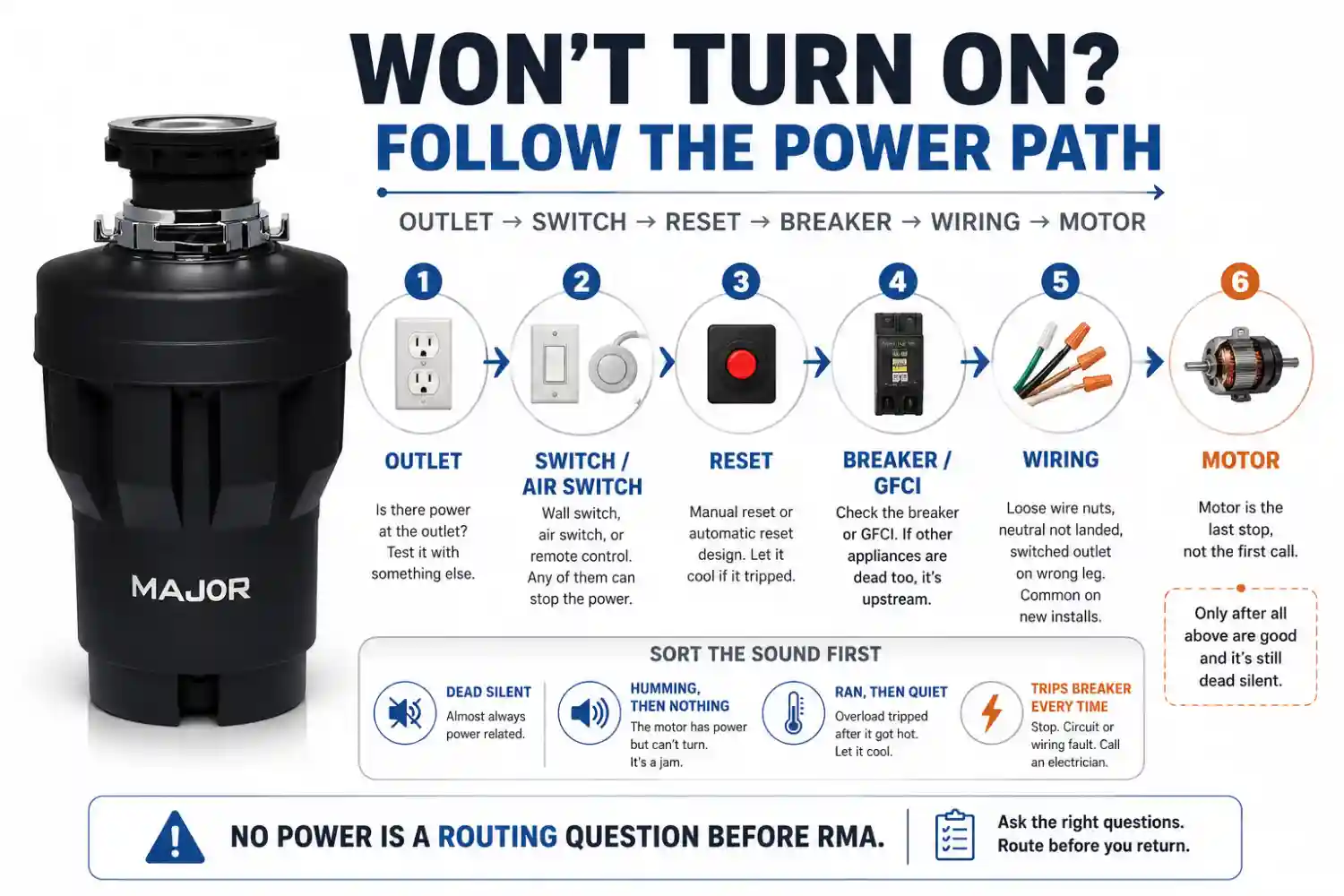
- Dead silent → power path (continue below).
- Humming, won’t turn → a jam, not power. See humming but not spinning.
- Ran, then quit, won’t restart → overload cooling down. Wait, don’t condemn.
- Trips the breaker every time → stop. Circuit/wiring fault — electrician, not another reset.
Step 2 — For dead silent, walk the power in order
- Outlet — power at it? Plug something else in. Cords work loose under a sink.
- Control — air switch, wall switch, or remote. An air switch is a button + tube + control box; any one can break it.
- Reset — sitting flush is normal (self-reset). “Won’t stay in” is the real ticket.
- Breaker / GFCI — dishwasher on the same circuit also dead? It’s upstream, not the unit.
- Wiring — on a new install, the usual cause. A handoff to check, see power cord & plug.
Outlet has power · switch fine · cooled and still dead · nothing else on the circuit out → only now is it the motor.
First, what kind of silent?
The noise the unit makes tells you which road you’re on. Sort it before anything else.
- Dead silent — no sound at all. Start with power; that’s where most silent units stop. The unit isn’t getting any, or the thing that controls it isn’t passing it through. An internal electrical part can fail silent too — so power is where you start, not where you close the case.
- Humming, then nothing. That’s not a power problem. The motor has power and can’t turn — a jam, covered in humming but not spinning.
- It ran, then went quiet, and won’t restart. That’s the overload cutting in after the motor got hot. It needs to cool, not be condemned.
- Trips the breaker every time you try. Stop. Repeated trips mean a circuit or wiring fault, and that’s an electrician’s call, not a reset you keep pushing.
Only the first one is really a “no power” case. The rest are different articles wearing the same complaint.
The power path, in order
When it’s dead silent, walk the power from the wall to the motor. Each step either passes power along or it doesn’t.
- The outlet. Is there power at it? Things shift around under a sink and a plug works loose. Plug something else in and check.
- The control — air switch, wall switch, or remote. An air switch isn’t a normal wall switch. It’s a button, an air tube, and a control box, and any of the three can be the break. A loose tube and the button does nothing. This is its own layer, set out in the air switch guide.
- The reset. More on this below, because the reset is where most people guess wrong.
- The breaker or GFCI. A tripped breaker cuts power with everything under the sink looking normal. If a dishwasher on the same circuit is also dead, that’s your sign — it’s upstream, not the disposer.
- The wiring. On a fresh install, this is the usual culprit, and it’s not a unit fault. More below.
Run that in order and the dead-motor verdict is the last stop, not the first.
An unpopped reset button isn’t a fault
This is the one the whole internet gets backwards. Someone looks under the unit, sees the reset button sitting flush — not popped out — and reads it as the unit being dead, or jabs it over and over waiting for a click.
Our units lock out and reset themselves. When the motor overheats or binds, it cuts its own power and cools down. Then it comes back on its own. We keep a manual reset button too, as a second layer. So a reset that hasn’t popped out isn’t a fault. It can mean the unit already cooled and cleared itself, or that nothing tripped in the first place. We mark this on the first page of the manual, because the assumption runs the other way everywhere else.
What that means for a buyer: the after-sales script has to say it plainly. “Reset hasn’t popped” and “reset won’t stay in” are two different tickets. The first is usually the design working as built. The second is a unit that needs a real look.
A new install that won’t start is usually a handoff, not a defect
A disposer goes in, gets switched on, and does nothing on day one. The reflex is “dead on arrival.” It rarely is.
A unit that left the line tested and starts its life silent is usually pointing at the wiring — a loose wire nut, a neutral that didn’t land, a switched receptacle on the wrong leg. It can be the switch or the circuit too. The common thread is that this is the install handoff, not a product fault, and the fix is at the connection, not in an RMA box. The power interface itself — plug-in, hardwired, or a switched outlet — changes by market, and it’s covered in the power cord and plug guide. For a new-install no-start, that’s the first place to look, not the last.
What to ask before you take the RMA
A “no power” claim shouldn’t open as a motor return. A few questions sort most of them before a unit ships back:
- Dead silent, or humming, or did it run then quit?
- Does the outlet have power — tested with something else?
- Wall switch, air switch, or remote?
- Has the reset been left to cool, or just pushed over and over?
- Breaker or GFCI checked? Anything else on the circuit dead too?
- New install, or a unit that’s been running fine for months?
- Cord-and-plug or hardwired?
Most of those land somewhere outside the motor. The ones that don’t — outlet has power, switch is fine, it’s cooled and still dead, nothing else on the circuit is out — those earn the freight back to the factory.
Where a no-power complaint hands off to the other guides
A no-power complaint borrows from a few of these and shouldn’t repeat them. The hum is the jam article. The button-and-tube control is the air switch guide. The plug, cord, and hardwire interface is the power cord guide. Whether a truly dead unit is worth replacing is repair or replacement. This article only does the routing — which of those a silent unit is actually pointing at, before anyone calls the motor. No-power is the first fork in the field-complaint routing an importer runs before any RMA; the other forks — hum, leak, drain, odor — branch from the same first question.
FAQ
Why won’t my garbage disposal turn on?
First sort the sound. Dead silent points at power — outlet, switch, reset, or breaker. Humming points at a jam. Ran-then-quit points at the overload cooling down. Each goes a different way, and most don’t start at the motor.
Why does my garbage disposal have no power?
Garbage disposal no power almost always means the power stops somewhere between the wall and the unit. Check the outlet, then the switch, then the reset, then the breaker or GFCI. If a dishwasher on the same circuit is dead too, the break is upstream of the disposer.
Why is my garbage disposal not working, no sound at all?
No sound usually means no power reaching the motor, not a dead motor. Something earlier in the path — outlet, switch, reset, or breaker — is holding it back.
Does a garbage disposal have a reset button?
Ours has a manual one, and it also resets itself after it cools. So a reset button sitting flush — not popped out — is normal. It doesn’t mean the unit is broken.
How do you reset a garbage disposal with no reset button?
On a unit built to reset itself, you mostly wait — cut power, let it cool, and it comes back on its own. Where there’s no visible button, that automatic reset is doing the work. Where a manual button is fitted, as on ours, it’s a backup on top of that.
Why does my garbage disposal hum and then stop?
That’s a jam, not a power fault. The motor has power and can’t turn. Cut the power before looking — the routing is in the humming article.
Why does my garbage disposal keep tripping the reset or breaker?
Repeated trips aren’t something to keep resetting. They point at a jam, a failing overload, or a wiring fault, and the last two need a real look rather than another push of the button.
Why won’t a newly installed garbage disposal turn on?
On a new install it’s usually the wiring, not the unit — a loose connection, a neutral that didn’t land, or a switched outlet on the wrong leg. It’s a handoff to check, not a defect to return.
Is a garburator reset button different from a garbage disposal reset button?
Same part, different market word — “garburator” is Canadian. The reset works the same way, and the naming is covered in the market names article.
Before a “won’t turn on” complaint ships a unit back, run the power path: outlet, control, reset, breaker, wiring — then the motor. Send us the answers to those, plus the model and a short video of the switch and the reset, and we’ll tell you whether it’s a handoff your installer fixes on site or a unit that’s earned the freight back. Most of them never need to leave the kitchen.
Sources
- InSinkErator — Resetting a Garbage Disposal Referenced for units equipped with an automatic overload switch and the cool-down period before a unit on a wall switch comes back.
- Moen — Garbage Disposal Has No Power Referenced for testing the outlet for power first and checking the breaker before treating the unit as faulty.
- The Home Depot — How to Fix a Garbage Disposal Referenced for checking the plug, reset button, breaker and installation wiring when a unit shows no activity.
- Lowe’s — How to Repair a Garbage Disposal Referenced for checking the plug and built-in circuit breaker, resetting the overload protector, and treating a humming unit as a separate jam path.
The dual-protection reset design (automatic recovery after cool-down plus a manual reset button), the manual-marking practice, the new-install handoff logic and the after-sales intake questions in this article are based on Wanjiamei Technology Development Co., Ltd. records and product information. The general reset and power-source references are drawn from the public sources above.